Showing posts with label Science Fiction. Show all posts

Sunday, March 19, 2017

Mini-Reviews: London Belongs to Us by Sarra Manning, Monstrous Beauty by Elizabeth Fama, and The Next Together by Lauren James


Title: London Belongs to Us

Author: Sarra Manning

Rating: 4 Stars

I didn't expect to love this book as much as I did, but I should have known better because Sarra Manning. This entire book is a crazy roller coaster of an adventure as our heroine, Sunny, finds out that her boyfriend has another girlfriend from his previous school and has been two-timing her for the entire duration of their "relationship." Sunny starts off wanting to forgive him, but as she searches London for him, she begins to realize that she deserves a lot better. The plot doesn't seem all that revolutionary, but the people Sunny meets on her night--girls who encourage her to stand up for herself, friends who tell her that self care is not selfish, buddies who support her for who she really is, and even other girlfriends who prove that women support each other instead of putting each other down--make this a wonderful story. I love these types of strong friendships and this book passes the Bechdel test ten times over. It also has so many meaningful conversations about class, privilege, and race. Just... I love Sarra Manning. Can every YA book be this nuanced and yet still so much fun?

Title: Monstrous Beauty

Author: Elizabeth Fama

Rating: 2 Stars

Oh, this book had so much potential. I want to start by saying that, whatever my reservations with this story, I did really love the mermaid lore. Fama's mermaids are deadly and savage and I loved them. However, the story, which alternates between present-day where Hester, a young teenager, begins to investigate her family history where every woman has passed away after giving birth, and between a time years ago when Syrenka, a mermaid, fell in love with a human, Ezra, and left the ocean to be with him, leaves a lot to be desired. 

Syrenka's story is vastly more interesting than that of Hester's. For one, Hester has sworn off of dating because she doesn't want to end up like her mother and grandmother before her, which is rather faulty logic because dating someone very rarely equates automatically having a child with them. What's more, Hester's storyline undergoes some vast changes, with some rather late insta-love happening and weird details seemingly explained away such as her absentee parents and her far-too-understanding-best-friend Peter. It just never came together for me and I wasn't able to love Hester as a heroine, either.

Syrenka, though, I adored. Her story is expertly told but the mystery plaguing the novel and subsequent solution is all a little too flimsy for my liking. I'm not one for strange supernatural tales, so perhaps this is just a case of "me-not-you", but Monstrous Beauty is a novel I'd skip, fascinating folk lore and all. Take my advice and read Fama's sophomore novel instead: it's brilliant.

Title: The Next Together

Author: Lauren James

Rating: 3 Stars

I had heard a lot of praise for this novel before launching into it, but it wound up falling seriously short for me. I really love the premise of this one--a couple, separated by circumstances in every generation but they keep managing to find each other again in their next life. It's done quite well, too, with James slipping between eras seamlessly as she makes us swoon for this couple. But, where the issue crept up for me was in the final third of the novel. Our main era, essentially present-day-ish, features Katherine and Matthew as high school students. As we learn how they fell in love in previous lives, present-day Katherine and Matthew are investigating their aunt and uncle, respectively, who were married and then labeled as terrorists. Of course, they realize that they are their reincarnations but their love story, based completely upon their recollections of past lives, is flimsy at best. I couldn't root for present-day Katherine and Matthew, despite loving all of their past incarnations.

What's more, the explanations for how Katherine and Matthew remember their past is essentially non-existent. The book is written in such a way that it seems as if there is some higher time-traveling power that is watching over Katherine and Matthew and reincarnating them to save the world, for some purpose or the other. But, none of this is ever explained. I suppose I have to pick up the sequel, but I'm so confused and rather irritated by the lack of answers that I won't be launching into the companion novel. The Next Together is well-written and I'm impressed by the multiple historical fiction love stories bound together in this one, but the ending doesn't pull off this intriguing premise as much as it promises to and, by the end, I was only left disappointed.

Wednesday, November 23, 2016

Review: The Forgetting by Sharon Cameron


Title: The Forgetting

Author: Sharon Cameron

Rating: 4.5 Stars

I didn't expect The Forgetting to become by favorite of Sharon Cameron's works when I picked it up. It's a complete 180 from her typical brand of historical fiction, for one, and for another, this novel is much more mature and dark from the beginning. I loved it. I haven't read a sci-fi/dystopian thriller in what seems like years, but is almost definitely a few months. Cameron's launch back into the genre, with a fresh new twist, surprised me--after all, I was quite sure we, as YA consumers, had exhausted everything this genre had to offer. I'm glad the era of Hunger Games look-a-likes and love-triangle infused tropes are over, though, so that a novel like The Forgetting can hopefully set the tone for future sci-fi/dystopian reads.

Nadia's world revolves around The Forgetting, an event that happens every twelve years and wipes away the memories of every human in her village. As such, her society is protected by walls--because who knows what's outside when no one can remember?--and no one ever leaves the house without their books, where they have written everything they can remember about each day. Their books are their truth and without them, they are no one. It's a shocking, dark realm but Nadia is seemingly the only one who can remember. As threats of food shortages emerge from the Council who governs Canaan, Nadia begins to use her memories and her knowledge of the world outside Canaan to solve the mysteries behind her town--and hopefully save her family, too.

Nadia is the heart and soul of this story and I loved her narration. It's unflinching and honest, in a world where no one remembers and lives could very well be built on lies. I was with her every step of the way as she uncovered the layers to Canaan and the plot twists were not ones I saw coming in the least. Nadia's relationship with her family--her mother, on the brink of craziness, her older sister, who believes she's an imposter, and her younger sister, who loves her dearly--were impeccably written. Many of the secondary characters truly came alive and I loved the romance with Gray, the glassblower's son, who becomes central to both the plot and to Nadia's growth. It's the perfect slow-burn with plenty of development but it takes a back-seat when needed to the action and plot at the core of this story.

My only complaint with this novel is that the ending felt a little too Disney-like for me. Just one villain, just one hero, etc. There are so many gray layers to the secondary characters in this story that I was disappointed by the black-and-white treatment of the villain. I love this world, though, and am so curious to learn more about Nadia's future exploits that I hope Cameron writes a companion novel, or the very least a few novellas to satisfy my curiosity. For fans of Cameron, or even those who haven't been charmed by her historical fiction/steampunk works in the past, The Forgetting is a completely new venture from her and one I think older readers, in particular, will appreciate. Cameron's previous works definitely read on the side of naivety, when it came to her heroines, so I love that she holds back no punches with Nadia's fierce personality. Believe me, you won't be forgetting this story very easily; not even in twelve years.

Friday, February 5, 2016

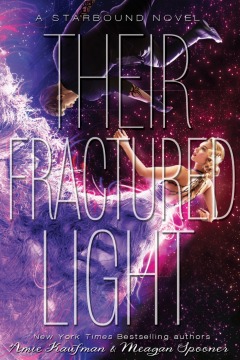
Review: Their Fractured Light by Amie Kaufman and Meagan Spooner


Title: Their Fractured Light (Starbound, #3) 

Author(s): Amie Kaufman and Meagan Spooner 

Rating: 4 Stars

Note: This review is SPOILER-FREE but does mention characters from the previous books. If you would like to read my spoiler-free reviews of the prequels, click the link to read my review of These Broken Stars and This Shattered World.

3 Things I Loved About Their Fractured Light:

1. Gideon and Sofia's Doomed Romance

Oh, my. Gideon and Sofia. In their efforts to take down LaRoux Industries they wind up bumping into one another and reluctantly working together, despite the fact that they don't trust one another at all. What's more, Gideon is the famed internet hacker, the Knave of Hearts, and Sofia just happens to hate the Knave. After all, the Knave has been chasing her across planets relentlessly and won't seem to let her breathe. Only, Sofia and Gideon don't know who each other really are--they don't trust anyone, remember?--and as they slowly fall in love, the inevitable looms ever closer.

I really enjoyed Sofia and Gideon as a couple. I'll admit that their romantic angst got to be a liiiitle much by the end of the novel, only because it had dragged on for a full novel, but theirs is my favorite couple swiftly following Tarver and Lilac. You're going to be rooting for these two, both as individuals and as a couple which is always a common component in my favorite couples--if I can't love you both as strong, independent heroes then I can't fall for the dynamic duo you make together. With Gideon and Sofia, though, they tick off all the right boxes. I especially love that they are not always likable; they do not always do the right thing. Yet, they still find it in themselves to be forgiving, to love each other, and to recognize the truest parts of both themselves and the other person. It's so, so special and beautifully written... I adore it.

2. Cameo Appearances

Roughly half of this novel is all Gideon and Sofia but then the second half introduces our old favorites--Lilac, Tarver, Flynn, and Jubilee. I thought that the manner in which these three threads intertwined was brilliant and I loved seeing the three couples we've come to love and support individually join forces to take down LaRoux Industries. Their combined brain power, knowledge, and strength is immensely satisfying to behold and while the showdown isn't easy, simple, or even remotely predictable, it's enjoyable and an absolute page-turner. It's so hard to write a finale because it needs to be as grand and epic and plot twist-y as readers are hoping it's going to be and, let me tell you, this writing pair knows how to deliver. I already cannot wait for whatever they plan to write next because I'm sure it's going to be just as well-scripted and clever as this, their debut trilogy.

3. World Building

There are so many small pieces of world building that come together in this novel and, for me, this series is really DEFINED by great world building. It's evident in each novel on its own as the world building plays a huge role in the politics of every planet, shaping its conditions and its people in bold, rich hues. It's even more evident in this final installment, though, as we begin to zoom out to see the big picture. I won't say much more for fear of spoilers, but I will say that we get to know a certain group of creatures much better than we may think going into this novel and the insight that they brought, both to the world-building and the plot twists, were phenomenal.

Their Fractured Light did not disappoint in the least and I am so thrilled to not be disappointed with a series end, for once in a long time. This series has been consistently fantastic throughout, delivering believable, hard-won romances in a war-torn world with unique world-building and, what's more, it delivers on diversity in a way that few other fantasy/dystopian/sci-fi novels do. Like I said before, this writing duo is one to watch out for and I can only prepare myself for whatever they next throw as us readers.

Thursday, August 27, 2015

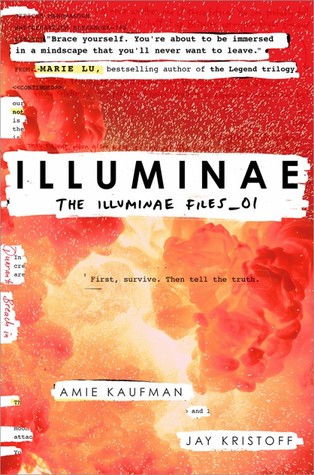
ARC Review: Illuminae by Amie Kaufman & Jay Kristoff


Title: Illuminae (The Illuminae Files, #1)

Author(s): Amie Kaufman and Jay Kristoff

Rating: 3 Stars

Release Date: October 20th, 2015

Shockingly, I really did not love this book and doubt I'll be continuing with the sequel either. I adore epistolary novels, particularly when they're written by Jaclyn Moriarty, but a science fiction novel written in this format just didn't do it for me. For one, when compared to the contemporary epistolary written by Moriarty, Illuminae was not as humorous or as poignant. While the story told within these pages is stellar--and very cleverly conveyed through data files, journal entries, and chats--a multitude of other facets did not sit well with me.

1. Illuminae revolves around Ezra and Kady, a young teenage couple who has recently broken up and find themselves on two separate spaceships due to the fact that their planet was attacked. Though Ezra and Kady are broken up, much of their relationship stems from the fact that they used to be dating--and are still in love with one another despite the circumstances that wrought their breakup. As a reader, we don't know Ezra and Kady's backstory. We don't know who they are as individuals, forget as a couple, and their interactions throughout the entire first half of the novel failed to resonate with me. I just couldn't bring myself to really feel for these characters, both through their personalities--so tied up in one another, understandably so--and their situation, so far removed from anything I could even imagine.

2. A few of the methods used by these authors to convey snippets of the story felt distinctly like cheating. While I understand that there are a limited number of ways to tell this story in an epistolary manner, at times it was necessary for this to read like a normal tale. I enjoyed this--quite a lot, in fact--and wonder if Illuminae would have been a stronger novel had it not been epistolary. Kady and Ezra speak to each other through technological means and their diary/journal entries are not truly as soul-searching as one would wish, which convinced me that either than an epistolary format being unique and interesting for Illuminae, it was not necessary. Nor did it improve the story-telling in any manner. Again, however, keep in mind that this epistolary format made me feel more isolated from the story, as a reader, than a part of it so take my cautions with a grain of salt.

3. The pacing of Illuminae was FAR too slow. The events outlined in the synopsis take hundreds of pages to occur and I considered DNFing this novel numerous times. It picked up drastically by the end and I enjoyed the last 30-40% of the novel a LOT, but not enough to want to continue with this series, sadly.

I seem to be the black sheep on Illuminae so I recommend giving it a try. If it isn't meshing for you early on, though, it probably won't click for you miraculously until the end and, even then, it's only a shell of the true emotion you wanted to be feeling throughout the novel. Illuminae is certainly a unique and compelling novel; just not one for me.

Friday, January 16, 2015

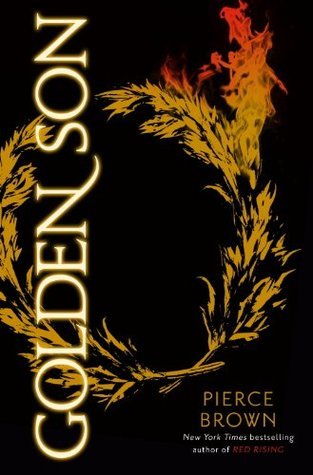
Review: Golden Son by Pierce Brown


Title: Golden Son (Red Rising, #2) 

Author: Pierce Brown 

Rating: 4.5 Stars

Note: This review is spoiler-free for Red Rising and Golden Son. However, if you are new to this series I recommend reading my review of Red Rising first as it sets up the scope of this world and provides background information about the general plot which this review does not. (You can read my review of Red Rising here.)

I have a LOT to say about Golden Son,--it's just one of those books--but to start with...

1. I experienced HIGH levels of stress while reading Golden Son. Making me care that much for your characters is not cool, Pierce Brown.
&
2. Um, what was that ending? A joke? Because I'm not laughing... I'M CRYING.

Now that that's off my chest I can honestly admit that Golden Son is a sequel that rivals the brilliance of Red Rising and transcends it. While it is still prone to bouts of dramatism, Golden Son amps up the political stakes in this intergalactic world and spares no qualms about destroying, torturing, and killing off every one of your favorite characters. If you thought this was Young Adult, think again. Golden Son begins two years after the events of Red Rising and Darrow, our protagonist, is no mere boy. At twenty-years-old he has come a long way from the sixteen-year-old Red he started out as. Moreover, his time in Gold society has altered his perceptions of the world he lives in. Even in Red Rising, Darrow resisted seeing the world in gray. He wanted to hate Golds and their power; he wanted to fight for Reds and nothing else. By the end of Red Rising, Darrow was forced to grudgingly admit that the world was not quite as black-and-white as he had hoped. In Golden Son, though, he finally understands that this war he's fighting isn't about Red vs. Gold; it's so much more.

In comparison to its predecessor, Golden Son feels more volatile. Darrow is no longer confined and with the entire universe at his disposal, his task seems far more impossible than it ever did before. Brown weaves political power plays alongside epic war battle a la Game of Thrones and every time I think I've got it all figured out, he throws in a curve ball and changes up the game yet again. There isn't a moment to breathe in Golden Son. If Darrow isn't plotting war, engaging in war, or dreaming about war then he's himself; a Red, stripped away of the facade he displays to the world. Although some may argue that the strength of these novels lie in the quickly-paced plot lines which move forward with purpose, I would argue that Brown's true talent shines through in the more quiet, introspective scenes. It isn't often that readers are given a chance to look into the mind of a male narrator but Darrow is a flawed hero that, had I lived in Brown's fictional universe, I'd give my life for.

What I find most remarkable about this series is the fact that Brown has seamlessly created a world of great political divide, strife with violence, yet the humanizing moments are what ultimately linger. Golden Son expands on its cast from Red Rising and though I struggled to remember who was whose son or daughter, the larger host of characters only amplify Darrow's struggles. Whether it be an increasing host of enemies or just the friends Darrow is forced to alienate as he hides the truth of his lineage, Darrow battles his loneliness time and time again. Eo remains a constant in his thoughts; both an inspiration and a guiding compass. Nevertheless, it is her memory which ultimately forces his isolation too. Although Darrow is widely known in the Gold community for his brute strength and battle skill, the Sons of Ares have had little contact with him and the burden of what he has agreed to do is now felt, two long years later. Throughout Golden Son Darrow comes to the realization that, cheesy as it may sound, the truth will set him free. Unless he trusts those around him, they will not linger long enough for him to rely on later.

Golden Son is interspersed with chapters that consist solely of conversation between Darrow and a close friend of his. Those chapters, squeezed between the politics and battles, utterly charmed me. Just as Darrow won over allies, he won me over too. Golden Son emphasizes just how difficult friendships can be: how fickle and fleeting; how we don't realize their worth until they're gone. In his war against Gold, Darrow needs as much back-up and support as he can find. Moreover, if Darrow can convince those around him that lower colors deserve the equality that Gold enjoy, then Darrow is that much closer to changing the world. Slowly, but steadily, Golden Son transforms Darrow's purpose to an even greater one. While Darrow may have started out wanting revenge against Gold, now he recognizes that it isn't Gold who must burn but their society.

Brown writes three-dimensional, flawed characters. No one within these pages is perfect and their imperfections are what make them downright human. I was already attached a decent number of characters from Red Rising but I fell for even more of them in Golden Son. As an author who uses death as a purposeful stab to the heart, I bled while reading Golden Son. Ultimately, it's one big stress fest; wondering who will be the next to die, anticipating who will betray Darrow, trying to figure out the political machinations ahead of time. And yet, that's what makes Golden Son such a thrill to read. Flipping each page more and more quickly in an effort to discover what happens is part of the experience.

One of the most stressful aspects to this novel, though, was the romance. Darrow and Mustang share hints of a love story in Red Rising but in Golden Son, with Mustang in such a pivotal role, their push-and-pull dynamic comes to a head. I know I said it in my review of Red Rising, but Darrow is a feminist male narrator. He respects Mustang, trusts her to make her own decisions, and understands that her strengths are different from his and, as such, she just may be one step ahead of where he is in the game of Gold politics. Mustang is one of my favorite characters precisely because she understands the political situation, seizes the upper hand, and does whatever is necessary to gain it. Unlike so many strong female characters whose purpose molds them into villains, however, she maintains a strong moral compass and winds up bettering everyone at their own game. When it comes to Darrow, though, she refuses to be with someone who continues to hold part of himself back and, despite the fact that their friendship is grounded in equality and their partnership balances out, the possibility of a true relationship remains in question. Mustang and Eo are such strong forces in Darrow's life; women who propel him to be better and convince him that he doesn't need to resort to the depravity of his enemies. Thus, despite the fact that the romance in these novels is so minimal, the romantic interests themselves are integral to creating Darrow.

At one point in the novel, Darrow acknowledges that it is all women who have molded and shaped him to become the person he is. Whether it be his mother who made him the man Eo fell in love with, or Eo who gave him the power to transcend and become the man Mustang fell for, or Mustang who pushed him to be the man others followed. In a world of war and mayhem, dominated by men, the influence of femininity is not forgotten which I, as a female reader, appreciate. What's more, there's a scene in Golden Son where Darrow simply starts crying and the fact that it simultaneously breaks down gender stereotypes while humanizing our protagonist deserves praise, indeed. With Golden Son, Brown has created a rich, heart-felt novel, more science fiction than dystopian, with characters who both maim and inspire. Not only compulsively readable, but also brimming endlessly with themes, messages, and underlying nuances I won't even pretend to be smart enough to pick up, this is not a trilogy to be missed. Knock down The Hunger Games from your shelves if you have to make room for this; it's worth it ten-fold.

Thursday, December 18, 2014

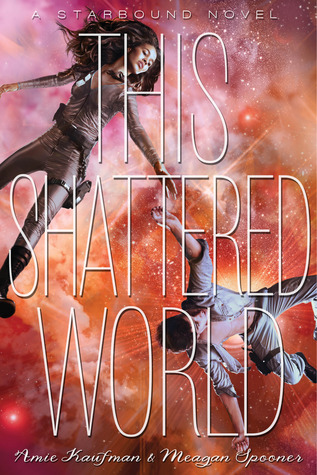
ARC Review: This Shattered World by Amie Kaufman and Meagan Spooner


Title: This Shattered World (Starbound, #2) 

Authors: Amie Kaufman and Meagan Spooner 

Rating: 4 Stars

Release Date: December 23rd, 2014 

I have to be honest: This Shattered World isn't nearly as good as These Broken Stars. But, it's still really, really good. With this companion novel, Amie Kaufman and Meagan Spooner not only introduce us to new characters which burrow their way into our hearts, but they significantly expand on their galactic world as well. While This Shattered World didn't capture my heart to the extent These Broken Stars did--it lacked the same level of swoon-factor and, what's more, I missed the back-to-back revelations--it's a sequel I wouldn't hesitate to re-read, re-visit, and cherish on my shelves.

This Shattered World takes us to a new planet, Avon, where the terraforming that should have taken place never has. Thus, there is a divide between the original residents of Avon, now rebels and militants fighting for their planet back, and military personnel who have been hired to keep the peace and monitor the planet. Flynn, the younger brother of a rebel leader who died for their cause, is now leading the rebellion against the corporations which have taken over Avon. When he captures Captain Lee Chase, a deadly fighter sent to crush the rebellions occurring on Avon, the course of their lives changes forever.

The opening pages of This Shattered World are impossible to look away from. Lee and Flynn's initial meeting, Lee's kidnapping at the hands of Flynn, their travels in the swampy marshlands of Avon to the rebellion hideout... It all feels cloaked in an aura of dream-like reality. Not only is it a brilliant start to a novel that is full of action and betrayal, more so than These Broken Stars, but it also introduces us to two such strong personalities at their best. Lee, whose name is uttered in fear as she is a tough captain, is immediately placed in a position of vulnerability where she finds herself duped by a rebel. Thus, the antagonism between Lee and Flynn is understandable though the slow manner in which their perceptions of one another grow to change is simply captivating.

While Tarver and Lilac's story felt so isolated--the two of them, a mysterious planet--Lee and Flynn's story is set against a backdrop of war, rebellion, and years of suppressed misconceptions and anger. It raises the stakes in their relationship and makes that eventual reconciliation between the two seem far more inevitable than that between Tarver and Lilac. After all, what is social hierarchy in the face of war? Yet, their story is completely unpredictable from start to finish and I found myself pleasantly surprised by the turns the narrative would take and, moreover, the slow build to the truth about Avon and its lack of terraformed earth.

Although Lee and Flynn's romance is not as large an aspect of this novel as Tarver and Lilac's may have been, it is no less effective and swoon-worthy. Additionally, the dual narration, giving us both Lee and Flynn's perspectives, is executed to perfection. Not only are both their voices completely different, but their demons are too. Lee and Flynn's pasts play an integral role in their growth and romantic journey and witnessing that from two perspectives allowed these two to become as near and dear to my heart as Tarver and Lilac themselves.

This Shattered World would not be complete, however, without a glimpse at our previous hero and heroine. Tarver and Lilac don't play a huge role in this novel, but their parts are more substantial than I anticipated and I loooved re-visiting them. Flynn, Lee, Tarver, and Lilac. I love these characters, the depth of their personalities, and their relentless passion for the galactic world at hand. Without a doubt, I know that the next novel Kaufman and Spooner write is going to be just as good, if not better, than these previous installments. In my eyes, they can simply do no wrong.

Wednesday, December 10, 2014

Blog Tour: This Shattered World by Amie Kaufman and Meagan Spooner (Guest Post & Giveaway)

I am so excited to be part of The Midnight Garden's Blog Tour of This Shattered World today! I loved These Broken Stars when I read it last year and I can vouch for the fact that this companion novel is just as brilliant and romantic as its predecessor. If you're even the tiniest fan of science fiction, you'll want to pick up this series for sure!  

Today I'll be welcoming the authors of This Shattered World, Amie Kaufman and Meagan Spooner to talk about the world-building in their science fiction realms. If you're a frequent reader of the blog then you'll know that I love nothing more than a well-developed world, especially one grounded in reality, and I thoroughly enjoyed reading what Amie and Meagan had to say about their world-building. I think you will too. :)

Secrets of Starbound Unlocked: Science and Settings

The Starbound trilogy might be set in the future, but it’s grounded solidly in today’s science. We check our science is correct by consulting with physicists, doctors, botanists and others, or we check our science is plausible, if we’re getting creative. Some things (like hyperspace travel) we can’t do yet, but we try to make sure that nothing is scientifically impossible based on what we know right now.

Back when we were drafting These Broken Stars, our editor asked us to put together what we now call the Starbound Encyclopedia. It’s nearly ten thousand words of vital information about the characters and worlds you’ll encounter as you read these books. Here are a few excerpts that will tell you a little bit more about what you’re going to find on Avon in This Shattered World!

Terraforming: A Brief History

Mankind’s first experiments in terraforming took place on Mars in the mid-21st century, but the process did not become viable until after the discovery of faster-than-light travel almost a hundred years later. With the advent of interstellar exploration, the transportation of materials to Mars for terraforming became much cheaper and quicker, and the Mars Company took over from the government-funded scientists. By the time Mars was (barely) habitable, mankind had discovered dozens of other candidates for terraforming outside of our solar system, and had begun to apply the same process to them. These days, Earth is little more than a vast museum of mankind’s history, with environmental stabilizers to prevent complete ecological collapse. Thus far there have been no signs of life elsewhere in the galaxy, intelligent or otherwise… as far as the public record shows.

Avon: Planetary Purgatory

Avon is a recently terraformed planet, unable to sustain human life without the aid of respirators until only a generation ago. It’s co-owned by NovaCorp and Terra Dynamics. It should be much further along in the process than it is, but for generations the planet has been “stuck” at a particular stage in its development. Much of the planet is infertile swamp land, and the plant life is limited to algae and reeds. Its skies are constantly obscured due to a thick, constant cloud cover shrouding almost the entire planet.

The Fianna

Ten years before the start of This Shattered World, some of the descendants of Avon’s original colonists rose up in rebellion against Terra Dynamics and NovaCorp. Calling themselves the Fianna (Irish for warriors), they were led by a young woman named Orla Cormac. They demanded to know why Avon’s terraforming hadn’t progressed—until the planet becomes self-sufficient, Avon’s colonists are not considered citizens, and have no representation in the Galactic Council. The rebellion was unsuccessful, and Orla was executed for her crimes. The military has had fully-operational bases there ever since, acting as the planet’s police and security force until it becomes self-sufficient enough to have its own local governmental forces. Now, Orla’s little brother, Flynn Cormac, has inherited the rebellion. Unlike his sister, Flynn longs for peace, and hasn’t given up on the idea that there’s a way out for his people that doesn’t involve bloodshed.

Avon: The Fury

Though the locals are unaffected, soldiers posted on Avon succumb to a creeping madness called the Fury, which begins with disturbing dreams and escalates into an outburst of (usually fatal) violence. Most soldiers last only a few months before being reassigned to other planets. Despite numerous studies of the environment by doctors and scientists, no one has been able to determine a cause for this affliction. The only cure, once symptoms begin, is to be transferred off of Avon.
Amie Kaufman and Meagan Spooner are longtime friends and sometime flatmates who have traveled the world (but not yet the galaxy), covering every continent between them. They are sure outer space is only a matter of time. Meagan, who is also the author of the Skylark trilogy, currently lives in Asheville, NC, while Amie lives in Melbourne, Australia. Although they currently live apart, they are united by their love of space opera, road trips, and second breakfasts.
Tour Schedule:
Monday, December 8          The Midnight Garden    Secrets of Starbound: Characters

Tuesday, December 9         The Book Smugglers    Making an Audiobook
Wednesday, December 10  Ivy Book Bindings        Secrets of Starbound: Science and Settings
Thursday, December 11       Cuddlebuggery             How Amie & Meagan Met
Friday, December 12            Little Book Owl             Video Interview
Monday, December 15         Mundie Moms               Shooting the Cover
Tuesday, December 16        Xpresso Reads             Starbound Inspirations
Wednesday, December 17   A Book Utopia               Video: Your New Book Boyfriend
Thursday, December 18       Supernatural Snark       Q & A
Friday, December 19            Love is Not a Triangle   Gender in Science Fiction

Giveaway!

We have some incredibly cool giveaways thanks to the authors and Disney-Hyperion. Not only do we have 5 hardback copies of This Shattered World to give away, but we also have a grand prize that’ll make fans of the series super, super excited!

Grand Prize:
Autographed copies of These Broken Stars and This Shattered World
Starbound Swag
A secret letter from Tarver to Lilac, which you may keep secret for yourself, or may be posted and shared with others
Your choice of coffee with the authors at one of their upcoming U.S. tour stops (locations TBD) OR a Skype chat!

All you have to do is fill out the Rafflecopter form and leave a thoughtful comment below telling us why you’re specifically excited to win this prize! Don’t forget, you may earn additional points by sharing this giveaway on social media and by visiting the other tour stops as well.
a Rafflecopter giveaway
A huuuge shout out to Wendy @ The Midnight Garden for organizing this blog tour and for selecting me to be a part of it. I had a blast, Wendy, so thanks a bunch! If you haven't already, be sure to check them out! :)
Also, be sure to look out for my review of This Shattered World soon to find out more about these characters, their journey, and, most importantly, their love story!

Sunday, September 7, 2014

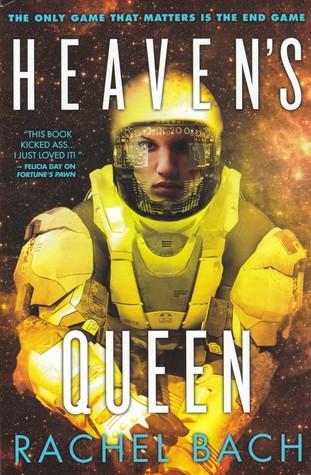
Review: Heaven's Queen by Rachel Bach


Title: Heaven's Queen (Paradox, #3) 

Author: Rachel Bach

Rating: 4 Stars

*This review is spoiler free for the Paradox Trilogy*

Having finished Heaven's Queen, I can honestly claim to be baffled towards the dislike this final installment has received. Granted, it isn't the strongest of the three novels in this trilogy and, what's more, the ending reads perhaps a little too convenient, but I find myself strangely satisfied.

Honor's Queen is, oddly enough, a much more introspective piece than its predecessor. While it has no shortage of action, wit, or humor, it also forces us to face--head-on--the atrocities in this world and the gray nature of its secondary characters. Fortune's Pawn certainly hinted at an unquiet nature present in space while Honor's Knight exposed the dark underbelly of the intergalactic world, but those facts and figures were left to float about in our minds...until now. In this final installment, Devi has to do something, trust someone, and deal. In a world where the secondary characters are not black or white, but gray, grayer, and grayest, this task becomes incredibly difficult.

Thus, I wound up loving the direction the romance took in this installment with Devi cautiously learning to trust Rupert once again after their formerly rocky emotional relationship. What's more, I loved the evolution of her relationship with the secondary characters we came to love back in Fortune's Pawn. In Heaven's Queen Devi takes chances and often winds right back at square one, but she is making those decisions--which, really, makes a world of a difference. It's a fascinating story simply because we, as the reader, still don't know who to trust or to what degree to trust them and, as such, neither does Devi. Moreover, the difficult moral decisions that have been made in this world are not easily brushed aside and handled. For me, so much of the sheer energy and kudos from this debut trilogy comes from creating such a difficult, complex scenario to begin with and continuing to probe it, poke at it, and find a solution, no matter how simplistic.

Having read every book in this series back-to-back, I didn't stop in-between the formulate theories or evaluate what I wanted--nay, needed--from a conclusion. Perhaps that made the difference. I went into Heaven's Queen wanting Devi to grow, to find her happily-ever-after, and to become a better person. I got that. It may not have been nearly as tension-filled as I'd have wanted (or bittersweet as I'd have liked) and there were certainly moments where this finale lost me, whether it be in Devi's reactions to meeting old friends or simply in the bow-tie conclusion, but seeing as this trilogy was spectacular from start to finish, I don't have a bone to pick with Heaven's Queen after all. Needless to say, I need Rachel Bach to polish off another sci-fi trilogy--fast!--preferably with a cameo appearance by Devi. I'm going to miss this kick-butt, no-nonsense, act-first-think-later, brave girl. I really am.

You can read my spoiler free reviews of Fortune's Pawn and Honor's Knight here and here respectively. 

Friday, August 1, 2014

Review: Honor's Knight by Rachel Bach


Title: Honor's Knight (Paradox, #2) 

Author: Rachel Bach

Rating: 4.5 Stars

*This review is spoiler free for the Paradox Trilogy*

Honor's Knight presents a paradox to the typical trilogy; it defies Middle Book Syndrome. Having read far too many trilogies than I probably should have ever read, I can truthfully claim that MBS is real and it usually occurs when an author has a story to tell--only it's a duology, not a trilogy. Thus, that fated middle book is the source of dragging plot lines, new love interests, and lackluster characters. Bach, however, truly does have a story that needs to be told in three books. As a result, Honor's Knight is remarkable: fast-paced, thought-provoking, and most definitely mind-blowing.

Without giving away spoilers for Fortune's Pawn, all I will remark about the plot of this novel is that it begins in an unusual situation. Devi, our kick-ass, no-nonsense protagonist finds herself a stranger on her own ship, due to circumstance, and watching her battle those around her--but especially herself--in a quest for the truth is enlightening. It reveals even more facets to Devi than we thought existed. Fortune's Pawn does such a terrific job of presenting us strong Devi, weak Devi, fierce Devi, romantic Devi, ass-kicking Devi, etc. that to see her as more than those images is seemingly impossible. Yet, I loved her growth arc throughout the novel.

Honor's Knight moves forward through a series of multiple plot twists. Of course, for readers of Fortune's Pawn, there is an obvious reveal that needs to occur that the reader knows of but not Devi. Yet, even beyond that, Bach unveils the extent of her world-building and the secrets--answers, really--we've been yearning for since Fortune's Pawn are displayed in their full glory. Witnessing Devi react, process, and act on these new sources of information is the main motivation of the storyline. It works. Not only is Bach's world richly layered and morally ambiguous, keeping readers questioning their own set of standards and blurring that line between right and wrong, but it also keeps readers on the edge of their seat anticipating both the next unknown to fly at Devi and her consequent change as a result.

As with Fortune's Pawn, the secondary characters support and enhance Honor's Knight beautifully. All strong characters in their individual right, Devi's relationship with even the most minute of secondary characters carries weight. What's more, Honor's Knight is set up in such a manner that the nature of the relationships Devi has sustained from Fortune's Pawn change. In Honor's Knight there are many more layers to the seemingly two-dimensional and simplistic relationships Devi held in Fortune's Pawn and that evolution is a treat in and of itself.

Of course, the romance in this trilogy is note-worthy since it truly is hard-won. Honor's Knight is the least romantic of the trilogy, strife with conflict and the never-ending battle of inner conflict. Both the romantic leads, Devi and Rupert, must overcome their insecurities and pasts to be with one another and, even then, the unspeakable acts they've done hang in the air between them. While they're both fighters, they're also betrayers, and the bitterness that adds to their complex equation is entertaining, to say the least. Honor's Knight truly made me care for their relationship in a way I hadn't in Fortune's Pawn and the outcome of it is one I eagerly anticipate in Heaven's Queen.

Honor's Knight is not an easy novel to have written, I am sure. It sets up a dark, tragic problem at hand--one whose solution remains shrouded. Although this is Bach's debut trilogy, she is already a master at creating tension and forcing readers to think beyond their typical capabilities. Heaven's Queen will, undoubtedly, be a treat; I am sure of it.

You can read my review of Fortune's Pawn, the first book in the Paradox Trilogy, here.

Tuesday, July 22, 2014

Series Review: Sirantha Jax (#5-6) by Ann Aguirre

I did a series review of the first three books in this space opera last summer and, having finished the books at last, realized it was only fitting to review the last three novels as well. I couldn't find much to say about the fourth novel, Killbox--which was excellent with the exception of rather unnecessary relationship drama--but here are my thoughts on the conclusion to this series.

Note: The following reviews are spoiler free for the Sirantha Jax Series

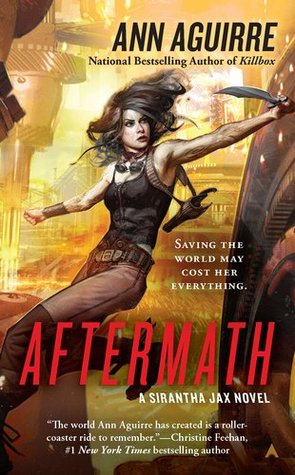
Title: Aftermath (Sirantha Jax, #5) 
Author: Ann Aguirre
Rating: 3 Stars

Aftermath got off to a promising start, what with Jax on trial against the Conglomerate, but it quickly became apparent that Book 5 of the Sirantha Jax Series was very much a--and I hate to use this word--filler novel. Essentially, nothing much happens. Jax isn't acting as a diplomat to a foreign planet, she isn't off fighting a war, and nor is she doing much jumping. Aftermath fills in the gaps that we've forgotten about since Doublebind burst onto the page and, as such, it isn't a favorite of mine.

Yet, by no means is it forgettable. If anything, the emotional growth Jax undergoes throughout this novel--not to mention the palpable strength of her bond with both Vel and March--push this story onward. It's the most introspective novel of the series, oddly enough, and though there is plenty of action, it isn't the most memorable aspect of this tale. Instead, combing through Vel's past, facing the harsh realities of March and Jax's relationship, and labeling the differences between the bonds Vel and March share with Sirantha cause Aftermath to stand out. It's an emotional journey, from beginning to end, and though it falters in part plot-wise, it's still a valuable addition to the series.

Aftermath may have lacked much of a climax, what with every issue Jax tackling resolving itself far too easily, but I'm still on board with this crew. With Endgame up next, I should be feeling nostalgic but I think I'm ready to see Jax off, once and for all. I just hope it's as explosive of a conclusion as I'm gearing up for.

Title: Endgame (Sirantha Jax, #6) 
Author: Ann Aguirre
Rating: 4.5 Stars

I thought I was ready to say goodbye to Sirantha Jax after Aftermath, but Endgame is such a brilliantly plotted novel that I feel nostalgic, bittersweet, and ever-so-upset after all. Aguirre's Endgame weaves together everything I've loved about this series since Grimspace: excellent world-building, blooming character growth, and complex relationships.

Once again, Sirantha Jax is a solider, a fighter, a warrior. On La'heng now, she is determined to free an enslaved race of people--despite knowing the mission will keep her on ground for years to come. Endgame has no shortage of well-written battle scenes, devious schemes, and military plans ensuring its plot is set at a break-neck pace. Nevertheless, the strength of this novel stems from Sirantha herself; from the bond of friendship she sustains with Vel and the lengths she will go to aid him, from the relationship she shares with March and the difficulties they endure, from the new characters she meets and the sacrifices she makes even for them.

Endgame doesn't allow Sirantha to take the "easy" way out, charging in guns blazing and somehow saving the day. Instead, it pushes her to her limits testing her patience, her unselfish desires, and her loyalty to those around her. It compels her to both stay and to fight, though not always in combat. Where this novel suffers, in my eyes, is in the odd jumps of time. The war on La'heng takes years and for Sirantha to oddly mention that a year or six months have passed from the turn of a page is jarring, to say the least.

Yet, despite it all, I love her and her romance with March undergoes necessary strife in this novel. Unlike past novels where Sirantha and March have been thrown into dramatic situations, likely to prolong the story, in Endgame these two finally embrace the honesty of their relationship and unearth their hidden insecurities. It isn't always easy, between these two, but it's always strong and sure. Sirantha's relationship with Vel is of a different--and frankly easier--nature, but that in no way diminishes its strength. For me, this series is defined by the two men in Sirantha's life; both their respect for her and her respect for them. Aguirre never fails to create fascinating, equal-footed relationships and that isn't different even with this volume.

Endgame is, well and truly, the end. Aguirre has not left this world, thankfully, though Sirantha and her journeys are behind us now. Will I miss her? Yes, undoubtedly. Somewhere between all the psychological probing of Sirantha's mind, I fell in love with her, flaws and all. Nevertheless, all good things must come to an end and, as always, Sirantha goes out with a memorable bang, never a whimper.

In case you missed my reviews of the first three novels in this series last summer or just want a refresher, you can read them HERE

Needless to say, I'd highly recommend this series to fans of science-fiction romance and space operas. I gave Grimspace 4 Stars, Wanderlust 3 Stars (generously), Doublebind 5 Stars, Killbox 4 Stars, Aftermath 3 Stars (well-earned), and Endgame 4.5 Stars. It hasn't been a perfect journey and there have certainly been ups-and-downs, but if you're willing to meet flawed characters and be entertained no matter what, this is certainly the series for you! :)

Tuesday, July 8, 2014

Review: Fortune's Pawn by Rachel Bach


Title: Fortune's Pawn (Paradox, #1) 

Author: Rachel Bach

Rating: 4 Stars

Rupert is the worst aspect of Fortune's Pawn. And not even the character Rupert, but his name.

I don't know about you, but when the name of the love interest is just about the only flaw you can find within a novel then that's a damn good book you've got there.

I've had Fortune's Pawn on my TBR ever since Wendy first reviewed it over at The Midnight Garden, making me jump for joy at the thought of a well-done science-fiction novel. It seemed too good to be true. While the reviews for the conclusion to this trilogy had me wincing and re-evaluating my decision to pick up these books, the influx of positive reviews for this first installment wore down my air-thin resistance.

I am so glad they did.

Devi is the backbone, protagonist, and true star of Fortune's Pawn. Not only is she physically strong and kick-ass, but her mental strength is admirable as well. Only upon reading a novel narrated by a confident woman--one who freely admits she's attractive and goes above and beyond to be treated with the respect she deserves--is it all the more evident that the majority of books out there lack a truly feminist character like Devi. Alongside her intelligence, quick wits, and clever jibes, Devi is compassionate and always the first to mentally scold herself and pick herself back up from the lows in her life. What makes her such a remarkable heroine, though, is that fact that she is flawed--and embraces those flaws. She knows she's ambitious and reckless and acts before she thinks and though she suffers for these mistakes, she also steps up to the plate and acknowledges that these traits are here to stay and deals with that. Instead of trying to change herself or improve her personality or rise above society's standards, Devi is comfortable just the way she is in her own skin which is such a remarkable change to find in a fictional heroine. I love her.

When our tale begins, Devi is looking for a fast and easy way to become a Devastator--one of the King's elite guard--and thus, joins Brian Caldswell's ship. It's meant to be a cursed aircraft, with a high death toll, but if Devi survives for even just one year, she's almost guaranteed to achieve her dream. Being as qualified as she is, Devi gets the job easily and, at first, the ship seems to be her tamest job yet. In fact, her only bright spot in the midst of the lack of danger is the handsome cook, Rupert. Soon enough, however, Devi begins to realize why Caldswell's ship has the reputation it does and, what's more, she slowly uncovers that things are not as they seem on this spaceship. Rupert, the cook, isn't the innocent civilian he seems to be; Ren, Caldswell's strange daughter, may not be entirely human; and Caldswell himself, a reputed trader, may be far more than he claims. Devi, as a simple merc and security guard aboard the ship, knows she shouldn't investigate further into the true goings-on of Caldswell's business, but curiosity only ever killed the cat--and that, Devi most certainly is not.

You'd think a science-fiction novel with actions scenes spaced out through the narrative would lose traction when its protagonist wasn't battling foreign aliens, but that isn't the case with Fortune's Pawn at all. Devi's time spent on The Glorious Fool, her relationships with the ship crew, and her blooming romance with Rupert are all just as engaging, if not more. It's hard to find time to breathe in-between this narrative because of its fast pace, but you'll hardly find me complaining. Bach manages to infuse plenty of depth alongside her action, making for the perfect combination of a debut novel. What's more, despite the fact that we don't know too much about the true motivations of the secondary characters in this novel, they still manage to come alive on the page--particularly Rupert. It's difficult not to fall for Rupert's sweet, calm exterior and the dangerous secrets he harbors only make him all the more alluring. Even when he makes decisions on Devi's behalf--standard angst-y issues such as pushing away the one he loves--Devi never lets him live it down, which makes for a relationship truly established on equal footing. It's different, it's romantic, and it feels authentic--which is more than I can say for most fictional romances.

Granted, Fortune's Pawn ends off in a slightly abrupt--and slightly cliffhanger-y--spot in the sense that readers are going to need the sequel on hand, but seeing as all three books in this trilogy are already released, this is hardly a complaint; just a caveat. Bach's debut is truly flawless; executed perfectly, written impeccably, and guaranteed to entertain readers of science-fiction. With original world-building, alien species attacking spaceships, and plenty of secrets to fit into the crevices of our minds, you can't go wrong with Fortune's Pawn. Just try it; I dare you.

Saturday, February 15, 2014

ARC Review: Salvage by Alexandra Duncan


Title: Salvage 

Author: Alexandra Duncan 

Rating: 3 Stars

Release Date: April 1st, 2014

WARNING: THIS BOOK HAS A LOVE TRIANGLE!

I really wish someone had told me about that BEFORE I read it, or even better, requested it. Just MAYBE this would have been a good instance to include in the synopsis that there was a LOVE TRIANGLE present. If there's anything I hate more than a love triangle, it's an unexpected love triangle.

ANYWAY, getting past that LOVE TRIANGLE (*rages*) Salvage was only moderately decent. I might as well call myself a critic of science-fiction/fantasy because of how picky I am about the genres and Duncan's debut doesn't live up to the mark. Ava, our protagonist, starts her journey on the space ship where she lives in a dominant patriarchal society. So dominant, in fact, that the women are kept illiterate and expected to perform household duties. Futuristic? Um, try prehistoric. While I appreciated that this divide was starkly outlined, evident even in mythology that told of women misbehaving and causing disaster when given too much freedom, the feminist growth arc Ava undergoes after leaving her home behind left much to be desired.

On her home ship, Ava is told that she is to be a bride soon. Ava hopes - desperately - that it is Luck, the brother of her friend, Soli, who she has only met once. When they meet again, Ava and Luck's feelings for each other are strongly existent, despite the time they've spent apart. Unfortunately, however, a tragic series of accidents leads to Ava being thrown off her space ship and back down to a polluted, dying Earth. If you couldn't already tell from my description of Romance #1, it's little more than insta-love. Yet, Luck does see Ava as a woman capable of learning the tasks of men and Ava, after living a sheltered life submissive to men, is naturally drawn to Luck who sees her as more than a mere child-bearer. On Earth, however, Ava must attempt to survive and her primary objective to find her aunt who resides in Mumbai.

Once on Earth, the narrative of this novel drags, becoming increasingly boring. In fact, I am almost positive I spaced (no pun intended!) out on more than a few occasions. As such, I can only be 99.9% certain in my claim that the world-building on this futuristic Planet Earth is limited. While the evidence of its decline is glaringly obvious, I remain puzzled about the nascence of the communities aboard space ships, not to mention why there is such a large population still on Earth when they could be living in space. Moreover, what made the communities aboard these space ships believe that they needed to go backwards in time after making so much modern-day progress in the women's movement? I wish Duncan had spent more time exploring these corrupt politics aboard these ships instead of focusing on the romance story line. After Amy Kathleen Ryan's Sky Chasers Trilogy, I've realized that the scope to be explored aboard a space ship is far more than most authors would lead their readers to be believe and, on that front, I was disappointed by Salvage.

Nevertheless, on Earth Ava does come to recognize the inconsistencies with her previous life. While her transition into a bad-ass feminist is rushed, it is still present which is a relief. Ava forges many strong bonds with characters she meets on her journey to find her aunt in Mumbai, but I wish those secondary characters could have come into their own a little more instead of the focus remaining solely on Ava's characterization. Once in Mumbai, though, my issues began to arise with Duncan's setting itself. I've been to Mumbai and though the landmarks mentioned are accurate, as are the mention of elephants, I found that the rich atmosphere of Indian culture that pervades every part of India to be missing. In The Lost Girl, Sangu Mandanna does a brilliant job of capturing the essence of Bangalore, the city where part of her novel takes place. Sadly, the essence of Mumbai isn't portrayed the way I'd have liked it to be in Salvage and instead of connecting to a setting I'd been to, I felt distanced from it instead. (Of course, this is a personal qualm I have as I've been to India many times, so I'm sure most readers will not struggle with this.)

Of course, Mumbai brings us to Love Interest #2 and, honestly, I just did not see this coming. I don't know why. I figured that since this novel is a stand-alone and Ava was so hung up on Luck throughout the novel, there couldn't be anyone else for her. WRONG. I saw Love Interest #2 as a genuinely sweet FRIEND to Ava, so to find that this character was actually a love interest in disguise shocked me. It's a sweet romance, but one I found rather unnecessary to the plot line as it is given such minimal screen time. Instead, it is the friendship that is developed well and I wish this novel could have remained that way. Not because I'm Team Luck, but because I'm Team Ava. I enjoyed the conclusive ending of this novel, though, and am thankful the love triangle is wrapped up quite neatly and very tastefully, actually empowering Ava.

Ultimately, though, Salvage is a character-driven novel where I didn't feel much for the characters. I love the world Duncan has created and I wish she had spent more time detailing this universe to the reader and exploring intriguing plot devices within the different nooks and crannies of her richly imagined future. Instead, I found myself flipping these pages rather dully, looking up with excitement from time to time but mostly reading this as a disengaged individual. Salvage isn't a spectacular debut and for fans of science-fiction, I wouldn't recommend this. On the other hand, though, if you're just looking for an innovative new read, this novel does the trick.

Wednesday, February 12, 2014

Review: Flame by Amy Kathleen Ryan


Title: Flame

Author: Amy Kathleen Ryan

Rating: 4 Stars

I find I don't have very much to say about Flame. From the moment I put down my copies of both Glow and Spark, it was as if my fingers were possessed, desperately needing to type, to crow in glory, to shove this series into the hands of every unsuspecting bibliophile. After Flame, however, I remember sitting. Simply sitting, soaking up the lingering words in my mind. I was - and still am - very much shocked by the brilliance of this concluding installment. While I may not have much to regale about this novel - not without giving away spoilers, at any rate - Flame has been one of the few satisfying conclusions I've read in a very, very long time and I suspect it might remain that way for awhile to come.

Compared to its predecessors, Flame is a much slower novel than Glow or Spark were. And rightfully so. After the bitterness of violation, the anger of rebellion, the closed fist of anarchy, and the open strike of betrayal, these characters are exhausted. Kiernan and Waverly are now on the New Horizon, back under the influence of Anne Mather. Or are they? When Waverly meets an old doctor on board the New Horizon, she agrees to help him take down Anne Mather but, soon enough, she begins to question just who is the true enemy aboard the New Horizon. Meanwhile, Seth is - once again - a fugitive aboard a space ship, only this time it's the New Horizon. While he receives help from a small group of rebels aboard the New Horizon, his health is slowly deteriorating. All aboard on the same ships, friends and enemies alike, these teens don't know where - or who - to turn to. Despite having their parents back, they have been brainwashed by Mather and follow her blindly. Which means that, once again, Waverly, Kiernan, and Seth are alone. Only, this time, if they don't stop the evil aboard the New Horizon once and for all, they might not get another chance.

What makes Flame such a spectacular sequel is the fact that it stresses ideals such as redemption, friendship, and love. After writing such a bloodthirsty, violent series, Ryan comes back to these core values in a manner that never feels jarring but one that, rather, slips into the story line perfectly. Waverly and Kiernan, despite the differences they've shared, learn to set those aside and work together for the first time since their break-up. While they, along with Seth, try to infiltrate the New Horizon from within, though, they are no longer as convinced of Mather's cruelty as they once were. As they learn, Mather is not the only tyrant aboard the New Horizon. Escaped convicts from the prisons of the Empyrean have made it back to the New Horizon with the intent of wrecking havoc and Waverly's doctor has a following of adults who don't seem wholly trustworthy. Although these multiple villains may seem to overwhelm the plot, in reality they paint a picture of different kinds of evil. Mather has always been a villain with an extraordinary amount of depth and her gray matter is explored in even more detail within this installment. Although the other "villains" in this conclusion do not share the same degree of depth that Mather does, they nevertheless contribute to the slow, but constant, build-up to the climax of this tale.

As far as the plot goes, Flame is impeccable. It forces Waverly, Kiernan, and Seth to reach new heights as characters - areas from which they are able to look past the injustices done to them and the anger they feel. Ryan has truly made these teens transcend their barriers and the bumps they experience along the road are realistic. Additionally, this novel wraps up perfectly too. Ultimately, there are sacrifices that must be made and bittersweet separations as well, but I ended this novel utterly satisfied. While Flame is the most romantic installment to-date, its love stories never overwhelm the focus of the story. Although these romances remain minimal, they are heartfelt, equal, and true which I appreciated. Moreover, and perhaps best of all for me, is the fact that every loose thread is tied up, albeit not always in ways we want. Seth, Waverly, and Kiernan don't find the answers to all their questions, but they find enough to live by. Ryan has always been impeccably realistic, to the point of harshness, in this series and I loved that her stance on realism was never compromised in this finale.

Ever-so-slightly bittersweet, achingly romantic, heart-pounding action, and an influx of complex moral situations made this a conclusion to love. Amy Kathleen Ryan: write something else amazing! Quick!

Monday, January 6, 2014

ARC Review: Uninvited by Sophie Jordan


Title: Uninvited (Uninvited, #1)

Author: Sophie Jordan

Rating: 3 Stars

Release Date: January 28th, 2014

I am no stranger to disappointment. It trails me, especially in-between the words, in the spaces where potential lingers, but is passed over. I often pause at these gaps – these chasms – of un-realized fulfillment, seeking the gratification of invisible letters to clutters the emptiness. Alas, Jordan’s Uninvited is just another novel whose premise enticed me, concept intrigued me, and first few pages kept me glued…only to close the cover with a bang, a whoosh of air, and a sigh of discontentment. Admittedly, Jordan tries to cover the expanse her original idea covers, but these attempts are no substitute for a full-fledged, thought-provoking thriller. Ultimately, Uninvited isn’t bad…it just isn’t unforgettable either. 

In the not-so-distant future of Uninvited, scientists have found a gene that identifies killers. In fact, according to statistics, at least half of the murders committed in America were committed by individuals who carried this gene, known as the Homicidal Tendency Syndrome (HTS). Davy, a talented musician whose acceptance to Julliard has clinched her future, could never have imagined she carried the killer gene. When her genetic testing results report positive, her admission to Julliard is rescinded, she is uninvited from the private school she attends (despite her economic advantages), her best friend and boyfriend refuse to interact with her, and she is placed with five other carriers in a public school nearby. Now, the only question in Davy’s life remains…is she the girl she thought she was or the killer her DNA proclaims her to be?

It should come as no surprise that the question of “nature vs. nurture” is still regularly debated; a question whose answers vary just as much as the life-long question of “what comes first – the chicken or the egg?” Needless to say, with this innovative concept, Jordan had more than just a little to handle on her plate. And, at first, I was more than satisfied. Davy’s sudden recognition of the gene she carries, the slow estrangement of her friends and family, the fear she sees in the eyes of others…it’s a shocking, but realistic, reaction. After all, though Davy is the same girl she always was, the knowledge of the gene she possesses leaves her close comrades in harm: if anything were to trigger her killing gene, they would be the first targets. Thus, it becomes no difficult task to sympathize with Davy. 

Moreover, Jordan delves into the unforeseen consequences of discovering this gene. Davy is placed in public school to graduate, but in solitary confinement with five other students. In fact, she has no teacher, no friends, no lunch time, no recess, no gym class…nothing. While Davy is far from a killer – or seems that way – that isn’t the case with the other carriers she meets. Some, like the tech-savvy Gil, seem unable to commit harm, but others, like Sean, have been branded for their violence. What I found most interesting about this situation was the fact that the discovery of this gene isolates individuals, which coincidentally puts them in the ideal situation to trigger their killer instincts. Estrangement, after all, leads to bitterness and in the teenage boys Davy meets, manifests itself in violent ways. Even more disarming, however, is the fact that the girls – also estranged from society – are now placed in situations with violent men who are stronger than they are. Thus, though these girls, like Davy, have the potential to become killers, they are still weaker than those around them and will resort to terrible means to find a modicum of safety. For me, this first-half of Uninvited was the strongest, outlying the different results of this gene and truly portraying humanity in a realistic, though uncomfortable light. 

Where this story began to lose my attention, though, was in the second-half. After a mall shooting committed by individuals possessing the killer gene, all carriers in America are rounded up and placed in seclusion camps. A select few teenagers, though, are taken to a government training facility to be taught how to control their violent tendencies. As a musical prodigy, Davy is – naturally – chosen. Unfortunately, instead of using this opportunity as a means to instill world-building, background, or politics into this novel, Jordan continues along the same stream she already has. Additionally, the romance begins to gain greater importance in this part of the novel, which is fine – I rather enjoyed the slow-burn story between Davy and Sean, particularly their initial differences and gradual conversations – but I did feel as if Sean’s presence inhibited Davy’s growth. In fact, it become cumbersome to see Sean save the day, time-and-time again, by going to Davy’s rescue. I genuinely wanted to see more growth from her, beyond the initial eye-opening scenes into her new life. Moreover, the ending of this novel is rushed and abrupt, refusing to examine the sticky emotional situation Davy is reeling from after events towards the end. While I appreciate that this series is a duology – a pleasant change from the typical trilogy – I was still left disappointed; confused whether it was worth my time and effort to pick up the sequel when it released. 

Uninvited, you see, lacks world-building. For one, we are given absolutely no information about the discovery of this gene or the political/scientific repercussions about it. While it is made clear that the training facility Davy is sent to is mandated by the government, there are very few insights into the political scheme revolving around this situation. I, for one, would have imagined that the discovery of this gene immediately would raise gun-control concerns. After all, do we want potential killers to be in possession of guns? Moreover, what about the rights being violated by quarantining these people away? Where are the human rights activists? Where are the protests by disgruntled family members? Uninvited takes place in a bubble, with few glimpses into the real-world repercussions if this event were to actually take place. Even Davy’s family, beyond her older brother Mitchell, is strangely non-vocal about what their daughter is going through. Davy’s interactions with them are minimal, which is yet another disappointment. 

Nevertheless, I do not doubt that most readers will enjoy this novel immensely. Its characterization and romance are spot-on and, to some extent, it even makes one think, bringing up an uncomfortable, but intriguing, subject matter. For the readers who are expecting more of a psychological bite, however, or just a pleasant dose of science-fiction and politics, Uninvited is not that story. We are all, sadly, still waiting for it to be written.