Showing posts with label 2.5 Stars. Show all posts
Saturday, February 11, 2017
Series Review: Nameless by Jennifer Jenkins
Title: Nameless (Nameless, #1) & Clanless (Nameless, #2)
Author: Jennifer Jenkins
Rating: 4 Stars & 2.5 Stars
NOTE: This joint review contains NO SPOILERS for the series that are not already mentioned in the synopses of these books.
Clanless was a mixed read for me. Nameless seemed like a promising start to a new fantasy series--fast-paced, slow-burn romance, and plenty of plot twists to keep readers guessing. I loved the world Jenkins had created and, more than that, I enjoyed the secondary characters and the originality of failing to fall for typical YA tropes. But, Clanless was a far cry from the sequel I was expecting after the cliffhanger ending of Nameless.
In Nameless our heroine, Zo, infiltrates the Ram territory to spy and pass on information to her clan, the Wolves. Her plan goes for a toss, though, when her eight-year-old sister, Tess, follows her in. Now, Zo is determined to escape the impenetrable fortress with her sister instead of risk her life for the Allied, an agreement of clans to unite against the Rams. The Ram clan is ruthless, training their young for battle from the start and killing anyone and everyone who doesn't pass their tests. Now, their numbers have dwindled and the territory they've amassed is failing. They don't have enough food and their captured slaves, the Nameless, outnumber the Ram. As they make plans to attack the Wolf and the Raven clans for food stores, the Nameless gather in rebellion and Zo passes on information. But Zo doesn't expect her life to become intertwined with Gryphon, a Ram striker whose father deserted the clan, making him work twice as hard for everything he's achieved.
Nameless works because of Zo and Gryphon, individually. They're both battling with their loyalty to their clans and the new information they're uncovering about each other but I love that Zo never loses sight of her goal and Gryphon allows himself to be open to new ideas. Ideas like realizing that the Ram attack the weak, would kill his best friend's newborn child for a slight lip deformation, and that Ram can fall in love with other clans, too. The secondary characters, namely Gryphon's foster brother, Joshua, are fleshed-out characters in their own right and I loved the large host of characters that accumulated as the story went on.
In Clanless, Jenkins continues to prove that she is an expert at action, never losing the fast-pace that she has set in Nameless. But, where Clanless falters for me is in its portrayal of male and female roles. Early in the story, Zo and Gryphon are separated and believe that the other is dead. This drives the entire plot of the story forward as Zo fights for Joshua and Tess and Gryphon sets out to fulfill Zo's desires for him. While I continued to enjoy their individual story arcs, particularly because the world-building is so well-done in this sequel, I grew annoyed by the very stereotypical gender roles.
For me, the best aspect of fantasy is the fact that it isn't our world. Not our world, not our rules, and it doesn't have to be our gender stereotypes, either. This was such an incredible opportunity for Jenkins to use Zo and Gryphon's independence from one another to build their individual characters for the first time. Instead, I felt as if so many key moments in this plot became Zo fighting off unwanted attention because of her beauty (again), Zo falling and crying and breaking apart because Gryphon wasn't there, Gryphon having to nearly yank up a tree to express his grief, etc. This world is far more patriarchal than it needed to be, especially because it's fantasy. All of these clans have different customs, religions, languages, and fighting styles. They all look different and have different builds and skills. But they can't have different gender rules? I didn't buy it.
The world-building expands significantly in this novel and though I am quiiiite sure I've predicted a "major plot twist" in the final novel, I'm still planning to pick it up. I love the concept of this world and especially the way that the differences between clans and the misunderstandings about clans are a mirror of the way we misunderstand and stereotype other cultures and races in our own world. But, I do feel like Clanless is a huge missed opportunity for Jenkins, despite the action of the plot and the expanded world. If you're not as critical of fantasy or gender roles, though, I suspect this is going to be a hit. If I recommend the series remains to be seen with the release of Book 3, but so far, it's a mixed bag of high highs and low lows.
Tuesday, October 18, 2016
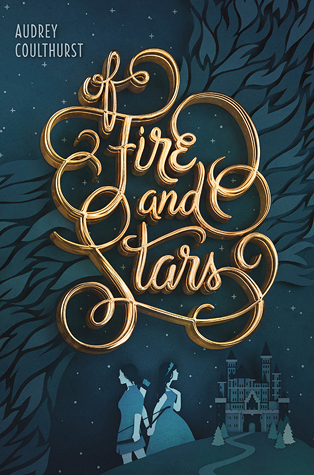
ARC Review: Of Fire and Stars by Audrey Coulthurst
Title: Of Fire and Stars
Author: Audrey Coulthurst
Rating: 2.5 Stars
Release Date: November 22nd, 2016
I want nothing more than to have the future of fantasy fiction become well-worn stories with women marrying women or men marrying men. I love the fantasy genre and I especially adore that Coulthurst is among the first to write YA LGBTQIA fantasy. But, sadly, I am disappointed to report that Of Fire and Stars is a novel I would recommend skipping, despite the female romance at its core.
For me, one of the main issues with Of Fire and Stars is how completely it throws the reader into its world. We are given no prior knowledge of world-building or character background before cutting straight to Denna's arrival in Mynaria as she prepares to marry Thandi, the prince she has been betrothed to since birth. Denna has had an affinity for fire magic since she was young and though Thandi and his people revile magic, she hopes to keep her abilities a secret for the rest of her life and successfully fulfill her duty to marry the prince and bring an alliance between their two reasons.
Why Mynaria hates magic is a mystery, as is the history of these nations which, very quickly, are upon the bring of war with another small country. Coulthurst tries too hard to create an intriguing political situation but she belittles her audience, failing to give them an adequate backstory or write a unique culture for any of these countries, with the exception of their stance on magic. Thus, the entirety of this novel feels...lacking. It is impossible to get a true grasp of the plot without solid world-building and though the reader becomes accustomed to switching between Denna and Mare, our two narrators, a little more backstory for both heroines would have been useful.
Speaking of Denna and Mare, I will admit that their romance is satisfactory. It is a slow-burn, classic hate-to-love tale and I enjoyed reading of their growing attraction and friendship. However, once again returning to the lack of world-building, neither Denna nor Mare fully explain why they cannot be together. It isn't forbidden to take on lovers or even marry within the same sex in this world but why Denna and Mare cannot form an alliance, instead of Denna and Thandi, is rather puzzling. While I greatly appreciated the fact that sexuality is so fluid in this novel and many of the characters are bisexual, I almost wonder if all of the characters are bisexual until proven otherwise. And while I have nothing wrong that assumption, it almost seems just as dangerous as the assumption that everyone is heterosexual. It fails to account for sexual diversity in a novel that seems as if it must do that, if nothing else.
Another disappointment, for me, is that at times these characters seem incredibly juvenile. And ignorant, perhaps? Both Denna and Mare have grown up in societies where homosexuality is normal yet they ignore their feelings for one another, passing it off as friendship, for most of the novel. While I find this to be realistic in a society where homosexuality is not accepted, I found it confusing in the society Coulthurst created. I find that this is an increasing issue with YA fantasy, in fact--a fantastical, fictional setting often means that issues that plague our world are non-issues within the novel. But I want fantasy to reflect messages and themes that we can learn from in our own worlds, despite the lack of magic, and Of Fire and Stars rather fails on that account.
I will not deny that this novel is fast-paced and entertaining. There are plot twists, sudden deaths, and of course the secrets of Denna's magic. Her blooming romance with Mare is exciting and their clash of wills, especially the manner in which they change one another, is rewarding. I enjoy both of these heroines, individually and together, but the world they've been placed in makes little sense and raises more questions than it answers. For a debut, this shows promise, certainly, but I hope for YA fantasy with LGBTQIA heroines where the plot is just as good as the romance and the diversity is not limited to that of sexual diversity. We have a long way to go in creating diverse, well-written novels but Coulthurst's debut is certainly an important first step in that direction.
Sunday, August 3, 2014
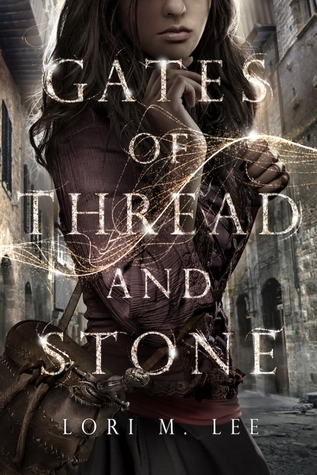
ARC Review: Gates of Thread and Stone by Lori M. Lee
Title: Gates of Thread and Stone (Gates of Thread and Stone, #1)
Author: Lori M. Lee
Rating: 2.5 Stars
Release Date: August 5th, 2014
I felt hopeful, sliding open the cover of Gates of Thread and Stone. Lee's debut begins with promise, introducing us to Kai, a fierce and headstrong heroine whose ability to slow down time is refreshingly unique. Moreover, the first few chapters of this novel present us with an intriguing fantasy world, one in which Kai, living practically in the slums, must earn credits--opposed to hard cash--to rise above her rank. Kai, who was adopted by an orphan boy, Reev, when she was eight-years-old, has a strong bond with her older foster brother. Seeing the two interact on the page at the opening of Gates of Thread and Stone was heart-warming--just as witnessing Kai's frantic worry over Kai's sudden disappearance is heart-wrenching.
With the help of her childhood friend (and crush!), Avan, Kai sets out to find Reev knowing only that he has been taken by the Black Rider, formerly thought to be a mere legend. Unfortunately, I found that this novel gradually declined from this point on-wards. For me, where Gates of Thread and Stone is strongest lies within Kai. Unlike typical protagonists, she doesn't allow the presence of her love interest to distract from her mission. Instead, I admired Kai's unflinching devotion to saving Reev and, moreover, her inner strength in challenging herself and overcoming her own hurdles. When it came to the romance I certainly had a bone--or two, really--to pick with Kai but with that slight exception, I found her to be a welcoming heroine.
Yet, despite her shining qualities, I feel as if Lee fails to utilize Kai to her fullest potential. We, rather disappointingly, see very little of Kai's marvelous ability and the instant camaraderie I felt upon meeting her during those initial pages vanished only chapters into the narrative. I continued to enjoy Kai, support her decisions, and marvel at her actions but, I couldn't feel much for her. In large part, this is due to the lack of development that Lee offers her secondary characters. Reev brings out the best in Kai and, seeing the strength of their bond in the opening of the novel, establishes the reader-character connection that is absolutely essential. Lee fails to sustain that thread throughout the narrative, however, as Kai is constantly on the move from one location to another, meeting characters only to dismiss them at later points in the tale. I never felt grounded, neither to a location nor to a character, over the course of Gates of Thread and Stone. I relish secondary characters, not only for their different personalities but more so for what they bring out in the protagonist. Lee's secondary characters are forgettable, at best, and their roles in Kai's life are all-too-similar to those played by other, far more memorable, secondary characters in other novels; whether it be teacher, guide, betrayer, fighter, potential friend...none of these roles are filled in a manner that bears remembrance and I found myself ever-so-slightly saddened by the direction the plot took.
I will say, though, that Lee keeps readers guessing at her plot lines. I often expected the story to travel in one direction and it pleasantly surprised me by taking a different path. Nevertheless, I didn't find the pacing of this novel to be particularly engaging and, once Kai leaves the city gates, the world-building felt confusing at best, nonexistent at worst. Now, that's not to say it isn't there--because it is. Lee infuses her debut with hints of mythology, pulled from various sources, and the result is rather fascinating. I only wish it had been presented in a different light. By the time the entirety of Lee's world becomes evident, the story is winding down and the influx of emotion, detail, and plot twists all packed into the final few chapters isn't lovely.
What's more, the conclusion of this novel banks upon the fact that you, the reader, actually cared about the romance. Which, I assure you, I didn't. I found Avan to be a respectable romantic interest--not too perfect but not an asshole either--yet I couldn't summon up much emotion for him. Avan and Kai skirt around their feelings for far too long. Lee takes it to a point where it begins to feel unnatural--seriously, how could they not have figured out one another's feelings sooner?--and the romantic tension isn't of the welcome variety. Granted, Gates of Thread and Stone avoids a love triangle but--I'll warn you--don't come here looking for swoon. I genuinely felt as if Avan's character, particularly with his past and liberal mindset, could have been utilized in a different--and possibly better--manner throughout the narrative. Just...unimpressive, is all.
I am confident that Lee's debut will finds its die-hard fans. Of that, I have no doubt. Yet, for me, it wound up being a mash-up of too little magic (Kai, USE YOUR POWERS!), too little chemistry, and far too little connectivity. I just couldn't get into this one and while I truly loved the sibling bond that lies at the core of this novel, not to mention the qualities of Kai's that are truly admirable, Gates of Thread and Stone just didn't amaze me.
I was given a copy of this book from the publisher in exchange for an honest review. Thank You!
Monday, February 17, 2014
Review: Split Second by Kasie West
Title: Split Second (Pivot Point, #2)
Author: Kasie West
Rating: 2.5 Stars
I read a little over half of Split Second before skipping to the end of the novel and remaining unsatisfied. For fans of Pivot Point, there is no doubt in my mind that Split Second is a sequel worth waiting for. For me, though? Not so much. Split Second picks up directly where Pivot Point leaves off, which is both a relief and a point against its favor. On one hand, the novel doesn’t suffer from a slow start the way its predecessor did but, at the same time, it relies a little too much on Pivot Point to define our relationships to the characters. Instead of re-building the bonds we have with characters we’ve come to anticipate and love, Split Second reads very much as plot, dialogue, and action opposed to emotion, feeling, and response.
First and foremost, it should be mentioned that West’s duet is about parallel universes. Pivot Point followed Addison, our main character, as she explored two different paths before by choosing to live with either he mother or her father who were divorcing. Split Second starts off with Addison switching to visit the parent she didn’t choose to stay with as she copes with the events from Pivot Point. Since we already met two casts of characters, one that lives where Addison’s mother lives and one where her father lives, we find ourselves meeting old characters again while Addison meets them for the first time. Unfortunately, I found myself distancing from these story arcs a second time around, both because I knew the events that would draw two characters together and also because I enjoyed the way their relationships played out in Pivot Point and wasn’t a fan of seeing them rehashed in a different manner in Split Second.
Perhaps the most obvious difference between Pivot Point and Split Second is the fact that this sequel adds Laila’s perspective to the story. Laila is Addison’s best friend and after the two went through a series of traumatic events in the past novel, I was surprised to find that neither of these girls mentioned those issues or their reactions to them. In fact, Pivot Point seems to exist solely to establish a link with these characters as Split Second doesn’t re-build that connection. Moreover, I found myself skimming over Laila’s perspective which I wasn’t quite interested in. I never connected with Laila the way I did with Addison and I didn’t feel the strength of their friendship in this novel the way I did with Pivot Point either.
As I kept reading Split Second and the plot become more and more evident, it also become more and more familiar. West relies on tropes similar to the dystopian genre as she delves into not-so-secret secrets from the Compound Addison hails from. Frankly speaking, I wanted a little more politics, a little more shock, and a little more focus on the world-building than the romance with this installment. While I believe that fans of Pivot Point will find lots to love with this sequel, I’ve had little luck with West’s work in the past and Split Second simply wasn’t for me. It is a romantic, unique duet but not one I was able to become emotionally or psychologically invested in.
Saturday, February 8, 2014
Review: Cress by Marissa Meyer
Title: Cress (Lunar Chronicles, #3)
Author: Marissa Meyer
Rating: 2.5 Stars
I can't say I enjoyed reading this; I counted down till the end. For those of you who aren't aware, Marissa Meyer and I have a love-hate relationship, leaning towards the latter, unfortunately. I found Cinder to be less-than-stellar, devoid of world-building and overtaken by a plot that was far too predictable. When the synopsis of Scarlet released, all it took was one mention of Wolf to have me scrambling for a copy. Admittedly, Scarlet had its flaws too, but I loved it. Unabashedly. For a few blissful months I felt like a white sheep; just like everyone else. And then I cracked open the spine of Cress.
Cress is a loose re-telling of Rapunzel, a tale which was once unknown but has now been popularly marketed thanks to the brilliance of Disney's "Tangled." In comparison to "Tangled," Cress leaves a lot to be desired. In comparison to Scarlet, it leaves even more. Where Meyer excels as a writer is in the fact that her plotting is impeccable, tight and focused without wandering astray even once. We begin this novel with a plan to stop Prince Kai's impending wedding with Queen Levana and, despite the hurdles thrown at these characters, that remains the goal throughout. In order to achieve this, however, Cinder & the Gang need the help of Cress, a Lunar born as a shell, lacking powers, who is trapped aboard a satellite where she spends her time hacking into computer systems, infiltrating into top secret facilities, and reporting information back to Sybil, a.k.a. Mother Gothel. And, as you can guess, of course Sybil works for Queen Levana.
When Cress first makes contact with Cinder & Co., she is eager to help them escape scrutiny from the Lunar Queen and find a way to escape herself. Needless to say, their plans fall through - rather catastrophically - forcing an unexpected visit to the Sahara Desert. With so much going on, Cress is a fast-paced, action-packed novel. Flitting from one perspective to the next, Meyer continues to build upon our understanding of this world. While the history behind the nascence of Lunars and their magic remains nonexistent, I've learned to survive without these vital tidbits of information. Instead, I appreciate the fact that Meyer has created a complicated political system at hand, one that Prince Kai is constantly attempting to work through.
While Prince Kai may not have been my favorite character in Cinder, over the course of the past two novels he has truly grown. In fact, it is Kai and Cinder, the main leads of the first installment in this series, who continue to surprise me as this series wears on. Both of them play important roles in society, but their inner musings and the manner in which they navigate through their fears while still attempting to do what is right for the citizens of the world they live in is admirable. Meyer has, slowly but steadily, won me over to this couple which failed to spark my interest two installments ago. But, then again, Kai and Cinder have very little competition in Cress. Not only are my two darlings - Scarlet and Wolf - conveniently captive or unconscious for much of the novel, but Cress and Thorne are pathetically disappointing.
I will be the first to admit that I loved Thorne in Scarlet. Loved. Him. In Cress, however, I found that his character lacked the same dynamic, presumably because of the presence of Cress. Individually, I really enjoy the characters of both Cress and Thorne. As a couple, however, they leave much to be desired. The bulk of Cress follows this pair as they trek across the Sahara and my eyes glazed over the page far too many times. Quite simply put, Cress is no match for Thorne. Not only is she naive and shy, but she lacks the inner anger and fury that Rapunzel of "Tangled" possessed. Cress's rebellious streak starts and ends with her desire to escape. Once outside the confines of her satellite, she has little interest in much else. Except Thorne. Cress has had a crush on Thorne ever since the handsome rascal first made it across her news feed and while the universe may believe Thorne is a criminal, Cress already believes he hides a kind heart within.
While this could have been an incredible spring board to launch an epic romance, it sizzles and dies out quickly. Though Thorne tells Cress, immediately, that her infatuation with him is tainted by bias and lies, she holds onto those beliefs throughout the book. Even when she doubts Thorne, a small action of his - a kind, normal, human gesture - is seen as heroic. Cress places Thorne on a pedestal and though she experiences a unique growth arc, I feel as if she never falls in love with the real Thorne. Moreover, there is next to no development of Thorne's attraction to Cress until the last few chapters, which honestly sprang out of nowhere. I was blindsided and, honestly, a little upset over the direction this romance took. I believe that Thorne and Cress have the potential to become a worthwhile couple, but the way they were written never made me believe in their romance, let alone the equality and stability of their bond.
And yet, perhaps nothing takes the award for Disappointment with a capital D the way Scarlet and Wolf do. In Scarlet, this couple was sizzling, full of unacknowledged sexual tension, betrayal, and a complex scope of emotions. Both Scarlet and Wolf still have a long way to progress in their relationship, so the fact that they are separated early in the novel is a little jarring. (Especially as their separation occurs after the majority of the "Rapunzel" fairy-tale is told, so the re-telling in Cress is compressed to the first fifth of the narrative. Not a fan of that plot choice either.) If it weren't bad enough that Scarlet and Wolf are separated, they have just about two scenes each afterwards. Um...WHAT? With Scarlet, Meyer won me over with her ability to delve into the minds of two complex characters, all while sustaining a convoluted story scheme. With Cress, she fails to give Scarlet and Wolf the depth we know they contain. Instead, their intriguing story arc is pushed aside in favor of other characters. While it is difficult for me to continue on my angry rant about this decision without giving away spoilers, I'll leave you with this last thought: I don't think Winter can repair the damage of Scarlet and Wolf's relationship from Cress. Both these characters go through traumatic events in this novel and the effects of those experiences will, most likely, not be explored to their full capacity in the sequel, which disappoints me even further.
Speaking of Winter, though, we are awarded a taste of the mad Winter and her lover in Cress and I am rather intrigued to meet them in more detail. After coming this far, reading every novella and novel within this series, I plan to see it through to the end. Frankly, though, Cress has little to offer besides an enticing plot line. While this would, ordinarily, be alright, I read for characters, not for plot twists. I didn't wholly dislike everything about this novel, but I disliked enough to know that I won't be recommending this to many readers. In fact, I may just re-read Scarlet and rationalize it into a stand-alone in my mind. Still, take my words with a grain of salt: after all, I am the only reader to dislike this novel. (So far.)
Friday, January 31, 2014
Mini-Reviews & Giveaway: Between the Devil & the Deep Blue Sea by April Genevieve Tucholke & Amber House by Kelly Moore
Title: Between the Devil & the Deep Blue Sea (Between, #1)
Author: April Genevieve Tucholke
Rating: 2.5 Stars
...that's it? Are we all sure I received the right book in the mail, because I'm just a little bit confused. Between the Devil & the Deep Blue Sea became a blogging sensation when it first released a few months back and, ever since, I've been curious to try it out for myself. When my copy first arrived, I got through about half the book before turning to other pressing ARCs. Now, having finally found the time to settle back into this story, I've wound up disappointing. For some reason, I expected a lot more to...happen. *scratches head, still confused*
Between the Devil & the Deep Blue Sea excels as the gothic mystery it is marketed as. Not only is the writing beautiful, painting an atmosphere of chilling nights and howling winds, but the imagery Tucholke forces us to conjure, of little children holding sticks and hunting the devil, are spine-tingling. With the exception of this lyrical prose, however, this novel has little to offer. Its protagonist, Violet, is much like any typical heroine who plans to resist the "bad boy" but fails spectacularly. Moreover, I didn't appreciate the manner in which our feelings for Violet are intentionally manipulated. Violet's twin brother, Luke, is a rude misogynist and his girlfriend, Sunshine, essentially exists as a foil to Violet. Both Luke and Sunshine do little to develop the story, but their existence makes Violet seem like a much better alternative character. Frankly speaking, though this method is used by many authors, I'm not a fan of it merely because it doesn't offer many reasons to like the protagonist for who she is, which seems like cheating to me. If you only like the protagonist in comparison to those around her, do you really even like her at all?
River West, the mysterious boy who rents the guest house behind Violet's huge house, is essentially a creep. And an insta-love machine. Although he has never fallen for a girl before, of course he falls for Violet. Why? I still have no clue. And Violet too, who is a sensible teenager (supposedly), takes one look at River and instantly falls for him as well. *gag* While I really liked the moral questions that River's presence brings up - after all, can you really love someone if their actions go against your moral code? - ultimately that wasn't enough to save this novel for me. Between the Devil and the Deep Blue Sea is very similar to most paranormal reads, but its writing style sets it apart, giving it a gothic feel that I really enjoyed. When you strip that away, however, this is nothing but a slow-moving novel with characters that are just a little too familiar.
Title: Amber House (Amber House, #1)
Author: Kelly Moore, Larkin Reed, Tucker Reed
Rating: 3.5 Stars
Amber House is dull, at first, rather boring and difficult to get through. Once the novel hits its stride, however, it soon delves into an intriguing tale. Sarah, the protagonist of our tale, can see the past. And in Amber House, a building known to preserve echoes of its history, Sarah's abilities thrive as she witnesses pieces of her ancestry come together to reveal truths she never knew about her family. One of the highlights of this novel is the relationship Sarah sustains with her family members. With her autistic younger brother, Sam, she is unfailingly caring, but with her mother, her relationship is tenuous at best. Moore and the two Reeds explore this rift between the two in a complex manner, giving us insight into Sarah's mother's past, which therefore sheds light on her present behavior.
Unfortunately, there is a rather irritating - and unnecessary - love triangle at play here. In fact, it only detracts from the story and causes Sarah to forget her usual sensibility. Quite thankfully, however, the love triangle is resolved in this first installment and will - hopefully - be absent from the sequel. With such a rushed ending, one that leaves behind more questions than answers, I am glad to have the sequel already on hand. Needless to say, I won't be wasting much time to find out just where Sarah's journeys take her next.
Win a Gothic Romance Bundle of Books!
In preparation for the month of February - the month of romance! - I will be picking two winners and each winner will choose a Gothic Romance Bundle of their choice from the list below:
Bundle #1: Of Old Houses
ARC of Between the Devil and the Deep Blue Sea
Brand New Hardcover of Manor of Secrets
Bundle #1: Of Old Houses
ARC of Between the Devil and the Deep Blue Sea
Brand New Hardcover of Manor of Secrets
Bundle #2: Of a Series
ARC of Amber House
Brand New Hardcover of Neverwas, sequel to Amber House
US ONLY
Ends 2/10
a Rafflecopter giveawayARC of Amber House
Brand New Hardcover of Neverwas, sequel to Amber House
US ONLY
Ends 2/10
Friday, December 6, 2013
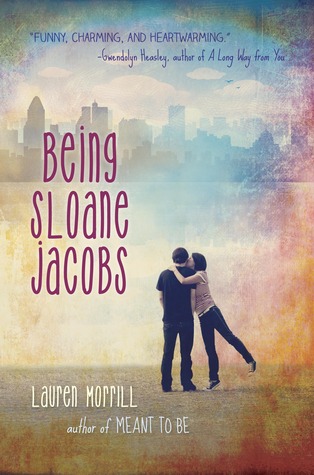
ARC Review: Being Sloane Jacobs by Lauren Morrill
Title: Being Sloane Jacobs
Author: Lauren Morrill
Rating: 2.5 Stars
Release Date: January 7th, 2014
If there is anything flawless about Being Sloane Jacobs it is its marketing campaign. Morrill has been launched as a chick-lit, contemporary romance author, akin to Stephanie Perkins, and while that isn't an altogether apt comparison (in my opinion), it isn't incorrect either. What I appreciate about this novel is that I knew what I was getting into even before I cracked open the cover: pure, mindless entertainment. Being Sloane Jacobs is the type of novel where you are forced to overlook the little details that fail to fit together, compelled to push aside the gaping plot holes that don't add up, and just read. For readers who were disappointed that novels like Just One Year promised endings that didn't happen, Being Sloane Jacobs is a relief, giving exactly what it says it will. For others, however, who anticipate the hidden depth in every novel, this story may just prove a little too juvenile, a lot too short, and a slight bit disappointing by the end.
Sadly, one of the best aspects of this story is its synopsis. Sloane Emily Jacobs, the daughter of a senator running for re-election, is a figure skater - one who desperately needs to re-launch her career after failing to perform well the past year. Sloane Devon Jacobs is an ice-hockey player - one with a bit of an anger management issue - who hasn't been playing her best lately. When the two Sloane Jacobs meet on their way to their respective figure skating and ice hockey summer programs, they decide to switch places. With similar builds and a desire to escape the mounting pressure they feel, Sloane Devon Jacobs goes off to figure skating camp while Sloane Emily Jacobs rushes off to play ice-hockey. As it turns out, however, running away doesn't solve your problems...not even close.
While the plot for this novel is similar to The Parent Trap, an important difference is the fact that these two Sloanes are running away from their lives. Not only do they belong to different social classes - rich and middle class - but their family issues are also vastly different. Yet, they find a thread of connection in their loneliness, fear, and inability to face their difficulties head-on. Needless to say, Morrill nails this issue in her sophomore novel, capturing the sinking feeling of despair and helplessness that so many teens feel. Where Being Sloane Jacobs faltered, however, was in the missed opportunity and lost potential for this concept to develop further. Both Sloanes, after a few initial difficulties, acclimate into their new lives with ease, making friends and learning their new sports with ease - a little unbelievable, don't you think? Moreover, they both find incredibly sweet love interests who - unfortunately - become a large part of the narrative.
With a plethora of issues at hand, this 352 page novel just didn't cover it all. Sloane Emily and Sloane Devon's growth is rushed and limited to the last few chapters, the development sloppy and lacking the layers of depth it could have had. Additionally, the guys these two girls fall for have their own share of problems which could have been explored to a larger degree as well. Mostly, however, the issue lies in the fact that Being Sloane Jacobs is far too much surface-story and too little depth. With alternating perspectives - that worked really well, surprisingly - Morrill could have easily focused this story on the inner dilemmas both these girls faced. Instead, there's unnecessary romantic drama, a large focus on proving these girls can master another sport, and a hasty epilogue that does little to the story as a whole. I wanted a novel about two girls who gained the courage to face their problems - and formed a tight friendship along the way - but the relationship these two Sloanes share lacks a true bond and the strength I wanted to emerge from these girls happened far too quickly, far too late.
Ultimately, I couldn't overlook the plot holes or missed opportunities in this narrative to enjoy the story within these pages. It is entertaining, certainly, and compulsively readable, forcing me to flip page after page even when I was bedridden and sick, but it lacks more than a little something to make it memorable. Both Sloanes are forgettable heroines, their journey unremarkable and childish, reading more like a middle grade comedy than a young adult contemporary piece. Being Sloane Jacobs will find its place among shelves of beloved readers - certainly - but it won't be replacing Anna and the French Kiss anytime soon on mine.
Friday, November 8, 2013
Series Review: October Daye (#1 - #3) by Seanan McGuire
Title: Rosemary and Rue (October Daye, #1)
Author: Seanan McGuire
Rating: 3 Stars
Rosemary and Rue is a promising start to what I can already see shaping up to be one of my favorite UF Series. From the beginning itself, McGuire's novel starts out differently from most other UF Series - with our protagonist being turned into a fish for fourteen years. Thus, when the book really kicks off, Toby Daye, our changeling heroine in question, is determined to avoid her past as a faerie knight and PI. What I really love about this set-up is that it allows us, the reader, to be newly introduced into this world all while assimilating right in the middle of Toby's life. McGuire writes superbly, imbibing her characters with depth and covering the back story - full of well-crafted world-building - perfectly too.
I was particularly surprised, however, by how quickly I came to enjoy Toby's narration. Usually, it takes me awhile to warm up to a new UF narrator, but with Toby, I seemed to merely fall into the story. Not only is she kick-ass - as you'd expect - but her vulnerability bleeds through as well, making her sharp feelings and conflicted emotions deeply felt. Moreover, her interactions with the secondary characters are filled with a past - which I always love - and has made me eager to see how these friendships - and not-so-friendly-relationships - develop in the future. If there are any true downfalls with this installment, it is that the middle lags - considerably. Rosemary and Rue is slow, as can be expected from Grant, but it does knock off the pace of the story until it finally picks up by the end. Nevertheless, this first edition to the October Daye Series leaves readers thirsting for more, both of Toby and her world. And, really, what more can an avid UF lover ask for?
Title: A Local Habitation (October Daye, #2)
Author: Seanan McGuire
Rating: 2.5 Stars
Title: An Artificial Night (October Daye, #3)
Author: Seanan McGuire
Rating: 2 Stars/DNF
I got through a little more than half of this novel before I realized, plain and simple, that I wasn't enjoying it. When it comes to the October Daye series, I go through a cycle, of sorts. First, there's the love phase, which is the first third of the book. McGuire sets up each novel perfectly, the mystery unique and intriguing, Toby's growth and relationships gripping...until the set-up is over and then comes the wait. McGuire has a tendency to drag out her stories, whether it be through a decreased pace or just an ignorance of in-your-face facts. During this phase of the books, Toby interacts with a variety of characters - none of whom I've come to feel much emotional attachment for - and the novel seems as if it will never end. Finally, during the last fifth of the book, the plot finally picks up, the story is wrapped up well, and Tybalt makes a final appearance.
It's Tybalt's appearance that screws me over every time. I feel the urge to pick up the next book and not give up on this series because of his presence, despite the fact that he is a rather underused character. I feel as if McGuire could develop so many more of these secondary characters, instead of keeping Toby the center - and only - true focus. More than that, however, the slow pacing of these books causes me to tune out, the repetitive settings and themes - particularly the fact that Toby isn't actually a hero - force me to grind my jaw in frustration and, ultimately, I don't have the patience to continue with this series anymore. I still believe it has a lot of potential and, I know for a fact, that many readers will really enjoy this. I prefer my Urban Fantasy fast-paced, emotional, and not quite a chore to read through, though. I know I'll be checking out McGuire's Indexing sometime soon, but my adventures with Toby (and sadly Tybalt too!) have come to an end.
Sunday, August 25, 2013
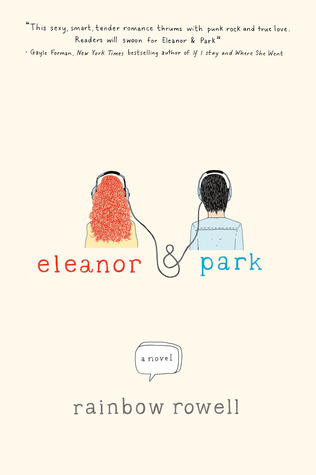
Review: Eleanor and Park by Rainbow Rowell
Title: Eleanor and Park
Author: Rainbow Rowell
Rating: 2.5 Stars
I sincerely hope no diabetic patients read this novel. Seriously.
Eleanor and Park is almost a sickly-sweet kind of romance. I
could feel myself cringing at the utter delight of it all: the gentle Asian
boy, the big red-headed girl who didn’t fit in, the slow hand-holding, the
chaste kisses, the Star Wars compliments, the cradle-the-phone-in-the-night
discussions, the endless question-and-answer sessions, and most of all, the
improbable romance of a poor girl who doesn’t even have a toothbrush and the
rich boy who has a room full of model airplanes and cassette tapes. Nevertheless,
despite the clichés in this novel and the almost dream-like quality of the
story itself, I found myself hard pressed to dislike this story.
Eleanor and Park is most definitely a love story I’m going
to forget within a few hours, but somehow Rainbow Rowell is an author I’m not.
If you haven’t already figured it out, this is the type of
novel that depicts what an almost perfect romance is like. Almost
perfect because despite the cheesiness of the dialogue and the cloying sweet
quality of the scenes in this, Eleanor and Park are both flawed and realistic
characters; to some extent. I found Rowell’s depiction of Eleanor, in
particular, to be gratifying. Not only is she “Big Red,” the girl who stands
out from the crowd because of her bright hair and big-boned body, but she’s
also the girl who isn’t afraid to speak her mind, who’s stunningly intelligent,
and whose sarcasm and wit manages to utterly charm Park. Furthermore, her
family situation – abusive stepdad, single mom with five children – makes her
all the more complicated. Some of my favorite scenes took place when Eleanor
was upset, too shaken to speak about her family or simply too embarrassed to
discuss her situation and background. Just the fact that she, with her mood
swings and clipped tones and limited discussion about her own life, caused a
few prickly thorns to spring up in her relationship with Park was more than
enough to add an extra layer to their nerdmance.
On the other hand, Park is a little too opposite Eleanor for
my liking. First and foremost, he is really sweet, slowly
developing his relationship with Eleanor from silence to comics to music and
inviting her over to his house practically every day. Park struggles, for
awhile, to accept Eleanor - all of her - especially because
he so wants his parents’ approval of his first real girlfriend and somehow isn’t
brave enough to fight for her completely. Thus, his progression as an
individual was well-written, as was his complicated relationship with his
father. I feel like father-son relationships are too easily dismissed in favor
of mother-daughter relationships, but I do think that the former is just as
important as the latter. Needless to say, I was impressed by the complicated,
but affectionate, stance Rowell took in portraying their bond.
Nevertheless, Park is a little too perfect for my liking.
Although he is an Asian – and feels insecure about that – there is no denying
that females are clamoring for his attention. Park walks into a music store and
the girl behind the counter is totally into him. His ex-girlfriend from when he
was twelve is still, somehow, after his affections. And yet
he feels like girls don’t like Asian boys. I do think his insecurities are
valid, but I never was able to connect with him on the same level as I was with
Eleanor. Moreover, his family is just too perfect. His
father comes home from work and makes out with his mother, irrespective of the
fact that they have two sons, have been married for years, and will likely have
time to do all that – and more – behind closed doors. Eleanor, on the other
hand, has a father who abandoned her, a stepdad who abuses her mother, four
other younger siblings, and can’t even afford a toothbrush. If you had to pick
two lives to place on opposite ends of a spectrum, these are it. And I guess
Rowell was trying – as most authors of romance are – that love
can bloom among even the unlikeliest of couples, but it seemed all too forced
and purposeful for me to appreciate.
Yet, my main issue with this novel was with Park’s mother. We
have a Korean bride who marries an American solider and comes home to live with
him right next door to his Irish parents. But, despite this, there is not a
drop of Korean culture in Park’s life. No Korean food, no Korean language, not
even a mention of his mother’s family back in Korea until much later in the
novel. I’m all for diversity in YA, but simply introducing an Asian character
for the sake of having an Asian character, especially without the messy dilemma
that dual-culture brings into the picture, grates on me. I’m an Asian myself
and I live in a community where 75% of my neighbors are Asian. Indian, Chinese,
Korean, Filipino, Japanese, Sri Lankan, Pakistani…you name it. We’re here. And
I get that Eleanor and Park takes place in a different time
period, but this Asian audience that Rowell is trying to reach? We
exist. Also? We’d like to be represented in YA. Accurately. For one,
the majority of Asians I know – myself included – have very close ties to their
family members overseas. Maybe there isn’t international phone calling by this
time in history – I don’t know – but wouldn’t Park’s mom try to ensure that her
children knew about her background? Doesn’t she know any traditional Korean
dishes? I find it so difficult to believe that she simply left behind
everything, including her own Korean culture and beliefs, to
assimilate to American life. With the exception of her accent, you’d never even
know she wasn’t born and bred in America . And for an Asian
character, that just isn’t right.
For all of that, though, there’s something about
Eleanor and Park that makes it hard to put down. Impossible,
really. I enjoyed reading about Eleanor and Park’s relationship, no matter how clichéd
it was. I loved seeing Eleanor battle her demons, inner and outer, and seeing
Park help her. Is their romance too good to be true? Yes. Are their
declarations of love, of missing each other over weekends, etc. just a little
too my-eyes-are-tired-of-rolling? Yes. I won’t deny that this book has its
flaws – plenty of them – but every once-in-awhile, I found myself forgetting
about them and just enjoying this fairy-tale romance. And, either way, I will
definitely be getting my hands on Attachments soon because,
no matter what I’ve said, Rainbow Rowell can write.
Tuesday, June 4, 2013
Review: Live Through This by Mindi Scott
Title: Live Through This
Author: Mindi Scott
Rating: 2.5 Stars
I have very mixed feelings when it comes to Live Through This, but my most overwhelming emotion is simply disappointment. There is no denying that Scott's sophomore novel is a struggle to get through, full of emotion and nuanced writing that truly brings to light the psychological horrors of abuse, but at the same time, it could have been so much more. When the novel begins, Coley experiences a shocking moment – one that she wishes she shared with a boyfriend instead of her abuser. It becomes very obvious that Coley’s abuser is someone very close to her, which makes her situation all the more complex. And yet, after this gripping scene, the next half of the novel is devoted to details of Coley’s every day life, from her dance practices to her blooming romance with a saxophone player, Reece, to a vacation she spends skiing.
For me, this is possibly the weakest part of the novel. While I appreciated that Scott took the pains to paint for us the image of a seemingly normal girl who hid the truth of abuse and later shattered her life with her continued abuse, I felt strangely detached from the tale. Quite simply put, Coley did not capture me. I felt sympathy for her and her difficult position, but not much else. Coley and her elder brother, Bryan, have always stuck together ever since their mother re-married and gave birth to triplets, but I could never understand why Coley and Bryan detested their step-father the way they did. As far as evil step-fathers go, Tony doesn’t even deserve to be on the list. It was small aspects of the story like this one that simply didn’t connect together for me and I found myself questioning Coley more than I did immersing myself in her tale.
And yet, I cannot deny that the manner in which Scott writes this story of abuse is raw and powerful. It is eerily frightening and honest, making this a novel that truly is for older readers. In addition to the carefully written plot line of abuse, though, I appreciated that Scott took the time to discuss sex and sexuality in this book, especially as it pertained to teenage girls. Instead of the classic sex discussion between girlfriends, Scott took it further to explore the idea that it is okay for girls to seek sexual pleasure – a concept that seems to elude most of YA and disappear amidst slut-shaming. Even the so-called “slut” or “anti-heroine” of this novel is explored in increasing depth, which increased my respect for this book immensely.
Live Through This honestly has a lot to offer to readers, but its abrupt ending left me wanting more. It wasn’t enough for me to read about Coley’s situation and her journey into accepting that it was wrong, despite the fact that she cared for her abuser; I wanted to see Coley deal with the after effects too, not to mention her abuser as well. Not only did I finish this book with too many questions, but as I mentioned before, many small plot points didn’t connect together for me in the cogent way I wanted them too. In some ways, I believe there is too much in this story, from abuse to friendship issues to jealousy to best-friend-who-is-a-boy-but-just-a-friend…somehow, all of this didn’t connect in the seamless manner I wished. Thus, while Live Through This manages to be an excellent novel in terms of exploring an abusive relationship, it isn’t the perfect or emotionally-gutting book I was expecting. If you’re up for a read that is most certainly very different, though, in a mostly good way, then Live Through This is definitely for you.
Monday, June 3, 2013
ARC Review: The Pirate's Wish by Cassandra Rose Clarke
Title: The Pirate's Wish (The Assassin's Curse, #2)
Author: Cassandra Rose Clarke
Rating: 2.5 Stars
Release Date: June 4th, 2013
It seems to be a trend this year that every series finale disappoints me, in one way or another. As such, it was probably foolish of me to expect any better from The Pirate's Wish, but I did. I had high expectations for this novel - very high expectations - and while I certainly enjoyed the quick read it provided, it isn't the memorable novel that its predecessor was. And, frankly, I think this conclusion could have been better - a lot better - but I suspect that those thoughts belong solely with me. If The Pirate's Wish hadn't resorted to using some of the classic trends I dislike, perhaps this novel would have worked out better for me. Perhaps.
The Pirate's Wish starts off directly where The Assassin's Curse ends with Ananna and Naji stranded on an island, waiting for their pirate friend, Marjani, to pick them up so they can somehow break the curse Naji is under. Within the first three chapters of this book itself, a few important events occur that more-or-less chart the course for this novel and, consequently, my enjoyment of it. First and foremost, Ananna finds and befriends a manticore, striking a deal to deliver her back to her homeland if she refuses to eat Ananna or Naji. While the friendship between this protagonist and mythical beast cannot rival those in other novels such as Stormdancer, it is a cute addition to the tale that I found myself greatly enjoying. It is then, though, that the manticore convinces Ananna to kiss Naji in his sleep, thereby fulfilling one of the three tasks they must complete. And Ananna does. And, at that point, all hell breaks loose.
What The Pirate's Wish has in plentifold is creativity, action, and drama. Clarke continues to amaze me when it comes to the sheer span of imagination she has. Like its predecessor, this installment continues to impress in terms of world-building, magic, and new faces and realms both. Additionally, with a crew of pirates, action is never far behind and, once again, I greatly enjoyed this feature. Yet, side-by-side with these is a rather heavy dose of drama. Ananna, from the beginning of this novel itself, is cast as a heroine facing unrequited love and, as such, her mood swings and feelings for Naji are constantly changing - enough to give me a headache. Although Ananna is still the headstrong heroine we fell in love with in The Assassin's Curse, she has a new, mopier side to her too that we now get to see. Yay. -.-
Quite honestly, Ananna is the sole reason I was so disappointed with this novel. Although I sympathize with Ananna's situation, I wish that her character could have grown from this event, not remained static. Ananna could have developed to be the type of protagonist who doesn't allow a small set-back to overturn her life, but unfortunately, that isn't the case. Ananna makes a big deal out of Naji not loving her back, constantly putting herself down and jumping to the conclusion that no man can ever love her. Furthermore, she resorts to childish behavior, ignoring Naji and taking every opportunity she has to flirt with other men in an effort to make him jealous. Not only is this a typical trend in literature, it's one I've grown exasperated with. All the more, I wish the purpose of The Pirate's Wish was to convey to readers that girls can be headstrong and find meaning in life from themselves or others around them, not men. While Ananna does have some very interesting conversations with Marjani (fine, one to be exact), none of this courage is exhibited through her actions and she relies on Naji to feel good about herself, all throughout the novel. Folks, I cannot tell you how much it physically pains me to see a bright, strong, and ambitious girl reliant on a man to feel happy. Physical. Pain.
Yet, Clarke continues to use very standard tropes when it comes to the romance in this novel. As a fantasy author, she relies on magic to mysteriously throw her characters together instead of conversation or character development. While there continues to be plenty of tension between Ananna and Naji, when you strip away the magic, all that's left are two vulnerable, shy people who lack the faith in themselves to approach one another. In fact, if this was a contemporary novel, Ananna and Naji wouldn't even have found love together. Without the element of magic in their lives to bind them and tell them what they can't tell each other, their story would fail to move forward. Granted, this is a fantasy series and as an author, Clarke has the full capability to do what she wants with her stories, but what this does for me as a reader is cheapen the actual relationship as it fails to build upon a foundation of friendship or conversation. If you'd ask me how invested I was in this relationship after The Assassin's Curse, my praise would likely know no stopping point but that excitement gradually declined over the course of this story. Without much conversation, this love story fell flat for me.
In fact, the best part about it was within the last chapter, but by then I'm afraid this book was too far gone to salvage my disappointed heart. Nevertheless, The Pirate's Curse is an action-packed follow-up novel that I am confident many readers will love. Unfortunately, I'm simply not one of them.
Friday, February 1, 2013
Review: Timekeeper by Alexandra Monir
Title: Timekeeper (Timeless, #2)
Author: Alexandra Monir
Rating: 2.5 Stars
When I give a book three stars, it simply means indifference; I enjoyed it, but ultimately, it is a forgettable read. Thus, I am unable to remember why I picked up Timekeeper in the first place when its predecessor, Timeless, was equally as unremarkable for me. I suspect it has something to do with that cliffhanger ending and possibly my thirst for more historical fiction in YA. Whatever it may be, I read Timekeeper in a matter of hours, skimming through this short story and enjoying it, knowing that fans ofTimeless would be more than pleased but also knowing that, unlike most, Monir hasn’t improved greatly as an author or a storyteller from her debut piece.
Timekeeper picks up directly where Timeless left off, with Philip Walker, the man Michele fell in love with decades ago, somehow finding a way back to Michele’s present-day existence. In an unlikely turn of events, however, Philip remembers nothing of Michele. Yet, as much as Michele desperately wants Philip to remember her, a new evil is on the horizon. A spirit from the past, one who holds a grudge against her and is responsible for all the wrong in Michele’s life, has made a new plan, one that will kill her, for Michele is the product of a human from the present and one from the past and really shouldn’t even exist in the first place. As Michele races against time – once again – and fights for her love, she comes to know about who she – and her father – really are and ultimately embrace her abilities as time traveler.
I have to give Monir props by making this duo one with such an interesting set-up. As an avid fan of Doctor Who, I love time travel stories and Timeless definitely wow-ed me in that sense. Its time travel theories were impeccable and the rich history of the Gilded Age that colored every page kept me riveted. WithTimekeeper, on the other hand, Michele doesn’t do as much time traveling as she does reading the pages of her father’s journal, coming to learn who he is and uncovering an organization dedicated to time travel. In my eyes, all these new rules and regulations that were put place by this time society took away from the thrill and excitement of the time travel element previously present in the novels. Furthermore, I found myself missing Michele’s actual adventures in the past and while her father’s voice through his diary entries was unique and recognizable, it wasn’t as riveting as it could have been, causing me to skim the pages quite a few times.
In addition to that, the romance element was dealt with in a very unique manner. Philip Walker, the new kid in Michele’s school, feels something for Michele, but he fails to remember their past. It was sweet to see them nearly fall back in love with one another, joined by their love for music, and while the semi-insta-love inTimeless clearly bothered me, I was less concerned about it in this story. I will say that the ultimate reason to explain Philip’s presence in Michele’s world is a little far-fetched, though believable. It requires a little suspension of belief, although it does make complete sense, so I was a little skeptical, but pleased, and the ultimate conclusion of this romance.
What make Timekeeper a novel that is forgettable, though, is that it builds up to an obvious confrontation with the villain, only to solve it with a small action that renders this novel practically pointless. If it was so easy to kill the villain, why not do it years ago when Michele’s life wasn’t in danger? Plus, the story ends off very neatly, but I would have liked something more to see how Michele dealt with her newfound responsibilities, not to mention the fact that her friendships which I so adored in the first novel took a backseat in this one. Timekeeper is a very short story, which is why I read it in the first place, but it really isn’t a series I’d completely recommend. It’s enjoyable, interesting, and the concept is intriguing, but more than that, this series unfortunately does not have to offer.
When I give a book three stars, it simply means indifference; I enjoyed it, but ultimately, it is a forgettable read. Thus, I am unable to remember why I picked up Timekeeper in the first place when its predecessor, Timeless, was equally as unremarkable for me. I suspect it has something to do with that cliffhanger ending and possibly my thirst for more historical fiction in YA. Whatever it may be, I read Timekeeper in a matter of hours, skimming through this short story and enjoying it, knowing that fans ofTimeless would be more than pleased but also knowing that, unlike most, Monir hasn’t improved greatly as an author or a storyteller from her debut piece.
Timekeeper picks up directly where Timeless left off, with Philip Walker, the man Michele fell in love with decades ago, somehow finding a way back to Michele’s present-day existence. In an unlikely turn of events, however, Philip remembers nothing of Michele. Yet, as much as Michele desperately wants Philip to remember her, a new evil is on the horizon. A spirit from the past, one who holds a grudge against her and is responsible for all the wrong in Michele’s life, has made a new plan, one that will kill her, for Michele is the product of a human from the present and one from the past and really shouldn’t even exist in the first place. As Michele races against time – once again – and fights for her love, she comes to know about who she – and her father – really are and ultimately embrace her abilities as time traveler.
I have to give Monir props by making this duo one with such an interesting set-up. As an avid fan of Doctor Who, I love time travel stories and Timeless definitely wow-ed me in that sense. Its time travel theories were impeccable and the rich history of the Gilded Age that colored every page kept me riveted. WithTimekeeper, on the other hand, Michele doesn’t do as much time traveling as she does reading the pages of her father’s journal, coming to learn who he is and uncovering an organization dedicated to time travel. In my eyes, all these new rules and regulations that were put place by this time society took away from the thrill and excitement of the time travel element previously present in the novels. Furthermore, I found myself missing Michele’s actual adventures in the past and while her father’s voice through his diary entries was unique and recognizable, it wasn’t as riveting as it could have been, causing me to skim the pages quite a few times.
In addition to that, the romance element was dealt with in a very unique manner. Philip Walker, the new kid in Michele’s school, feels something for Michele, but he fails to remember their past. It was sweet to see them nearly fall back in love with one another, joined by their love for music, and while the semi-insta-love inTimeless clearly bothered me, I was less concerned about it in this story. I will say that the ultimate reason to explain Philip’s presence in Michele’s world is a little far-fetched, though believable. It requires a little suspension of belief, although it does make complete sense, so I was a little skeptical, but pleased, and the ultimate conclusion of this romance.
What make Timekeeper a novel that is forgettable, though, is that it builds up to an obvious confrontation with the villain, only to solve it with a small action that renders this novel practically pointless. If it was so easy to kill the villain, why not do it years ago when Michele’s life wasn’t in danger? Plus, the story ends off very neatly, but I would have liked something more to see how Michele dealt with her newfound responsibilities, not to mention the fact that her friendships which I so adored in the first novel took a backseat in this one. Timekeeper is a very short story, which is why I read it in the first place, but it really isn’t a series I’d completely recommend. It’s enjoyable, interesting, and the concept is intriguing, but more than that, this series unfortunately does not have to offer.
Wednesday, January 9, 2013
Mini-Review: Plain Kate by Erin Bow
Title: Plain Kate
Author: Erin Bow
Rating: 2.5 Stars
Plain Kate is, quite honestly, just not the book for me. I know a countless number of my friends and most trusted reviewers have absolutely adored this tale, but despite being an ardent fantasy lover, I somehow could not get into it. Bow's debut follows the tale of Plain Kate, a tale of woe for every time something bad happens to her, something worse is waiting just around the corner. Kate is orphaned at a young age and after her father's age, she struggles to survive in their town where everyone believes she is a witch. When Linay, an evil albino wizard, comes to town, he offers her a wish and whatever provisions she may want in exchange for her shadow. Kate, not knowing the seriousness of this bargain, agrees, only to have her life take a turn for the worse - yet again.
While many readers found this story to be vastly intriguing, I thought it was rather boring. In fact, the first hundred or so pages can probably be skimmed entirely since nothing much happens. Furthermore, the writing that so captivated others rendered me unable to connect with any of the characters. It made me feel aloof and distant from the story itself and while beautiful to be sure, I didn't enjoy it and felt it didn't work well with the novel. Perhaps my biggest qualm, however, is Kate herself. Throughout the novel, Kate only becomes tougher and stronger, but her experiences never truly change her or make her orient herself and her life in different directions. In addition, as I mentioned before, I was unable to connect with her and feel much but sympathy for her life.
Overall, Plain Kate isn't a novel I can recommend, but it is one I advise any fantasy reader to give a chance. I am in the minority when it comes to this piece and can only hope that other readers love it unlike I have. Nevertheless, I will admit that if Erin Bow decides to write a young adult fantasy novel next, one that is a little more sophisticated and with older characters, I'll be itching to get my hands on it for sure. Bow is an author whose works I am bound to love - I can just feel it.
While many readers found this story to be vastly intriguing, I thought it was rather boring. In fact, the first hundred or so pages can probably be skimmed entirely since nothing much happens. Furthermore, the writing that so captivated others rendered me unable to connect with any of the characters. It made me feel aloof and distant from the story itself and while beautiful to be sure, I didn't enjoy it and felt it didn't work well with the novel. Perhaps my biggest qualm, however, is Kate herself. Throughout the novel, Kate only becomes tougher and stronger, but her experiences never truly change her or make her orient herself and her life in different directions. In addition, as I mentioned before, I was unable to connect with her and feel much but sympathy for her life.
Overall, Plain Kate isn't a novel I can recommend, but it is one I advise any fantasy reader to give a chance. I am in the minority when it comes to this piece and can only hope that other readers love it unlike I have. Nevertheless, I will admit that if Erin Bow decides to write a young adult fantasy novel next, one that is a little more sophisticated and with older characters, I'll be itching to get my hands on it for sure. Bow is an author whose works I am bound to love - I can just feel it.
Wednesday, November 28, 2012
Review: Flawed by Kate Avelynn
Title: Flawed
Author: Kate Avelynn
Rating: 2.5 Stars
You need to know straight off the bat that this is one of those reviews you should take with a grain of salt. I read Flawed just after finishing Juliet Marillier’s masterpiece, Daughter of the Forest , and you should know, that reading order did no wonders for this novel. While both novels are vastly dissimilar, they both contain protagonists who have suffered through difficult situations and while Sorcha, the compelling heroine of Marillier’s tale, managed to make me weep and feel with intensity every feeling she felt, I unfortunately can’t say the same about Sarah, the protagonist of Flawed. Furthermore, Flawed is a novel that left me confused. I was forced to simply think about this book when I was finished with it – just not in a good way. It didn’t compel me to question society and think deeply about the issues this book covered, it simply made me think about why the book ended the way it did and how I actually felt about it – two questions I’m still not sure I entirely have the answers to.
Flawed is one of the most perfectly names books I’ve come across. It is flawed, just as the characters and the lives they lead are as well. Flawed starts off immersing us into a world of horror, sadness, and misery. Sarah and her older brother, James, have grown up in an abusive household. Not only does their father repeatedly beat them, but their mother is a drug addict and as such, they have been forced to rely solely on one another as they’ve aged. At a young age itself, the two siblings made a pact: James would protect Sarah from their father’s beatings as long as Sarah promised never to leave him. While Sarah sees nothing harmful in this simple promise, the true repercussions of it are felt later on in her life as she begins to fall for Sam, the sweet-spoken and gentle friend of James. As James witnesses their romance blossoming, his own pent-up feelings for his sister – not-so brotherly ones, mind you – begin to come to the surface. In this flawed world, is there any real hope for Sarah?
No, there isn’t. I hate to say it, but this book ends on a note that leaves me angry, upset, and feeling like I wasted my time because, to put it bluntly, this is not a story of hope. It isn’t even realistic, which is usually the other option when we are faced with novels that don’t feature around a theme of hopefulness. I’m getting ahead of myself though – we’ll talk about the end at the end. Firstly, what you need to know is that Flawed is a surprisingly quick read. It’s short, its chapters are short, and it will have you turning the pages in anticipation. Sarah and Sam’s romance is sweet – if you’re into sweet. I, on the other hand, yearned for more substance from Sam. If you liked Zeke from The Immortal Rules or Jase from My Life Next Door, then chances are you’ll love Sam. Like Zeke and Jase, Sam is perfect - too perfect. For a novel named Flawed, Sam ironically has none, which, for me, makes him a romantic interest who was sweet, but nothing else.
Sam aside, Sarah was a compelling heroine. It was evident that she was torn, both between accepting her love for Sam and staying true to her promise to her brother. Sarah realizes that James’ feelings for her are not normal and while she keeps him at an arms length physically, she too realizes that she needs James just as much as he may need her. Unfortunately though, this is never further explored. We have on our hands an intriguing psychological situation of two siblings who are too close, all due to their circumstances, but we can never see the repercussions or true impact of this type of a relationship. It isn’t quite incest in the way Forbidden is – these two don’t love each other and they don’t struggle to want to be together. Instead, they rely on each other for support, but in an unhealthy manner. While I found this all very interesting, I was disappointed that this was never explored further.
What prevented this novel from progressing to the depths it could have gone to? Well…the ending. It was convenient. Avelynn creates raw, tortured, and different characters, but instead of dealing with them, we have a rather convenient ending that very abruptly ends the story. A cop-out? I believe so. I guess readers were meant to cry and scream at the injustice of this ending or feel terrible for our protagonist, but contrary to all that, I just felt a massive dose of disappointment. Now, contemporary isn’t my preferred genre, so perhaps I go into it expecting a little bit more to really “wow” me, but somehow, this book failed to deliver.
My personal qualms aside, as a piece of literature, I believe Flawed tackles on more than it can truly handle. We have an abusive father, a drug-addict mother, and two psychologically messed up siblings, one of whom is the victim of unrequited love with his own sister. Hmm…seems plenty complicated to me. Now, throw in a best friend romance, a protective older brother, lots of sneaking out to make-out, and some issues concerning sex and we literally have two books on our hands, only they’re smashed into one and the issues concerning both fail to be developed to their full potential or degree.
All in all, I can’t say I really recommend Flawed. On the other hand, it was a novel that kept me entertained, captivated, and I enjoyed it a lot while reading it, but the overall impression it left with me was one of disappointment. I feel as if this novel could have been so much more and truly had the potential to resonate with the reader, but alas, I know this is one I’ll be forgetting easily. Yet, it seems as if I am – as I usually am, really – a black sheep when it comes to this novel. In fact, the majority of preliminary reviewers have loved this one and if you’re a fan of contemporary, issue books, or very sweet romances, you won’t be disappointed. If, however, contemporary isn’t your usual cup of tea, you only pick up issue books with severe persuasion, and you need your romances to have a little more, you may want to look elsewhere.
Sunday, October 21, 2012
Review: Night Beach by Kirsty Eagar
Title: Night Beach
Author: Kirsty Eagar
Rating: 2.5 Stars
I read this book with Jasprit from The Reader's Den for a read-along and honestly, if it hadn't been for the fact that I had to read three chapters every day, I would have given up on this one a looooong time ago. Night Beach is, in many ways, the perfect October read. It opens up with an interesting premise and there are more than a few hair-raising events within the first couple of chapters to keep your attention and leave you hanging on the edge of your seat but unfortunately, that's all Night Beach does. You see, there's such a thing in a book called a plot and a purpose and while Night Beach built up to what seemed to be an intriguing pinnacle, it was ultimately the most anti-climatic peak I've come across and from there on out, Night Beach just lost me.
Night Beach opens up by introducing us to Abby, our protagonist, who is hopelessly in love with her cousin, Kane. When Kane returns from a trip to an island, he is more different than usual. Not only does he exhibit strange, aggressive forms of behavior, but there seems to be a shadow following him. Abby, who is obsessed with Kane herself, cannot help but be worried about him. Yet, as time wears on, Abby will come to realize that there's more to stake here than Kane himself and moreover, that the "shadow" she sees near Kane is more than just a shadow...
Eagar's novel is written beautifully and if you're a fan of gothic literature, you'll definitely find something to love here. If, however, you prefer gothic literature similar to Jane Eyre where we have a mystery, plenty of red herrings, clues, and scary events, but eventually are told little tidbits to keep us going, then this isn't for you. Night Beach gives you a mystery. It gives you scary event after scary event. What it doesn't offer you, until the last quarter of this book really, is any type of clue, or hint, or tidbit to keep you going. I can essentially equate it to walking in a dark tunnel, not knowing where the tunnel ends or even if there's a light at the end of it; all you know is that you're lost, confused, and have no idea what's going on.
In addition to the lack of a plot - because I don't know how else to describe this! - the characters were unfortunately extremely flat too. Our main character, Abbie, only finally gains some depth and connection with the reader over half-way through the book and I am still no closer to understanding Kane than I was when I first picked up this book. In fact, I'd go so far as to say that people such as Abbie's friends, surfers, and even neighbors were more fleshed-out and easy to connect with than the main characters themselves, so that felt more than a little disjointed for sure.
Night Beach was a book I really wanted to like, but ultimately I couldn't summon up much feeling for it. It started out well enough, but leaving me confused for dozens of chapters is not the way to make me appreciate a novel. If anything, I wish the majority of the middle of this book had simply been condensed into a few chapters, allowing me to experience more of the mystery and less of the build-up. Furthermore, the ending was just...I don't even know. It left me confused just when I thought I had everything figured out and while I'm sure it serves as a deeper meaning for something I'm missing - because in many ways this entire novels feels like one giant metaphor - I don't feel as if I'm losing out on much by not understanding it. I've read other books that have tackled on the eventual subject in this book better, and as such, Night Beach was just not the book for me.
Quick Note: I sincerely hope this review doesn't put anyone off of reading Kirsty Eagar's novels. I adore her writing and Raw Blue is one of my favorite books ever, so I really can't recommend it enough. Read. It. Now. Seriously. You won't regret it. :)
Monday, October 15, 2012
Review: Stealing Parker by Miranda Kenneally
Title: Stealing Parker
Author: Miranda Kenneally
Rating: 2.5 Stars
Stealing Parker is, logistically speaking, not a bad book. In fact, I have an immense amount of respect for Miranda Kenneally for tackling on real-life, modern-day issues such as lesbian parents, gay friends, and even student-teacher relationships. Yet, I found myself to be sorely disappointed by this one. While I will admit that Catching Jordan had its flaws, mostly stemming from its dramaticism, it never altered by enjoyment and emotional investment of the novel. Stealing Parker, on the other hand, make me increasingly uncomfortable, leaving me with a sour taste in my mouth at the way many of the situations in it were handled and ultimately yearning for more closure.
When Parker's mother comes out about being a lesbian, divorcing her father and leaving her family to live with her best friend, Parker's life is turned upside down. Not only is she confused, torn, and upset that her mother has abandoned her, but the church which is such a huge part of her life has turned against Parker and her family, publicly ostracizing them. Furthermore, Parker must now leave behind her good-girl image to prove that unlike her mother, she isn't a lesbian, and as she begins to earn a not-so-good reputation, she also quits playing softball, the sport whose love she shared with her mother. Thus, when a hot new baseball coach comes into the picture, Parker can't help but want more - even if it's from a teacher. In the middle of this mix is her growing friendship with ex-valedictorian-rival, Will, more commonly known as Corndog, and her emerging suspicions about her gay best friend. Now, Parker must struggle to come to terms with what happened to her family, her passion for softball, and ultimately, what's really the right thing to do.
I think the premises of Stealing Parker is fascinating, and honestly, I wish Kenneally had simply stuck with it. We don't have many contemporary novels taking on lesbian mothers and the impact that that situation has on a family, so I was looking forward to reading this one. Unfortunately, however, while Parker's mother is a huge part of this novel and Parker's life, an equally large portion is Parker's student-teacher relationship with Coach Brian Hoffmann. In all honesty, I felt uncomfortable reading about their relationship, simply because of the subject matter, but more than that, I wasn't a fan of the way in which it was handled. I feel as if student-teacher relationships stem from issues in both the student and the teacher's life and while I definitely understood Parker, I didn't quite come to understand Brian the same way. Furthermore, the ultimate conclusion to this relationship wasn't what I was hoping for in terms of punishment and my biggest qualm has to lie with the fact that this relationship took away from many of the other qualities that Stealing Parkerhad going for it.
You see, Parker's student-teacher relationship took time out of her friendship with Corndog, which I wanted to see more of, her rocky relationship with her father and brother, which I wished had more depth, and even her own tangled feelings towards her mother. While I did appreciate that Kenneally touched upon all these issues, I wanted more. I didn't feel as if a student-teacher relationship was necessary to drive the point about this novel home and towards the end, it felt as if things came together a little too easily, simply because their complex plot threads couldn't be further explored because the student-teacher relationship exhausted practically everything else. Thus, while I found myself enjoying the story of Parker's growth and her very cute romance with Corndog, I wasn't completely satisfied with it by the end of this novel. (Or the lingering questions about Parker's church, friendships, brother, or her father's potential girlfriend for that matter...)
Alll of that aside, Stealing Parker is still a novel I enjoyed reading. It was a quick-read, although not a read-in-one-sitting novel likeCatching Jordan, but it kept my interest and my eagerness for Kenneally's next contemporary novel is still present. I have a feeling that fans of contemporary novels will adore this one and for someone like me, who always looks for something more in a story and for whom contemporary is not a favorite genre, this is simply bound to be another "black sheep" read. Nevertheless, if you're looking for another character to connect with, another sports-oriented novel to pick up, or just another story with fantastic friendships, Stealing Parker is, without a doubt, the book for you.
When Parker's mother comes out about being a lesbian, divorcing her father and leaving her family to live with her best friend, Parker's life is turned upside down. Not only is she confused, torn, and upset that her mother has abandoned her, but the church which is such a huge part of her life has turned against Parker and her family, publicly ostracizing them. Furthermore, Parker must now leave behind her good-girl image to prove that unlike her mother, she isn't a lesbian, and as she begins to earn a not-so-good reputation, she also quits playing softball, the sport whose love she shared with her mother. Thus, when a hot new baseball coach comes into the picture, Parker can't help but want more - even if it's from a teacher. In the middle of this mix is her growing friendship with ex-valedictorian-rival, Will, more commonly known as Corndog, and her emerging suspicions about her gay best friend. Now, Parker must struggle to come to terms with what happened to her family, her passion for softball, and ultimately, what's really the right thing to do.
I think the premises of Stealing Parker is fascinating, and honestly, I wish Kenneally had simply stuck with it. We don't have many contemporary novels taking on lesbian mothers and the impact that that situation has on a family, so I was looking forward to reading this one. Unfortunately, however, while Parker's mother is a huge part of this novel and Parker's life, an equally large portion is Parker's student-teacher relationship with Coach Brian Hoffmann. In all honesty, I felt uncomfortable reading about their relationship, simply because of the subject matter, but more than that, I wasn't a fan of the way in which it was handled. I feel as if student-teacher relationships stem from issues in both the student and the teacher's life and while I definitely understood Parker, I didn't quite come to understand Brian the same way. Furthermore, the ultimate conclusion to this relationship wasn't what I was hoping for in terms of punishment and my biggest qualm has to lie with the fact that this relationship took away from many of the other qualities that Stealing Parkerhad going for it.
You see, Parker's student-teacher relationship took time out of her friendship with Corndog, which I wanted to see more of, her rocky relationship with her father and brother, which I wished had more depth, and even her own tangled feelings towards her mother. While I did appreciate that Kenneally touched upon all these issues, I wanted more. I didn't feel as if a student-teacher relationship was necessary to drive the point about this novel home and towards the end, it felt as if things came together a little too easily, simply because their complex plot threads couldn't be further explored because the student-teacher relationship exhausted practically everything else. Thus, while I found myself enjoying the story of Parker's growth and her very cute romance with Corndog, I wasn't completely satisfied with it by the end of this novel. (Or the lingering questions about Parker's church, friendships, brother, or her father's potential girlfriend for that matter...)
Alll of that aside, Stealing Parker is still a novel I enjoyed reading. It was a quick-read, although not a read-in-one-sitting novel likeCatching Jordan, but it kept my interest and my eagerness for Kenneally's next contemporary novel is still present. I have a feeling that fans of contemporary novels will adore this one and for someone like me, who always looks for something more in a story and for whom contemporary is not a favorite genre, this is simply bound to be another "black sheep" read. Nevertheless, if you're looking for another character to connect with, another sports-oriented novel to pick up, or just another story with fantastic friendships, Stealing Parker is, without a doubt, the book for you.
Tuesday, September 25, 2012
Mini Reviews: Shatter Me and Defiance
Well, I'm back with some more mini-reviews! I only have two this time, so they're slightly longer than usual (at least Defiance is), but I hope you'll bear with me. Someday, I will master the true art of writing actual mini-reviews!
Title: Shatter Me (Shatter Me, #1)
I guess this novel just wasn't for me. I read a lot of reviews before picking it up and from what other reviewers have told me since I began, I think I'm better off spending my time on something else. Yet, I do sincerely believe that plenty of other readers will fall in love with this series, so I'd encourage you to check out some other reviews, read a couple of chapters, and give it a try yourself. So much of this novel is based purely on personal preferences and opinions, so if you're a romance fan, this is definitely one for you.
Title: Defiance (Defiance, #1)
Overall, this story just lacked a lot. It lacked world-building, it lacked feeling, it lacked character depth and it now also lacks my stamp of approval. Defiance is a novel I know a lot of people will love and it’s honestly not that bad, but if you’re someone like me who has read fantasy novels on the levels of Melina Marchetta, Meghan Whalen Turner, Kristin Cashore, and Juliet Marillier, I’m afraid that this is going to be one giant bowl of disappointment.
Title: Shatter Me (Shatter Me, #1)
Author: Tahereh Mafi
Rating: 2 Stars/DNF
Juliette hasn’t touched anyone in exactly 264 days. The last time she did, it was an accident, but The Reestablishment locked her up for murder. No one knows why Juliette’s touch is fatal. As long as she doesn’t hurt anyone else, no one really cares. The world is too busy crumbling to pieces to pay attention to a 17-year-old girl. Diseases are destroying the population, food is hard to find, birds don’t fly anymore, and the clouds are the wrong color. The Reestablishment said their way was the only way to fix things, so they threw Juliette in a cell. Now so many people are dead that the survivors are whispering war– and The Reestablishment has changed its mind. Maybe Juliette is more than a tortured soul stuffed into a poisonous body. Maybe she’s exactly what they need right now. Juliette has to make a choice: Be a weapon. Or be a warrior.
I think this book will work out for a lot of people - I really do. I even understand what the author was trying to accomplish with this - a novel that has a character-driven plot with a protagonist who is coming to terms with herself, her power, and her love. I get it, I really do, but I just can't bring myself to care.
First and foremost, reading books like this is hell. So is reading books written like this. If that wasn't enough to throw you off, I wasn't a fan of the writing style/narration in general. It was extravagently flowery, with poetic language and metaphors that didn't seem to make much sense either. I enjoyed the overly descriptive language in novels such as Daughter of Smoke and Bone, The Scorpio Races, and even Stormdancer, but it somehow didn't work for me in this one. Plus, just like how Throne of Glass was a romance novel parading around as a kick-ass assassin story, Shatter Me is a romance novel parading around as a kick-ass dystopian story. I wasn't impressed with the insta-love/lust in this, I wasn't impressed with the MC, I wasn't impressed with the lack of world-building, and I wasn't a big fan of the plot either. If anything, this book just reminded me of Article 5, a novel that I would, very much, like to forget.
I guess this novel just wasn't for me. I read a lot of reviews before picking it up and from what other reviewers have told me since I began, I think I'm better off spending my time on something else. Yet, I do sincerely believe that plenty of other readers will fall in love with this series, so I'd encourage you to check out some other reviews, read a couple of chapters, and give it a try yourself. So much of this novel is based purely on personal preferences and opinions, so if you're a romance fan, this is definitely one for you.
Title: Defiance (Defiance, #1)
Author: C.J. Redwine
Rating: 2.5 Stars
Within the walls of Baalboden, beneath the shadow of the city’s brutal leader, Rachel Adams has a secret. While other girls sew dresses, host dinner parties, and obey their male Protectors, Rachel knows how to survive in the wilderness and deftly wield a sword. When her father, Jared, fails to return from a courier mission and is declared dead, the Commander assigns Rachel a new Protector, her father’s apprentice, Logan—the same boy Rachel declared her love for two years ago, and the same boy who handed her heart right back to her. Left with nothing but fierce belief in her father’s survival, Rachel decides to escape and find him herself. But treason against the Commander carries a heavy price, and what awaits her in the Wasteland could destroy her. At nineteen, Logan McEntire is many things. Orphan. Outcast. Inventor. As apprentice to the city’s top courier, Logan is focused on learning his trade so he can escape the tyranny of Baalboden. But his plan never included being responsible for his mentor’s impulsive daughter. Logan is determined to protect her, but when his escape plan goes wrong and Rachel pays the price, he realizes he has more at stake than disappointing Jared. As Rachel and Logan battle their way through the Wasteland, stalked by a monster that can’t be killed and an army of assassins out for blood, they discover romance, heartbreak, and a truth that will incite a war decades in the making.
If I had to describe Defiance in one word, it would be ‘forgettable.’ Like so many books before it, Defiance has all the right ingredients to be an incredible novel, from its heart-stopping cover to its kick-ass heroine to its intriguing plot, but somehow, it just didn't work for me. I went into this novel with low expectations, simply because so many trusted reviewers had given this a low rating, and I absolutely have to agree with them. Defiance , far from being a defiant cry about the re-emerging fantasy genre in YA Fiction, has only made me extremely wary of it.
For those of you who know me well, you’ll know that two things make-or-break my opinion of a novel – its characters and the world-building. Rachel and Logan, while proving to be intriguing characters from the surface, are truly quite flat. First and foremost, it should be known that their dual narration was very poorly written and if it were not for their names appearing before every chapter, I would not be able to tell them apart. Both of them lacked any true ‘voice’ which was quite disappointing. Over and above that though, Rachel came across as petulant and whiny more than kick-ass and Logan , for all his romantic moments, was also controlling and seemed to look down upon Rachel from time-to-time. Yet, what really sealed the deal was the fact that I simply wasn’t able to care for these two. In this novel, both Rachel and Logan go through dire circumstances, experience piercing grief, and come out stronger for it and while I read about all this happening to their character, I didn’t really feel any of it and was strangely withdrawn from this novel the entire time I read it. Even the romance, which I loved because of its slow build-up and interesting twists, was something I didn’t care for because it was the love story of Rachel and Logan. If you had inserted two different characters into this equation, I guarantee you that I would have been completely invested in it, especially as the story arc for it was so well-done.
Yet, even beyond the characters, what defines Defiance is its genre: fantasy. There is one thing, and one thing alone, which defines a novel as fantasy and that is world-building. Strangely enough though, I still know nothing about the world of Defiance ! I read in another review that this was a futuristic realm where man had dug down so deep that they had awoken a beast, The Cursed One, who terrorized the people in this story, but this book could just as easily have been set in a fantasy realm or on another planet for all I know! It was simply very confusing and to add to that, the plot didn’t engage me in the least. It was fast-paced, but I found myself skimming through multiple chapters and I couldn’t feel the desperation of these people at all. It’s a horrible situation for sure, but the villain just made me feel like laughing with his clichéd plans and I really couldn’t summon up much feeling for this story even though I truly wanted to.
Subscribe to:
Posts (Atom)