Saturday, August 9, 2014

Review: Something Real by Heather Demetrios


Title: Something Real 

Author: Heather Demetrios

Rating: 4 Stars

As someone who turns on the television maybe five times a year--for the Australian Open, French Open, Wimbledon, U.S. Open, and ABC Family's 25 Days of Christmas--I couldn't adequately understand the hype over Something Real. I've never watched a reality TV show--not unless you count Food Network's "Chopped"--and was ignorant of the existence of "Honey Boo Boo" and "Dance Moms" until very recently. I may be young, but I really do live under a bookshelf. Needless to say, Something Real flew over my head, though not under my radar, until I read and loved Demetrios's sophomore novel, Exquisite Captive.

I'll admit it--the hype is right. For once. Something Real is a surprisingly poignant, emotional, and realistic debut. From the beginning itself, it's impossible to feel distant from the story at hand as Chloe's life is a tragic joke. Beth and Andrew Baker, once poor high school sweethearts with a dream of parenting a Baker's Dozen--or thirteen children--had their lives changed when MetaReel, a reality TV channel, decided to make their hopes a reality. For the first thirteen years of her childhood, Chloe's life has been documented on television--from her birth to her first steps to her medical overdose which put the show on hiatus for four years. Now seventeen, Chloe is finally living a normal life--friends, a potential boyfriend, and actual high school. But when she realizes her mother has signed up the family for another season of "Baker's Dozen", forcing Chloe back to her television persona of Bonnie and a life on camera, Chloe simply cannot deal. 

What I find shockingly depressing about "Baker's Dozen" is the viewer reaction to the show. Beth Baker is a role model of The Perfect Mother. Not only does she seamlessly run a household with thirteen children, but she has survived the infidelity of her husband and lived to find love again, marrying Kirk. Although Beth knows Chloe and her older brother, Benny, aren't eager to be back on "Baker's Dozen," she is forced to seek employment with MetaReel due to financial reasons. Chloe's reaction to "Baker's Dozen" immediately forces her into our hearts and her volatile relationship with the camera, her mother, and even her older sister Lex who loves being on television, are all so beautifully written. Demtrios creates nuanced familial relationships with so much depth, whether it be Chloe and Benny's easy sibling friendship or even Chloe and Lex's difficult sibling rivalry, both these sibling relationships of different natures are impossible to label or explain because they are multi-layered. Admittedly, I did find it difficult to condone many of Beth's actions, particularly towards the end of the novel, but I suppose a mother with thirteen children truly may react in the manner she does--I'll never know. 

Something Real is all-the-more endearing not for its reality television plot, but rather for Chloe's struggles to lead a normal life despite it all. Whether it be her tight friendship with her high school friends--who are seriously amazing friends--or her blooming romance with Patrick, the cute guy who sits behind her in government class, Chloe's internal battle to remain true to herself in the face of media dramatics is admirable. Chloe and Patrick's romance is a cornerstone of support throughout the difficult experiences Chloe undergoes. Of course, I found it far too perfect, but in Demetrios's defense it certainly made sense to write an easy, uncomplicated romance when so many other plot threads were complex. (Plus, if you want complicated romance from Demetrios just pick up Exquisite Captive--the gray matter is there in spades!) 

One of my favorite aspects of the tale, though, were the snippets from magazines, newspapers, or simply scripts from older "Baker's Dozen" episodes that are littered at the close of every chapter in Something Real. Demetrios brings her story alive by giving it a wider audience--paparazzi, scientists who study the psychological ramifications of reality television, etc.--and I loved this tactical decision. For me, it brought the effects of this story home in a truly impactful manner. Something Real isn't an altogether perfect debut novel, but then again, whose debut is perfect? Demetrios has written a thought-provoking piece, one ideal for the young adult genre as it forces readers to reflect on their exposure to media and the manner in which it shapes their lives. Moreover, this novel--lightly--touches upon difficult futuristic decisions, hinting at New Adult themes, which I further appreciated. I, for one, would love a New Adult follow-up novel, perhaps from the perspective of a different character. We won't be getting one, I don't think, but a girl can certainly dream, yes? 

Wednesday, August 6, 2014

On Old Hollywood, YA, and Love Triangles...

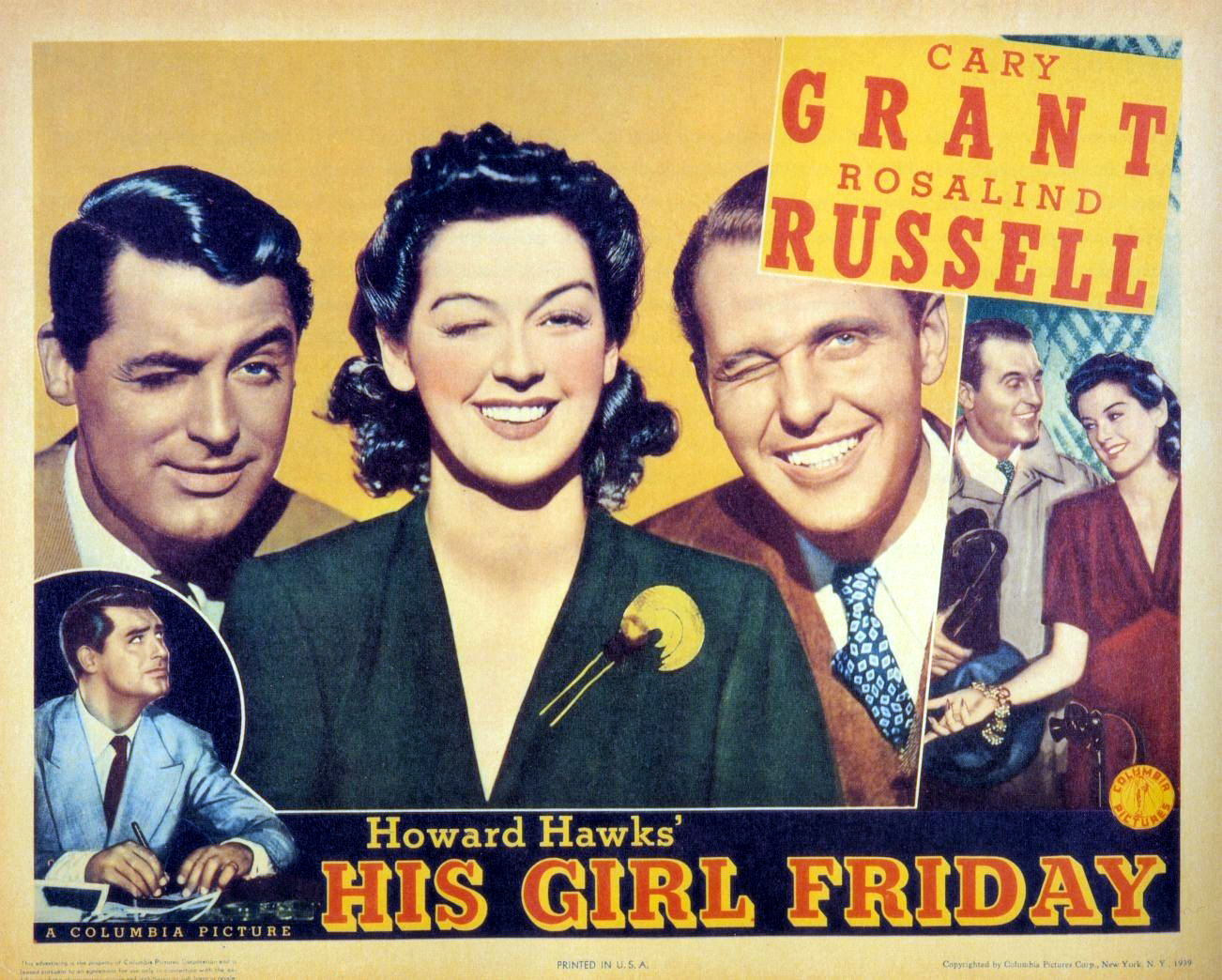
I spent my weekend with Cary Grant. After watching The Philadelphia Story, His Girl Friday, and Notorious in back-to-back succession I sent Lauren @ Love is Not a Triangle the following tweet:
And after that, I just couldn't stop thinking about these films. Why was it that these love triangles on screen translated so poignantly? I despise even the slightest hint of a love triangle in literature--and I usually despise love triangles in films too--but Old Hollywood just nailed it! ...how? 

I've found that all three of these films do, in some form or the other, contain a love triangle. During Grant's era of Hollywood, "screwball" comedies were all the rage; usually involving intriguing insight into the gap between the social classes, hilarious scenes, and romances in which a divorced (or about-to-be-divorced) husband and wife couple fell back in love together. Needless to say, this romantic set-up practically calls for a love triangle and His Girl Friday represents a quintessential scenario: Grant is still very much in love with his recently divorced wife who is engaged to another man and in order to break apart their engagement, he resorts to a series of hilarious events all while showing her just how integral both he and the journalism business are to her lifestyle. It is primarily a social commentary on journalism, with comedic tid-bits and an underplayed romance, which is I why I hesitate to label it as a love triangle. You don't feel the tension between the contenders for the heroine's heart--and in this case, that's perfectly fine. His Girl Friday isn't meant to be nearly quite that dark and as a "screwball" comedy, it's certainly worth the watch. 

The Philadelphia Story, on the other hand, yet another "screwball" comedy, is a film I fell in love with. Katharine Hepburn plays the role of a rich society heiress about to marry a self-made man whose rise to wealth and politics is admirable. Grant, her ex-husband, returns after two years in South America to attend Hepburn's wedding--bringing with him two newspaper reporters to cover the event. Now, the intricate details behind this set-up are ones I'll leave for the movie reviewers to explain but the film, featuring James Stewart as one of the newspaper reporters, engages in a truly captivating love triangle. In an early scene in the film Hepburn is told by Grant that she is a goddess; cool, aloof, and in a station above all others. Next, she is told by her current fiance that he worships her--even when she tells him that she wants to be loved, not worshiped. Lastly, her own father tells her that she is made of bronze--once again re-iterating the theme that both her ex-husband and future-husband have mentioned.


Critics will tell you that The Philadelphia Story was a breakthrough film for Hepburn and, seeing her performance, it isn't hard to see why. She nails the self-righteous, independent Tracy in such a manner that we come to perfectly understand the goddess-like image she holds for Grant while also viewing the flesh-and-blood human she is underneath. Stewart, a newspaper reporter whose station in life is far below that of Hepburn's in the film, becomes fascinated by the rich woman when Hepburn reads and appreciates his novel. At first, the two strike an easy friendship--Stewart never sees the sharp edges of Hepburn's character that the men who know her most intimately do see--but their affection blossoms quickly into a romance. It's that moment--when I found myself on the edge of my seat, utterly distraught over the fact that Hepburn might wind up with Stewart and not Grant--that I even realized there was a love triangle at play here. 

Yet, the reason The Philadelphia Story works is because the film's focus is firmly on Hepburn's character. Each of the men in her life, just days before her wedding, begin to show her what she truly wants, not only from a life partner but from her own existence as well. Whether it be her fiance, who is riveted by Tracy's status more than he is by her, or James Stewart, who feeds her pride without understanding her world view, or even Cary Grant, who sees her for the woman she is and finds it in himself to forgive her--but still love her despite it all--the love triangle in The Philadelphia Story makes the tale all-the-more rewarding. What's more, Stewart is Grant's best man by the end of the film when Hepburn and Grant re-marry, neatly avoiding the angst and drama that seems to accompany any literary love triangle. Moreover, the subtle threads binding them all to one another are never spelled out, the way they seem to be in modern-day romantic comedies with the hero confessing "I love you. I forgive you. I can't live without you...marry me!" in a melodramatic manner. Instead, the leap from seemingly distant to true passion lies in the undercurrents of conversation and is up to the movie-goer to watch, interpret, and process. 

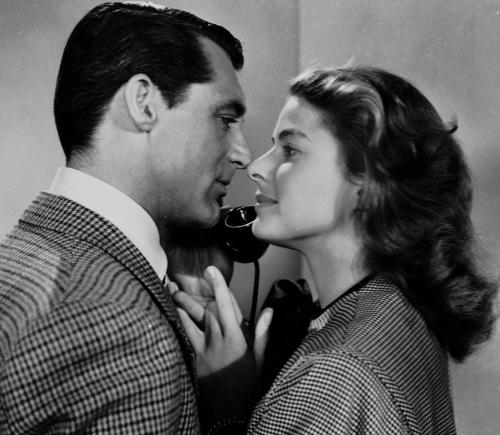
Hitchcock's Notorious is a far cry from "screwball" comedy and, instead, serves to place Grant in a much darker role. Grant, taking on the role of American agent Devlin, hires Alicia, played by Ingrid Bergman, as an American spy. Although Alicia's father has recently been arrested for treason, having worked as a German spy during WWII, Alicia herself is loyally American. Yet, following her father's sentence, Alicia drinks, parties, and conducts improper behavior with men. Devlin, upon first meeting her, is both enchanted by her beauty and repulsed by her actions. After hiring her, however, the two fall in love in Rio. In Rio, Devlin learns that Alicia's assignment is to seduce Sebastian, a German, and infiltrate his network. Alicia's duty throws a wedge in their romance and as Alicia eventually marries Sebastian, neither she nor Devlin profess their true love for another. 

It's a tragic love story, acutely felt as Devlin and Alicia are their own hurdles. Devlin, spurning Alicia for taking on the job, and then Alicia, taunting Devlin as she is "with" another man. It isn't an easy film to watch, precisely because of the acerbic quality of their interactions at times, but the talent with which the movie is shot and the quality of the acting is unparalleled. Sebastian, who serves as the third wheel in this love triangle, is ironically the better of Alicia's two options. Not only is he madly in love with her, but he defies his mother by marrying her, fighting her at every instance in order to give Alicia reign over his household and shower her with every luxury. Moreover, he never once doubts that she may be marrying him for his money or his contacts; he simply believes in her. In contrast, Devlin hears of Alicia's task and assumes that her promiscuous past leads her to take the job. Bergman's famous line--"You don't think a woman can change?"--essentially drives forward the entire broken romance. Devlin cannot trust himself--or Alicia--after such a brutal war and Alicia, who needs to be seen for who she is, opposed to her past, similarly won't settle for a man who sees her as the sum of her sins the way Devlin does. 

What I love most about this film, and its love triangle, is that Sebastian's presence drives forward the entire plot. Notorious is, at its heart, a love story and the spy plot threads serve as a mere backdrop. It certainly amps up the tension and allows for brilliant cinematic shots, but the true tale to be told is the one between Devlin and Alicia. As Alicia grows from a "lush" to a courageous woman; as Devlin learns to shed his veneer of cynicism and finally allow himself to love Alicia, especially when that means leaving the shadows he knows--the love triangle, once again, focuses on the characters. 

I find that in YA or NA, a "bad boy" persona such as Devlin's would be explained away by a tragic past--perhaps his parents perished in war, his brother was deported to a foreign land, etc.--but Hitchcock allows us to become so embroiled in the love story he tells that such extraneous information is never necessary. I found myself inching closer and closer to the television screen as the film noir played on and, by the end, I wanted to hit rewind and live in the bubble of suspense, thrill, and romantic tension that Hitchcock had built. 

From seeing and analyzing these two classics, it is evident that where Young Adult falters is in its molds. Whether it be the mold of a trilogy--which forces authors to add tension where otherwise unnecessary--or the mold of genre, these qualities spell disaster for love triangles, authors, and readers alike. We most often see love triangles emerge in dystopian or fantasy settings and, quite simply put, the romantic entanglements take away from the world-building and plot tension at hand. We, as readers, find ourselves anticipating sequels not to see where the plot is going but rather to see who the heroine winds up with. Moreover, these literary love triangles destroy the female protagonist, putting her in such a position that she acts out in silly, un-admirable ways. 

Yet, Bergman and Hepburn's characters in these Old Hollywood films are classic, touching, and poignant. We feel for them, we understand their situation, and we root for them, by the end, Grant's handsome face be damned. (I take that back, I love you Cary Grant!) 

Lauren sent me the tweet on the right, responding to my tweet above and remarking that love triangles in films just weren't as difficult to deal with. Admittedly, she is right. Not only are love triangles in movies limited by time, but they also don't feature cliffhangers or sequels. Instead, the tension is maintained for a bearable amount. It doesn't drag for hundreds of pages, it doesn't linger in our minds for a year, it doesn't re-emerge for another hundred pages, only to ferment in our minds for another year, before we finally gain closure. It just doesn't happen with a movie and the two mediums, vastly different, are that way for a reason. 

Certainly Notorious, if it were ever to be immortalized by the written word, would lose much of its sinister appeal and impeccable atmosphere (not to mention Cary Grant's gorgeous face!). Nevertheless, I firmly believe that the decisive choice to include a love triangle in a certain work, whether it be cinematic or literary, is one that must be made after considerable thought--and Old Hollywood somehow has me wanting to see more love triangles, not less. It never occurred to me that a love triangle could work in such an effective manner, perhaps, and seeing these directorial takes on a plot point I despise simply have me looking at the love triangle in a different format altogether. 

Well, that's all I have to say on the matter, but I'd love to hear from you! Do you enjoy love triangles more on screen than on the page? Do you believe that literary love triangles are all doomed? Or can YA and NA somehow manage to imitate these black-and-white classics? 

I'd also love any novel or film recommendations on what books and movies you think I must read/watch before heading off to college in less than three weeks! You can leave a comment below or--better yet--just respond to my frantic tweet if you have any recommendations. :) 

Tuesday, August 5, 2014

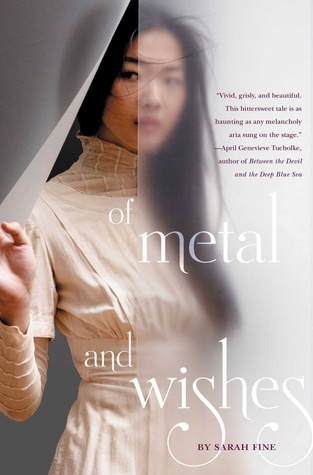
Release Day Review: Of Metal and Wishes by Sarah Fine


Title: Of Metal and Wishes

Author: Sarah Fine

Rating: 3.5 Stars

Release Date: August 5th, 2014

First and foremost, you should know that I've never read or seen "The Phantom of the Opera." Secondly, you should know that I read Of Metal and Wishes not even knowing it was a re-telling of the above classic. So. If you're looking for a comprehensive review comparing these two novels, you've come to the wrong place.

Nevertheless, despite my lack of insight into the re-telling aspect of Of Metal and Wishes, I enjoyed it immensely. Wen assists her father in a medical clinic located in a slaughterhouse--a slaughterhouse where a ghost resides. The Noor, a cast hired on as cheap manual labor, begin working at the slaughterhouse. When one humiliates Wen, she impulsively makes a wish to the Ghost and is shocked when it is granted in a violent manner. In an effort to ease her guilt, she befriends the leader of the Noor, Melik. But before long, Wen is torn between her growing feelings for Melik and her friendship with the Ghost. After all, nothing but brutality and violence are certain in the slaughterhouse and if Wen isn't careful, the two just may follow hot on her heels...

Where Of Metal and Wishes shines is in creating a palpable atmosphere. I don't usually gravitate towards horror/thriller novels--so I can hardly compare Fine with connoisseurs of the genre such as Stephen King--but the tension throughout the narrative reminded me distinctly of the impending sense of doom one feels when reading Rebecca or Nine Coaches Waiting. It doesn't overwhelm the senses but, rather, it lingers, festering until the dam breaks and the plot finally reaches its peak. Fine paces her tale impeccably, adjusting the background sensation in tune, and I found this to enhance the experience of the novel memorably.

Of Metal and Wishes, moreover, features a sympathetic heroine in Wen. Not only is she compassionate and considerate, but her blunders early in the novel prove that she isn't above mistake or reproach. Thus, it is impossible not to feel a connection with well-meaning Wen. Where I grow weary of her character, however, is in her distinctly damsel-in-distress portrayal. Now, perhaps this is my ignorance speaking and Fine is simply sticking to integral plot points as she re-tells "The Phantom of the Opera" but I found myself disturbed by the treatment of women in Of Metal and Wishes. If a young girl is seen alone with a man, it instantly means she is "loose" of morals, or a prostitute. Seriously, the number of times Wen, our protagonist, was forced to ward off unwanted sexual attention became tiresome. It did little for the setting--which I will discuss in a bit--and even less for the character growth. Additionally, I'm not a fan of dilemmas which are created to be solved with violence. For the romantic interest to prove himself by beating up the men who wanted to sleep with Wen seems far too reminiscent of Beautiful Disaster to me. It isn't a flaw, exactly, as Fine handles the issues she brings up with aplomb, but I had hoped YA was moving away from the artificial love stories of fists and helpless maidens.

Fine's tale further lost me with its setting. The Noor are--I believe, but do feel free to correct me if I'm wrong--a fictional group whose physical characteristics are similar to those of Asian origin. Yet, the novel contains a distinctly historical feel to it which threw me off on more than one occasion. The conflicts within this novel are merely fictional, as is the political turmoil, but it felt as if it lacked a true historical thread to tie it back to reality--mainly because aspects of the Noor culture are, certainly, derived from historical origins in Ancient China. What I did enjoy about this twist was the fact that Fine pitted two opposing social classes of people--neither of which were Caucasian--and I found that the commentary she was able to make as a result was thought-provoking. Nevertheless, I feel as if Of Metal and Wishes could have benefited from a slightly more concrete--grounded, if you will--historical air to it, particularly as the treatment of women alludes to a much older time period in history though Wen's father's dreams of sending her to medical school allude to far more recent times. It continued to plague me as the tale went on and, let me assure you, confusion is not a sensation I welcome.

Of Metal and Wishes is ideal for lovers of thriller/horror/mystery novels, especially as its genre contains just a hint of steampunk, romance, and hints at a sequel (though, as far as I know, a follow-up has not been confirmed). So far, none of Fine's works have been able to compare to her debut--for me, at least--but I can easily see her latest becoming a favorite among many. If there's anything Fine has proved with this one it is that no genre can deter her--she is, well and truly, a versatile writer.

Sunday, August 3, 2014

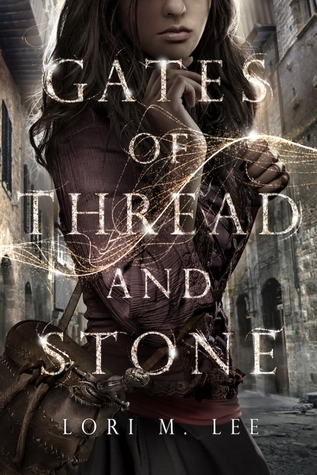
ARC Review: Gates of Thread and Stone by Lori M. Lee


Title: Gates of Thread and Stone (Gates of Thread and Stone, #1) 

Author: Lori M. Lee

Rating: 2.5 Stars

Release Date: August 5th, 2014

I felt hopeful, sliding open the cover of Gates of Thread and Stone. Lee's debut begins with promise, introducing us to Kai, a fierce and headstrong heroine whose ability to slow down time is refreshingly unique. Moreover, the first few chapters of this novel present us with an intriguing fantasy world, one in which Kai, living practically in the slums, must earn credits--opposed to hard cash--to rise above her rank. Kai, who was adopted by an orphan boy, Reev, when she was eight-years-old, has a strong bond with her older foster brother. Seeing the two interact on the page at the opening of Gates of Thread and Stone was heart-warming--just as witnessing Kai's frantic worry over Kai's sudden disappearance is heart-wrenching.

With the help of her childhood friend (and crush!), Avan, Kai sets out to find Reev knowing only that he has been taken by the Black Rider, formerly thought to be a mere legend. Unfortunately, I found that this novel gradually declined from this point on-wards. For me, where Gates of Thread and Stone is strongest lies within Kai. Unlike typical protagonists, she doesn't allow the presence of her love interest to distract from her mission. Instead, I admired Kai's unflinching devotion to saving Reev and, moreover, her inner strength in challenging herself and overcoming her own hurdles. When it came to the romance I certainly had a bone--or two, really--to pick with Kai but with that slight exception, I found her to be a welcoming heroine.

Yet, despite her shining qualities, I feel as if Lee fails to utilize Kai to her fullest potential. We, rather disappointingly, see very little of Kai's marvelous ability and the instant camaraderie I felt upon meeting her during those initial pages vanished only chapters into the narrative. I continued to enjoy Kai, support her decisions, and marvel at her actions but, I couldn't feel much for her. In large part, this is due to the lack of development that Lee offers her secondary characters. Reev brings out the best in Kai and, seeing the strength of their bond in the opening of the novel, establishes the reader-character connection that is absolutely essential. Lee fails to sustain that thread throughout the narrative, however, as Kai is constantly on the move from one location to another, meeting characters only to dismiss them at later points in the tale. I never felt grounded, neither to a location nor to a character, over the course of Gates of Thread and Stone. I relish secondary characters, not only for their different personalities but more so for what they bring out in the protagonist. Lee's secondary characters are forgettable, at best, and their roles in Kai's life are all-too-similar to those played by other, far more memorable, secondary characters in other novels; whether it be teacher, guide, betrayer, fighter, potential friend...none of these roles are filled in a manner that bears remembrance and I found myself ever-so-slightly saddened by the direction the plot took.

I will say, though, that Lee keeps readers guessing at her plot lines. I often expected the story to travel in one direction and it pleasantly surprised me by taking a different path. Nevertheless, I didn't find the pacing of this novel to be particularly engaging and, once Kai leaves the city gates, the world-building felt confusing at best, nonexistent at worst. Now, that's not to say it isn't there--because it is. Lee infuses her debut with hints of mythology, pulled from various sources, and the result is rather fascinating. I only wish it had been presented in a different light. By the time the entirety of Lee's world becomes evident, the story is winding down and the influx of emotion, detail, and plot twists all packed into the final few chapters isn't lovely.

What's more, the conclusion of this novel banks upon the fact that you, the reader, actually cared about the romance. Which, I assure you, I didn't. I found Avan to be a respectable romantic interest--not too perfect but not an asshole either--yet I couldn't summon up much emotion for him. Avan and Kai skirt around their feelings for far too long. Lee takes it to a point where it begins to feel unnatural--seriously, how could they not have figured out one another's feelings sooner?--and the romantic tension isn't of the welcome variety. Granted, Gates of Thread and Stone avoids a love triangle but--I'll warn you--don't come here looking for swoon. I genuinely felt as if Avan's character, particularly with his past and liberal mindset, could have been utilized in a different--and possibly better--manner throughout the narrative. Just...unimpressive, is all.

I am confident that Lee's debut will finds its die-hard fans. Of that, I have no doubt. Yet, for me, it wound up being a mash-up of too little magic (Kai, USE YOUR POWERS!), too little chemistry, and far too little connectivity. I just couldn't get into this one and while I truly loved the sibling bond that lies at the core of this novel, not to mention the qualities of Kai's that are truly admirable, Gates of Thread and Stone just didn't amaze me.

I was given a copy of this book from the publisher in exchange for an honest review. Thank You!

Friday, August 1, 2014

Review: Honor's Knight by Rachel Bach


Title: Honor's Knight (Paradox, #2) 

Author: Rachel Bach

Rating: 4.5 Stars

*This review is spoiler free for the Paradox Trilogy*

Honor's Knight presents a paradox to the typical trilogy; it defies Middle Book Syndrome. Having read far too many trilogies than I probably should have ever read, I can truthfully claim that MBS is real and it usually occurs when an author has a story to tell--only it's a duology, not a trilogy. Thus, that fated middle book is the source of dragging plot lines, new love interests, and lackluster characters. Bach, however, truly does have a story that needs to be told in three books. As a result, Honor's Knight is remarkable: fast-paced, thought-provoking, and most definitely mind-blowing.

Without giving away spoilers for Fortune's Pawn, all I will remark about the plot of this novel is that it begins in an unusual situation. Devi, our kick-ass, no-nonsense protagonist finds herself a stranger on her own ship, due to circumstance, and watching her battle those around her--but especially herself--in a quest for the truth is enlightening. It reveals even more facets to Devi than we thought existed. Fortune's Pawn does such a terrific job of presenting us strong Devi, weak Devi, fierce Devi, romantic Devi, ass-kicking Devi, etc. that to see her as more than those images is seemingly impossible. Yet, I loved her growth arc throughout the novel.

Honor's Knight moves forward through a series of multiple plot twists. Of course, for readers of Fortune's Pawn, there is an obvious reveal that needs to occur that the reader knows of but not Devi. Yet, even beyond that, Bach unveils the extent of her world-building and the secrets--answers, really--we've been yearning for since Fortune's Pawn are displayed in their full glory. Witnessing Devi react, process, and act on these new sources of information is the main motivation of the storyline. It works. Not only is Bach's world richly layered and morally ambiguous, keeping readers questioning their own set of standards and blurring that line between right and wrong, but it also keeps readers on the edge of their seat anticipating both the next unknown to fly at Devi and her consequent change as a result.

As with Fortune's Pawn, the secondary characters support and enhance Honor's Knight beautifully. All strong characters in their individual right, Devi's relationship with even the most minute of secondary characters carries weight. What's more, Honor's Knight is set up in such a manner that the nature of the relationships Devi has sustained from Fortune's Pawn change. In Honor's Knight there are many more layers to the seemingly two-dimensional and simplistic relationships Devi held in Fortune's Pawn and that evolution is a treat in and of itself.

Of course, the romance in this trilogy is note-worthy since it truly is hard-won. Honor's Knight is the least romantic of the trilogy, strife with conflict and the never-ending battle of inner conflict. Both the romantic leads, Devi and Rupert, must overcome their insecurities and pasts to be with one another and, even then, the unspeakable acts they've done hang in the air between them. While they're both fighters, they're also betrayers, and the bitterness that adds to their complex equation is entertaining, to say the least. Honor's Knight truly made me care for their relationship in a way I hadn't in Fortune's Pawn and the outcome of it is one I eagerly anticipate in Heaven's Queen.

Honor's Knight is not an easy novel to have written, I am sure. It sets up a dark, tragic problem at hand--one whose solution remains shrouded. Although this is Bach's debut trilogy, she is already a master at creating tension and forcing readers to think beyond their typical capabilities. Heaven's Queen will, undoubtedly, be a treat; I am sure of it.

You can read my review of Fortune's Pawn, the first book in the Paradox Trilogy, here.