Showing posts with label Mystery. Show all posts

Monday, July 25, 2016

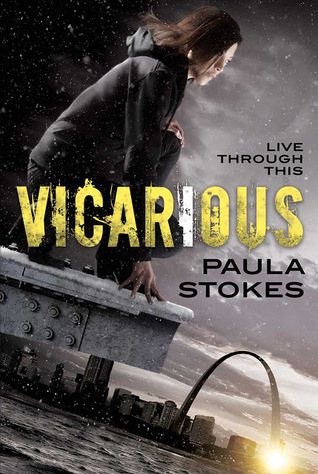
ARC Review: Vicarious by Paula Stokes


Title: Vicarious (Vicarious, #1)

Author: Paula Stokes

Rating: 4 Stars

Release Date: August 16th, 2016

Paula Stokes is full of surprises. When her debut, The Art of Lainey, burst onto the scene, ticking off all the right boxes for Contemporary YA, I thought for sure that I had discovered a new go-to author for the genre. Imagine my surprise when her sophomore novel, Liars, Inc. was full of mystery; a thriller featuring diversity in multiple ways. I knew her next contemporary novel would be stellar, but Girl Against the Universe surpassed my wildest expectations. So, when Vicarious fell into my lap, I knew only one thing: I would not be disappointed. And I was absolutely right.

Stokes's latest is a far cry from any of her previous novels. And, I suspect, to a large degree it's wildly different from most other YA novels out there, even within its genre. Winter, our heroine, owes everything to her older sister, Rose, and foster brother, Gideon, who helped her escape North Korea and, later, trafficking in California. Now, Winter works for Gideon, recording dangerous activities to create ViSEs. With a ViSE, not only can you see from the eyes of the recorder, watching as they bungee jump or escape the cops, but you can feel their neural impulses--the adrenaline, the fear, the excitement. While Rose spends her time in clubs, dealing with her past the only way she knows, Winter trains, making herself impenetrable and working her body to withstand even the most deadly of actions. But when a ViSE of Rose's murder turns up in Gideon's office, Winter is determined to find and avenge her sister's death--no matter the cost.

Winter is a completely bad-ass protagonist. She's focused and no-nonsense, so while some may dislike her serious nature, I appreciated her upfront honesty about her own personality. Her past is a vicious monster--and not just the fact that she escaped from North Korea. There's also the immense debt she feels she owes to both Rose and Gideon for making sure she escaped the trafficking situation they were caught up in in California. The combination of these two make Winter's past a depressing part of the novel. But, Stokes is careful to accompany Winter's darkness alongside plenty of action, not to mention lighter scenes and even humor from other, secondary, characters. Winter's relationship with her sister isn't perfect--after all, Winter doesn't understand why Rose uses her sexuality and is constantly seen with different men--but she adores her older sister as well. Even though Rose dies early in the novel, I still felt as if I knew her character, and most importantly her relationship with Winter, very well.

One of my favorite aspects to this story, though, is the romance. It takes a backseat throughout the novel but it's a slow-burn that utterly won me over and had me swooning from the beginning. Jesse is a friend of Winter's, someone who also works for Gideon and has had a tough past of his own. But he genuinely cares for Winter and watching as he breaks down her barriers and convinces her of his affection, despite her past and the demons she carries, is a highlight of the story. Their friendship is rock-solid, the trust between them a pillar for Winter to find support upon in the face of her sister's death. I also love that their relationship isn't always easy--not for Winter and certainly not for Jesse. But it's so rewarding and I'm really looking forward to seeing how it develops in the sequel.

Vicarious is a thriller from start to finish. I found myself flipping these pages, wondering at who could have killed Rose, where she was at the time of her death, and the people she spoke to. As Winter interrogates those in her life, she uncovers secrets about her sister that she never even suspected and the influx of clues and leads, not to mention dead-ends, makes for an exciting read. Add in the complex personalities of Winter--and Jesse's utter charm--and I'd have been sold. But Stokes also has another trick up her sleeve--the ViSEs. And, damn, they are cool. I love how the ViSEs were an integral aspect to Rose's death but, also, we get to see them filmed and in action later in the novel. Clearly, they're going to be playing an even bigger role in the sequel and I loved the futuristic tint that the ViSEs provided to this world, which is otherwise identical to ours.

The best part about Vicarious are all the twists and turns that you won't see coming. I was shocked and reeling by the end of this novel and though it is a part of a duology, with this portion of the story wrapped up, I want the sequel--now. Yet, for all its seeming perfection, I will say that I had a few sliiight issues with Vicarious. Namely, that I found it to drag a little in the middle. There are a lot of back-to-back sequences with lots of action, whether it be Winter tracking down her sister's body or haunting the places she frequented or visiting people that only Rose knew. There are also a lot of really intriguing ViSEs that we get to see--ViSEs that Winter finds of Rose and her adventures. But then, somewhere in the middle, I found myself flipping the pages and wondering when the action would pick up again. I think that with so many fast-paced scenes, the slower moments feel a little too slow. Thankfully, it doesn't seem that way for too long and Stokes regains her momentum, stunning readers with more action-shots, ViSEs, and plot twists.

Thus, all-in-all, I'm totally impressed and utterly in love with this book. It is clear that Stokes's research is impeccable and her incorporation of diverse characters, their heritage and their struggles, is admirable. Even if you're not looking for more diversity in YA, the mystery, the plot twists, and the thrills will keep you glued to your seat. And for fans of deeper connections, complex personalities, and tough relationships--Stokes delivers on that as well. Vicarious has something in it for everyone--read it, at least so that I'm not counting down the days to its sequel by myself. ;)

If you're interested in my GIF-ridden pre-review of the novel, you can find it here.

Thursday, January 29, 2015

Review: When by Victoria Laurie


Title: When 

Author: Victoria Laurie 

Rating: 4.5 Stars

Imagine being able to look at a person and see, always, the day of their death looming above them. It may be an extraordinary gift, sure, but it's also a curse. One that Maddie Fynn knows all too well. Ever since she was young, Maddie has been able to see the deathdays of those around her. It first happened when she drew a family portrait and wrote the etched the date of her father's death on paper and, ever since, her talent has singled Maddie out as a loner. With only one friend, Stubs, whose friendliness is matched only by his kindness, Maddie's life is a small, but fulfilling one. Her alcoholic mother, unable to drive after two DUIs, exploits Maddie's skill and forces her to read deathdates for money--money which Maddie uses to pay off bills; money her mother uses to purchase more alcohol. It isn't the healthiest situation and it's far more than any typical high school junior should manage, but Maddie takes care of herself, her mother, and her grades in a juggling act that has become routine.

She doesn't think there's much room in her life for things to get any worse until the FBI name her a suspect to the murder of a young thirteen-year-old boy. Earlier that week, Maddie had looked at an imagine of a young girl with cancer and told her mother that she would live. Inside that wallet, however, were pictures of two other children--one who was fated to die a week from that day. When Maddie tries to warn the mother, however, she is labeled a fraud and the angry customer leaves Maddie's house. A week later, when the boy is found missing, Maddie is questioned by the FBI. With the help of her Uncle Donny, a lawyer in Brooklyn, and her best friend, Maddie must try to clear her name and prove to the FBI that she's innocent. Because, after all, the real killer is still on the loose...

When is a brilliantly written YA debut from Victoria Laurie. Maddie's narration is raw, honest, and down-to-earth. She's a heroine who makes the best of her circumstances and even as life constantly tries to put her down, she gets back up every time, stronger than ever. I admire her will and determination and throughout the novel, all I wanted to do was shield Maddie from the false accusations and difficult situations she was forced to face as a result of the FBI's interference in her life. The FBI are ruthless and they are desperate enough to put an end to these string of murders--each gruesome, targeting minors, and filled with torture--that they're willing to put the blame on an innocent girl like Maddie.

Despite the fact that Maddie's mother is an alcoholic, I was glad to see that Maddie had other adults in her life whom she could turn to for support. The relationship between Maddie and her Uncle Donny, a bachelor who keeps insisting that Maddie can leave her mother and move in with him, is akin to that of a father and daughter. Maddie's father was Uncle Donny's brother and though it has been years since his death, neither of them can forget him. Moreover, Donny makes Maddie proud to be her father's daughter and though the two face their own set of relationship woes--namely the fact that Maddie is loyal to her mother when Donny can see that it isn't a healthy, or normal, relationship--they work well together as a team and Donny goes above and beyond to make sure that Maddie is safe and protected, despite the mayhem around her.

Maddie's friendship with Stubs is also at the forefront of this novel and their relationship goes through some truly difficult circumstances. Laurie isn't afraid to go to extreme measures when it comes to reinforcing the seriousness of this situation and though, at its core, When is an impeccably written and neatly planned murder mystery, that doesn't decrease the strength of the character relationships throughout the novel. Speaking of the mystery, however, I have to admit that I did not, at all, under any circumstances, predict the final reveal. Laurie threw in plenty of red herrings and clues but the true identity of the murderer is one that I am confident no reader will be able to guess beforehand. It's sneaky, it's shocking, and it all makes too much sense in retrospect--just as an excellent mystery should do.

Maddie deals with so much in this novel--FBI questioning, an alcoholic mother, a murderer on the loose, bullying as a result of the FBI's suspicions--that she has little time to be a normal teenager. Yet, despite the fact that there is little to no romance in this novel, we do receive a final, all-too-perfect glimpse of it at the end. And, let me tell you, it is cute beyond measure. I really enjoyed the fact that When remained focused on Maddie, the mystery at hand, and her consequent growth and change as a result of the investigation. Maddie learns a lot about her abilities over the course of this novel and, what's more, she learns a lot about herself. While she begins this story as a teen trying to fit in and hide her abilities, she grows to embrace them by the end and the confidence she accumulates over the course of this difficult murder is heart-warming to see. Thus, I appreciate that Laurie didn't make, say, Stubs, the romantic interest nor were the trickles of the love story involved, in any way, with the murder at hand. Both are separate storylines, one obviously the main plot, but they converge beautifully in an ending that is completely satisfying.

I'm not sure if I'll go back to read through Laurie's backlog--there's only so much thriller/mystery I can take at a time--but I will, without a doubt, be on the lookout for her next YA novel. If there's one author you should be looking out for in the YA genre, it's Victoria Laurie.

Saturday, August 16, 2014

ARC Review: Visions by Kelly Armstrong


Title: Visions (Cainsville, #2) 

Author: Kelly Armstrong

Rating: 3 Stars

Release Date: August 19th, 2014

Note: Mild spoilers for Omens, the first book in this series follow. I do not believe that the brief spoilers will ruin the series but you can read my review of Omens here.

It is always ever-so-slightly disconcerting to pick up a sequel and read a novel far altered from your expectations. I adored Armstrong's Omens when it released last year, both because of its unique paranormal plot line and its psychologically consuming characters. While neither of these traits have diminished in strength throughout this sequel, they have altered in some capacity. Granted, some are for the better--certainly--but some, sadly, for the worse.

In Omens Olivia, the protagonist of our tale, discovers that she has been adopted and that her biological parents are notorious serial killers, the Larsens. Working with her attorney, the elusive Gabriel Walsh, the two prove that the final two of eight murders committed by the Larsens were falsely accused. Thus, when Visions was announced I immediately assumed that the course of the series would be to continue to prove that Olivia's parents had not, after all, committed a single murder and their daughter would work to contribute evidence to that cause. Instead, Visions presents us with a different sort of mystery on our hands, one far removed from Olivia's true parentage but linked, rather, to the small town she loves: Cainsville.

When Visions begins Olivia witnesses a dead body in her car. One which bears an uncanny resemblance to her. Yet, when Gabriel arrives on the scene the body is missing and no evidence can be found. This body continues to plague Olivia, its head turning up unexpectedly in her bed one night only to vanish just as quickly. Soon enough, Olivia is able to identify the body as belonging to Ciara, a young girl who is distantly related to the town of Cainsville. But as Olivia begins investigating the truth behind Ciara's death and its unexpected link to her, she stumbles upon a secret she just may have been better off knowing. Because both Cainsville, and its residents, are not as they seem...

While I found that aspects of Visions could have easily been omitted--this book is, after all, a hefty volume--the plot is impeccable as always, well-timed, atmospheric, and unique. Perhaps what I love most about Visions is that it reveals a plethora of layers, both the characters we've come to know and the story line we've come to love. Since it touches only briefly upon the subject of the murders Olivia's parents are accused of it can be difficult to find ones bearings amid this novel. While Olivia is diligently tracking down the truth behind Ciara's murder, I couldn't help but seek the connecting draw behind the entire tale. It isn't until the end of Visions that Armstrong hits us with explosive reveals but the hints are present over the course of the narrative and the manner in which Omens bleeds into Visions, creating an even stronger story line than the one before, is remarkable.

Yet, while Armstrong excels in plot she sadly fails in the romance department. Omens seemed to establish a slow-burn romance between Olivia and Gabriel--my absolutely favorite kind--but early in Visions their friendship takes a deep setback. At this point in the tale, Olivia is no longer in shock or grief regarding the truth of her parentage. Thus, as a young woman, she is once again prepared to fill her life with the social standings she needs, boyfriend included. Gabriel, on the other hand, who remained an aloof enigma in Omens, is, by no means, prepared for a relationship as yet in Visions. We grow to learn of his traumatic past and the emotional scarring has left him in a position where he doesn't even view Olivia in a romantic light. While Visions continues to establish the strong connection forged between them and the strength of their friendship shines through and overcomes hurdles, neither Gabriel nor Olivia view each other as anything more than a close, reliable friend.

Consequently, it should come as no surprise to find that Olivia becomes romantically involved with Ricky, the biker we briefly met in Omens. Only, I was surprised. Rationally, I can reason the need for this romance and, certainly, Ricky is a balanced counterpoint to Olivia. Not only does her respect her independence but he never becomes jealous and supports Olivia's friendship with Gabriel. Yet, I honestly felt as if the love scenes in Visions were more than just a little unnecessary and theirs wasn't a romance I enjoyed, frankly. What I do appreciate about Armstrong, however, is that Ricky plays an important role to the plot as a whole beyond simply being Olivia's boyfriend. Moreover, the citizens of Cainsville are against Ricky and Olivia's fling and it is made evident that Ricky and Olivia are not a couple who are here to stay. Thus, while Visions lacks a love triangle the focus on the romance lacked authenticity and I couldn't engage as thoroughly as I'd wanted to as a result of it. Moreover, it completely took me by surprise so, hopefully, future readers can better prepare themselves for an assault of romance in this installment.

Ultimately, Visions excels as the paranormal thriller it is. Armstrong's research is on-point and enriches the atmospheric quality of these novels and, with the manner in which this installment wrapped up, I'm certainly expecting to see both the murder mystery of Omens and the paranormal twists of Visions converge in the next novel. While I remain a twinge nervous about the direction these characters are headed in, I look forward to their arcs; their growth is genuine, their personalities memorable, and their relationships authentic. Not my favorite Armstrong novel by a long-shot but, obviously, a must-read for fans of Omens.

Tuesday, August 5, 2014

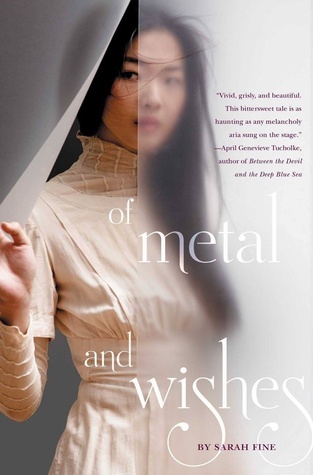
Release Day Review: Of Metal and Wishes by Sarah Fine


Title: Of Metal and Wishes

Author: Sarah Fine

Rating: 3.5 Stars

Release Date: August 5th, 2014

First and foremost, you should know that I've never read or seen "The Phantom of the Opera." Secondly, you should know that I read Of Metal and Wishes not even knowing it was a re-telling of the above classic. So. If you're looking for a comprehensive review comparing these two novels, you've come to the wrong place.

Nevertheless, despite my lack of insight into the re-telling aspect of Of Metal and Wishes, I enjoyed it immensely. Wen assists her father in a medical clinic located in a slaughterhouse--a slaughterhouse where a ghost resides. The Noor, a cast hired on as cheap manual labor, begin working at the slaughterhouse. When one humiliates Wen, she impulsively makes a wish to the Ghost and is shocked when it is granted in a violent manner. In an effort to ease her guilt, she befriends the leader of the Noor, Melik. But before long, Wen is torn between her growing feelings for Melik and her friendship with the Ghost. After all, nothing but brutality and violence are certain in the slaughterhouse and if Wen isn't careful, the two just may follow hot on her heels...

Where Of Metal and Wishes shines is in creating a palpable atmosphere. I don't usually gravitate towards horror/thriller novels--so I can hardly compare Fine with connoisseurs of the genre such as Stephen King--but the tension throughout the narrative reminded me distinctly of the impending sense of doom one feels when reading Rebecca or Nine Coaches Waiting. It doesn't overwhelm the senses but, rather, it lingers, festering until the dam breaks and the plot finally reaches its peak. Fine paces her tale impeccably, adjusting the background sensation in tune, and I found this to enhance the experience of the novel memorably.

Of Metal and Wishes, moreover, features a sympathetic heroine in Wen. Not only is she compassionate and considerate, but her blunders early in the novel prove that she isn't above mistake or reproach. Thus, it is impossible not to feel a connection with well-meaning Wen. Where I grow weary of her character, however, is in her distinctly damsel-in-distress portrayal. Now, perhaps this is my ignorance speaking and Fine is simply sticking to integral plot points as she re-tells "The Phantom of the Opera" but I found myself disturbed by the treatment of women in Of Metal and Wishes. If a young girl is seen alone with a man, it instantly means she is "loose" of morals, or a prostitute. Seriously, the number of times Wen, our protagonist, was forced to ward off unwanted sexual attention became tiresome. It did little for the setting--which I will discuss in a bit--and even less for the character growth. Additionally, I'm not a fan of dilemmas which are created to be solved with violence. For the romantic interest to prove himself by beating up the men who wanted to sleep with Wen seems far too reminiscent of Beautiful Disaster to me. It isn't a flaw, exactly, as Fine handles the issues she brings up with aplomb, but I had hoped YA was moving away from the artificial love stories of fists and helpless maidens.

Fine's tale further lost me with its setting. The Noor are--I believe, but do feel free to correct me if I'm wrong--a fictional group whose physical characteristics are similar to those of Asian origin. Yet, the novel contains a distinctly historical feel to it which threw me off on more than one occasion. The conflicts within this novel are merely fictional, as is the political turmoil, but it felt as if it lacked a true historical thread to tie it back to reality--mainly because aspects of the Noor culture are, certainly, derived from historical origins in Ancient China. What I did enjoy about this twist was the fact that Fine pitted two opposing social classes of people--neither of which were Caucasian--and I found that the commentary she was able to make as a result was thought-provoking. Nevertheless, I feel as if Of Metal and Wishes could have benefited from a slightly more concrete--grounded, if you will--historical air to it, particularly as the treatment of women alludes to a much older time period in history though Wen's father's dreams of sending her to medical school allude to far more recent times. It continued to plague me as the tale went on and, let me assure you, confusion is not a sensation I welcome.

Of Metal and Wishes is ideal for lovers of thriller/horror/mystery novels, especially as its genre contains just a hint of steampunk, romance, and hints at a sequel (though, as far as I know, a follow-up has not been confirmed). So far, none of Fine's works have been able to compare to her debut--for me, at least--but I can easily see her latest becoming a favorite among many. If there's anything Fine has proved with this one it is that no genre can deter her--she is, well and truly, a versatile writer.

Wednesday, February 19, 2014

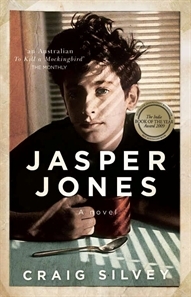
Young Adult Mini-Reviews: Jasper Jones by Craig Silvey & The Impossible Knife of Memory by Laurie Halse Anderson


Title: Jasper Jones

Author: Craig Silvey

Rating: 3.75 Stars

Despite all the 5 Star reviews of Jasper Jones clogging up the blogosphere, Silvey's novel isn't quite worth all the hype it has garnered. Granted, it is beautifully written with realistic dialogue, complex relationships, and a plot line that is equal parts bitter and sweet. Moreover, its prose is stunning, quiet and reflective without dragging the novel down. Within the pages of Jasper Jones lurks a shocking small town secret, an achingly sweet first love, and a realistically unfair portrayal of life in all its highs and lows. It does, admittedly, get off to a bit of a slow start, but once it hits its stride, Jasper Jones is impossible to set down. And yet, I will not be re-visiting the world of Jasper Jones the way I lovingly re-read the pages of Melina Marchetta's novels. As such, take my advice: lower your expectations for this novel and prepare to be, very pleasantly, surprised. You'll thank me later.

Title: The Impossible Knife of Memory 

Author: Laurie Halse Anderson 

Rating: 4 Stars

The Impossible Knife of Memory is impeccably told through the narration of Haley, a protagonist whose voice has just a touch of cynicism in it, thrown in with a scoop of sarcasm and a whole big bucket of survivalist instincts. Haley's father, a war veteran suffering from severe PTSD, is hardly equipped to take care of her, let alone keep a job. Nevertheless, he insists that Haley have a "normal" life, ending their years on the road while Haley learns to navigate the zombied existence of a high school teenager. Anderson's latest is not easy to read, however. Haley's relationship with her father is tenuous and fragile, a careful construct of one step forward just as quickly as two steps backward inevitably follow. Moreover, high school is no walk in the park for Haley. While she makes friends and snags Finn - an absolutely sweet, nerdy, and handsome swimmer - her schoolwork comes second to her father. As do her relationships, unfortunately.

The Impossible Knife of Memory is a beautifully written tale of growing up and, most importantly, facing the harsh realities of life even when we need to see the world through rose-tinted glasses. I did find myself disappointed by the ending of this novel, which wrapped up events a little too neatly for my liking. Still, I can't not love a book that contains swoon-worthy math pick-up lines, exemplary teenage driving, and features a genuine college application process (complete with college visits AND the essay prompts for the 2013-2014 application year!). And, if you needed any more motivation to read this novel: it's written by Laurie Halse Anderson. You simply cannot go wrong with her.

Friday, January 31, 2014

Mini-Reviews & Giveaway: Between the Devil & the Deep Blue Sea by April Genevieve Tucholke & Amber House by Kelly Moore


Title: Between the Devil & the Deep Blue Sea (Between, #1)

Author: April Genevieve Tucholke

Rating: 2.5 Stars

...that's it? Are we all sure I received the right book in the mail, because I'm just a little bit confused. Between the Devil & the Deep Blue Sea became a blogging sensation when it first released a few months back and, ever since, I've been curious to try it out for myself. When my copy first arrived, I got through about half the book before turning to other pressing ARCs. Now, having finally found the time to settle back into this story, I've wound up disappointing. For some reason, I expected a lot more to...happen. *scratches head, still confused*

Between the Devil & the Deep Blue Sea excels as the gothic mystery it is marketed as. Not only is the writing beautiful, painting an atmosphere of chilling nights and howling winds, but the imagery Tucholke forces us to conjure, of little children holding sticks and hunting the devil, are spine-tingling. With the exception of this lyrical prose, however, this novel has little to offer. Its protagonist, Violet, is much like any typical heroine who plans to resist the "bad boy" but fails spectacularly. Moreover, I didn't appreciate the manner in which our feelings for Violet are intentionally manipulated. Violet's twin brother, Luke, is a rude misogynist and his girlfriend, Sunshine, essentially exists as a foil to Violet. Both Luke and Sunshine do little to develop the story, but their existence makes Violet seem like a much better alternative character. Frankly speaking, though this method is used by many authors, I'm not a fan of it merely because it doesn't offer many reasons to like the protagonist for who she is, which seems like cheating to me. If you only like the protagonist in comparison to those around her, do you really even like her at all?

River West, the mysterious boy who rents the guest house behind Violet's huge house, is essentially a creep. And an insta-love machine. Although he has never fallen for a girl before, of course he falls for Violet. Why? I still have no clue. And Violet too, who is a sensible teenager (supposedly), takes one look at River and instantly falls for him as well. *gag* While I really liked the moral questions that River's presence brings up - after all, can you really love someone if their actions go against your moral code? - ultimately that wasn't enough to save this novel for me. Between the Devil and the Deep Blue Sea is very similar to most paranormal reads, but its writing style sets it apart, giving it a gothic feel that I really enjoyed. When you strip that away, however, this is nothing but a slow-moving novel with characters that are just a little too familiar.

Title: Amber House (Amber House, #1) 

Author: Kelly Moore, Larkin Reed, Tucker Reed

Rating: 3.5 Stars

Despite its unremarkable beginning, Amber House is a promising start to a new series. In many ways, this novel reminded me of The Dark Unwinding for both books feature a mysterious old house, even more curious tenants, and hidden mysteries. Where The Dark Unwinding relied upon steampunk machines, an "insane" uncle, and unknown towns to further its plot line, this novel features strange twists of time, hushed-up family secrets, and long-forgotten abilities.

Amber House is dull, at first, rather boring and difficult to get through. Once the novel hits its stride, however, it soon delves into an intriguing tale. Sarah, the protagonist of our tale, can see the past. And in Amber House, a building known to preserve echoes of its history, Sarah's abilities thrive as she witnesses pieces of her ancestry come together to reveal truths she never knew about her family. One of the highlights of this novel is the relationship Sarah sustains with her family members. With her autistic younger brother, Sam, she is unfailingly caring, but with her mother, her relationship is tenuous at best. Moore and the two Reeds explore this rift between the two in a complex manner, giving us insight into Sarah's mother's past, which therefore sheds light on her present behavior.

Unfortunately, there is a rather irritating - and unnecessary - love triangle at play here. In fact, it only detracts from the story and causes Sarah to forget her usual sensibility. Quite thankfully, however, the love triangle is resolved in this first installment and will - hopefully - be absent from the sequel. With such a rushed ending, one that leaves behind more questions than answers, I am glad to have the sequel already on hand. Needless to say, I won't be wasting much time to find out just where Sarah's journeys take her next.

Win a Gothic Romance Bundle of Books! 
In preparation for the month of February - the month of romance! - I will be picking two winners and each winner will choose a Gothic Romance Bundle of their choice from the list below:
Bundle #1: Of Old Houses
ARC of Between the Devil and the Deep Blue Sea
Brand New Hardcover of Manor of Secrets
Bundle #2: Of a Series
ARC of Amber House
Brand New Hardcover of Neverwas, sequel to Amber House

US ONLY
Ends 2/10
a Rafflecopter giveaway

Thursday, January 16, 2014

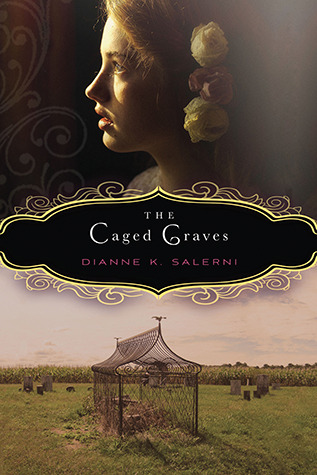
Review: The Caged Graves by Dianne K. Salerni


Title: The Caged Graves

Author: Dianne K. Salerni 

Rating: 4.5 Stars

When I think of the post-Civil War Era, I envision a nation torn apart by war, weary from years of struggle, and disheartened by life. I think of communities trying to re-build themselves, families joining together in companionship, and tentative smiles being shared over a dinner table. I think of the political strife in both the North and the South, the armies of soldiers kept to guard the untrustworthy South from resorting back to rebellion and the assassination of a beloved leader. I do not, however, think of Revolutionary War stories that haunt small towns, gold-digging visitors blinded by greed, or the graves of witches defiled both by the cages that stand over them and their blatant exclusion from holy ground. Now, though, it's practically all I can think about.

The Caged Graves is an incredibly atmospheric piece, immersing readers into the small-town life of 19th Century Pennsylvania where young men dream of growing farms, fathers ache to put the war behind them, and doctors yearn for the blissful ignorance they held prior to serving in the war effort. Verity Boone, having spent the last fifteen years away from her father and childhood home, finally returns to Catawissa, but not quite with the homecoming she's expecting. After agreeing to an arranged marriage with the most eligible bachelor in town, Verity is shunned by her new neighbors and distant from the father she never grew up with. Moreover, Nathaniel, the boy she has agreed to spend the rest of her life with, is a far different creature than his letters made him out to be. Although he is just as handsome - if not more - than his portrait alludes to, the shocking realization that Nate might have written his letters to Verity with a great deal of help from his sisters, potentially going so far as to have them select gifts for her, puts a damper on Verity's former excitement. After all, now she is stuck in the small town where she was born only this time, she is practically a stranger in her own household and, what's more, is about to marry a man who she realizes is not as familiar as she would have wished. Furthermore, to make matters worse, Verity discovers that her deceased mother and aunt are buried in caged graves, just outside the cemetery, and the quiet father she knows once used to fill his head with tales of buried treasure left over from the Revolutionary War. Already struggling to fit into her new home, Verity must now seek the answers to the questions regarding her mother's unexpected death and, most of all, the gold-diggers who still believe her mother's grave contains buried gold...

Where The Caged Graves shines is in its defiant portrayal of Verity, a heroine whose determination and flaws go hand-in-hand. From the first page itself, Verity's voice is seamless to slip into and her narration an enjoyment to read. While we first meet Verity on a train bound for Catawissa as a vivacious and energetic young woman, we quickly see her grow to make a niche for herself, despite the disappointments her homecoming brings. Moreover, it is Verity's unwavering stubbornness which drives the novel forward. Whether it be in her efforts to connect with the family she has grown without - father, uncle, aunt, cousins - or get to know her future husband, she is diligent and kind, not above letting her poised demeanor slip once in awhile, revealing the truly passionate girl that lurks within. Although The Caged Graves kept me glued to my seat from start to finish, the plot truly picks up once Verity uncovers the graves of her mother and aunt. From that moment on, Verity is an unstoppable force, going on with her day-to-day life while perusing her mother's diary entries and attempting to uncover the truth of her mother's death - a truth no one, especially not her father, will reveal to her.

It is an engaging mystery, paced impeccably and made all the more intriguing for the stories of buried treasure whispered through the winds of Catawissa. While these two plot threads seem to be quite distinct at first, they soon diverge to build the suspense already palpable within the story. Verity, as the novel wears on, hardly knows who to truly trust and though the ultimate reveal is a tad-bit anticlimactic, it is strangely satisfying. Moreover, the inclusion of the mystery throughout the novel only helps Verity's character to grow, change, and rise to challenges. Where she came to Catawissa prepared to wed, to run her own home and to deal with proper society, she did not expect to find so much mystery and mahem at her doorstep and, as such, the plot reveals hidden depths both to her character and those of the people who surround her as well.

And yet, for all the interest that the plot of this novel generates, not to mention Verity's indomitable nature, the romance still had me anxious, reeling, and swooning all at once. While there is, admittedly, a love triangle in this novel, it was one I enjoyed - embraced, in fact - as it built upon the plot and Verity's character both in admirable ways. For one, the inclusion of the love triangle is a welcoming admittance to the fact that Verity does, in fact, have options in life. Although Verity herself instigated her arranged marriage, for a woman during her time period to be able to choose who she wishes to marry is a freedom offered only to few. Henry, the assistant to the village doctor, is a far cry from Nate whose aspirations lie in successfully running his own farm. Not only does Henry make his interest in Verity clear, flattering her in the process, but his profession lends itself to a greater scope of knowledge which is attractive. Additionally, Verity feels safe with Henry, trusting him to help her solve the mystery of her mother's death and though her heart is firmly set in making a home for herself and Nathaniel, she cannot help but wonder how her life would be if she married someone different. The Caged Graves makes effective use of this love triangle, using it to mold Verity into a woman who eventually comes to stand by her beliefs and convictions. Moreover, the ability that Verity has to choose her future makes her a much more confident character and her doubts about her relationship with Nate, a man who seems obliged to court and marry her due to their arranged marriage situation and the fact that Verity's dowry included plenty of fertile land for the farm he dreams of owning, are realistic and this challenge is yet another one to overcome.
Attracted to both of them in different ways, yes - but how, at seventeen, was she supposed to recognize love? 
And though Verity considers another man, despite her engagement to Nate, he is still the one with whom her affections lie. At first, Nate is a difficult character to like. After all, he all but admits that his sisters helped him court Verity through letters and in person he is quick to follow his mother's orders, never taking the initiative to propose to Verity on her own. Nevertheless, rocky start aside, as Verity begins to spend more and more time with Nate, she comes to trust him, rely on him, and even admire the person he truly is. What Verity struggles with, throughout the novel, is identifying her feelings as love. Salerni touches upon this subject only briefly, but it is a lasting theme in the story as Verity, who comes to love her father, her extended family, and even the housekeeper who brought her up, is unable to identify if she loves Nate. While she once thought she did during their letter correspondence which began before she returned to Catawissa, she hesitates to throw the word around lightly. Moreover, doubts and hesitations stand in her way, as they do in every relationship. The Caged Graves, though a historical fiction novel with a mysterious plot line, takes the time to thoroughly flesh out its characters and their relationships to one another, creating complex story lines that are impossible not to become invested in. Yet, perhaps the best aspect of the romance is that I never truly took one side or the other; I wanted Verity to be happy. Salerni builds such a strong bond between the narrator and the reader that it is impossible to feel anything but happiness at the ultimate conclusion of this romantic dilemma, especially as it remains such an important emotional journey for Verity herself, integral to making her embrace the woman she becomes by the end of the novel.

Needless to say, The Caged Graves is near-perfect, drawing together real-life historical elements, fictional characters who feel life-like, and writing which flows seamlessly to create a novel that is not only impossible to put down, but impossible to forget. While I've been lucky enough to read The Caged Graves so early in the year, I already know it's one title I will be recommending for the next twelve months to come.

Thursday, January 2, 2014

ARC Mini-Reviews: The Killing Woods by Lucy Christopher & The Chocolate Temptation by Laura Florand


Title: The Killing Woods

Author: Lucy Christopher

Rating: 2 Stars

Release Date: January 7th, 2014

If Lucy Christopher's name hadn't been printed on the cover of this novel, I wouldn't have believed she wrote it. Granted, the prose is gorgeous, but the emotional complexity, character depth, and general plot originality I've come to expect from the author of Stolen wasn't present in this novel. Not in the least. Admittedly, I didn't expect The Killing Woods to be another Stolen, but I didn't expect to feel so apathetic to it as a whole either.

Told in alternating points of view, Christopher's latest is about a young girl whose father is charged with the murder of her classmate. Where The Killing Woods shines is in its portrayal of the emotions Emily feels, both after her father is accused and during his trial. What makes this situation so black-and-white is the fact that Emily's father has been suffering from PTSD after returning from the war and is often unable to discern from memory and his own reality. Thus, as Emily is left to pick up the pieces of human cruelty - friends abandoning her, questioning if she's a killer too - and confusion - who could have committed the murder? Damon, as the boyfriend of the murdered girl, is both outraged over her death and worried. Just the night before he had been out in the woods with her, high, and doesn't quite remember what happened. If he killed her, he wouldn't even know how he had done it, or why for that matter.

While this premise and set-up is fascinating, the slow unveiling of the murder isn't. Both Damon and Emily remain flat characters, never truly coming alive, and the story itself drags, bogged down by clunky chapters of Damon running through the woods, trying to remember what happened the night his girlfriend died, and Emily perusing her father's bunkers for clues of his guilt. Although the eventual reveal is satisfactory, the book as a whole is dull and forgettable. For fans of Christopher, I am afraid this will wind up being nothing more than a disappointment. And for those new to her work, do yourself a favor and pick up Stolen. It'll blow your mind; promise.

Title: The Chocolate Temptation (Amour et Chocolat, #6) 

Author: Laura Florand

Rating: 4 Stars

Release Date: January End, 2014

I can always rely on Laura Florand for a butterflies-in-my-stomach read, especially on a cold winter day when all I'm really craving is chocolate from one of these kitchens she writes about. The Chocolate Temptation follows Patrick, the suave second to Luc Leroi we met in The Chocolate Heart. You remember him, don't you? Always ready with a smile, a laugh, and a swoon-worthy face to lighten up your day. It's just too bad Sarah, the young American intern in Leroi's kitchen, doesn't think so. After all, as Sarah keeps trying to convince her intelligent Korean brain, she hates him. As we've established over the years, however, hate isn't all that far from love...

I practically squealed when I realized that The Chocolate Temptation finally took us deeper into these delectable kitchens than the previous novels ever have. Patrick is in charge of Sarah and, as always, Florand is the master of sexual tension. If you thought the heat from the ovens was hot, think again, because the steam between these two as they brush against each other in the kitchens is sizzling. Patrick, for instance, can't stop thinking about Sarah - about the concentration with which she does her work, her pure dedication to perfecting the art of cooking, and the passion she throws into work, tiring day after tiring day. On the other hand, Sarah cannot help but admire Patrick's talent, all while hating the way he will break her heart someday, even without realizing it.

As Sarah and Patrick get closer, however, they begin to realize that their facades of perfection are just that: masks. For me, the Florand's novels always have a two-fold appeal. One: the tension. As I keep mentioning, Florand's writing is divine. It just curls its way into your heart, creating emotion where there was none before. And two: the depth. Each of Florand's novels are romances about broken individuals, not necessarily broken in the same way or to the same degree, but who have barriers around their lives. What I particularly love is that she tackles a new issue with every one of her books, making them all such a delight to read. With Sarah and Patrick, both of them suffer from severe insecurity. Sarah, as a replacement child for the son who was killed in North Korea, never feels as if she's up to the mark and Patrick, a foster child, feels the same. Nevertheless, seeing them work through their struggles and find a way to trust and support one another was heart-warming.

Moreover, what I really love about Sarah and Patrick's relationship is that each of them have different dreams, but make conscious efforts to pursue them. Sarah, for instance, was a successful engineer in Caltech but she left her home and family behind to begin her life-long wish of sugar-making. Both the courage and guilt Sarah feels at pursuing her own dream, selfishly some would say, is depicted perfectly. Similarly, Patrick who - ironically - wishes he could be an engineer undergoes a mental journey as he realizes that dreams change with time and what he wanted as a twelve-year-old boy is not necessarily what he wants as a man now. Florand always touches upon such honest aspects of adult life with her novels that I feel enriched having read them. While the last few chapters of this book could veer on the lovey-dovey side, her books never fail to sate my thirst and bring a smile upon my face. Just as I expected, The Chocolate Temptation is a winner; another one.

Friday, November 1, 2013

Mini-Reviews: Hawksong, Nine Coaches Waiting, and Crossing Stones

If you're seeing this post, it means I have fallen on hard times. Over the past summer, there was a time when I had a wealthy backlog of reviews (oh, how I miss those days!), which meant that I crusaded around GoodReads, writing brief, short sentence "reviews" conveying my thoughts on a handful of novels I was too lazy to review in their entirety. I've gone back through those "mini-reviews" and compiled a small list of the better ones to entertain you, dear readers, with until I can get around to writing and posting a proper review. Either way, I hope you enjoy. :)

Title: Hawksong (The Kiesha'ra, #1)*
Author: Amelia Atwater-Rhodes
Rating: 4 Stars

Hawksong is possibly one of the most under-rated fantasy novels I've come across. In fact, this book simply seems to fall under everyone's radar - much to their own loss, I must say. Atwater-Rhodes is a brilliant writer, creating a world rich in lore, myth, and tradition. Danica, the queen of her hawk people, and Zane, the king of the cobras, are shapeshifters who marry to end the centuries-old feud between their people. Both Danica and Zane are tired of war, but their marriage will prove more difficult than either can imagine. Both the hawks and cobras share different traditions and as Zane and Danica grow to fall in love with one another, they also learn to assimilate their cultures and their people. Atwater-Rhodes writes world-building as a mere extension of her story, not as an overwhelming portion of info-dumping. With subtle legends and traditions, she manages to create and encompass the depth of these two races. Although I felt as if Hawksong ended a little too early, with both Danica and Zane falling in love slightly faster than I wished, I cannot deny that this is solid fantasy, full of the characters and type of complex world I love. Atwater-Rhodes, my friends, is not to be missed.

*I did read the sequel to this novel, Snakecharm, but wasn't impressed. I would still highly recommend this book, though, as it can be read as a stand-alone and it definitely worth a read for fantasy lovers.

Title: Nine Coaches Waiting 
Author: Mary Stewart
Rating: 4 Stars

What do I possibly say about Nine Coaches Waiting that hasn’t already been said before? Mary Stewart is a legend; her books are classics when it comes to the genre of gothic mystery. Although Nine Coaches Waiting suffers from a slow start, it is a breath-taking novel, beautifully written with a strong-willed and courageous governess at its center. Stewart, much like Daphne DuMaurier, is an expert at building suspense and causing our minds to flit between one suspect and the next. Nine Coaches Waiting is a thrill from start to finish and I finished this in a record three hours flat, unable to let go of the book until I knew for sure who the guilty party was. And, admittedly, it is a little obvious from the start, but there are many layers of doubt that Steward builds and, all the more, with a romance at the center, this book lacks nothing. If you’re a fan of Jane Eyre or simply gothic mysteries in general, then you cannot go wrong with Nine Coaches Waiting. Very highly recommended.

Title: Crossing Stones
Author: Helen Frost
Rating: 3.5 Stars

I've been on a bit of a verse novel binge lately, not to mention one of WWI (especially since I finished all three seasons of Downton Abbey in a record three and a half days!). Thus, it's almost not a surprise that I enjoyed this; it's merely a surprise that I enjoyed this as much as I did. Frost writes beautifully, choosing three separate styles to bring us the story of Muriel, a headstrong girl who isn't afraid to speak her mind; Ollie, her older brother who enlists for war despite being underage; and Emma, the sweet girl next door. With this short novel composed of poems, Frost is able to relate the horrors of war, the struggles of women, and the tension of those who remain home in such a way that it is bearable to us as readers. Not only is Frost's tale historically accurate, but it is also unexpectedly heartfelt.

Muriel, a young Alice Paul if you will, was my favorite narrator in the novel. I loved her outrageous opinions, her inability to accept the reality of her time, and her courage in standing up for her beliefs. Muriel is easily the most flawed of our three narrators which makes her, for me, the most realistic. Ollie provides us with the sole male perspective in this novel, one filled with the harsh realities of war and the peer pressure that men face to enlist. Emma, on the other hand, is possibly the dullest character. Although her poems had substantial depth, she herself is a relatively simplistic character, representing the average American women who was comfortable with her role in the house. With this novel, what Frost excels at is building the era both with war and politics. Granted, the characters aren't as fully fleshed as they could be, but as a piece of historic fiction this is one of the better - and more creative - ones.

Friday, October 18, 2013

Review: Another Little Piece by Kate Karyus Quinn


Title: Another Little Piece

Author: Kate Karyus Quinn

Rating: 4 Stars

I’ve been struggling to put together exactly what did – and didn’t – work for me with this novel. Another Little Piece is a strange story, there is no denying that. Annaliese, our protagonist, is found walking in her hometown with no recollection of who she is or even that she has been missing for nearly a year. As pieces of her past slowly begin to come back to her, however, Annaliese realizes that she isn’t, in fact, Annaliese; she is another girl in Annaliese’s body. And, even more hauntingly, Annaliese isn’t the first girl to lose her soul – she is only one of many.

What I Liked:

Bold: Another Little Piece is a bold debut, unflinching in its honesty and not hesitant, in the least, to portray gruesome, often horrific, imagery. Quinn, with her first novel itself, tackles on a variety of “taboo” topics in YA, which I loved. Not only does this novel talk about sex, but it discusses homosexuality, suicide, and death explicitly as well. If you’re not comfortable with these topics, then I’d suggest you seek out a different read.

On the other hand, what this enables Quinn to do is to approach her novel without any barriers, which is refreshing. Annaliese is subject to a variety of dreams, memories, and fleeting glimpses into the past lives she has lead, which makes for an interesting case study into the teenage girl. Why is it, after all, that so many of these girls are willing to sell their souls? Although Quinn portrays adolescent girls in a light that isn’t always positive, it is most definitely realistic, which I appreciate. Everything, from friendships to relationships to the obsessive tendencies which girls possess comes to light in a brutal, no-nonsense manner which really works. Although this novel is very much a mystery, dispersed with paranormal thriller and horror sub-genres, it remains a very intriguing look at the lives of teenage girls, in all their psychological glory. I’m all for authors who can expose hidden realities in our society, so I appreciate that instead of reverting to tropes such as slut-shaming or sexism, Quinn takes a different approach at looking at girls in YA.

Family: When Annaliese – or anyone, for that matter – goes missing, her family is devastated. Thus, when she unexpectedly returns, the bond she forms with the mom and the dad, as she calls them (for they aren’t her real parents), is realistic and beautifully written. I love the depth of the relationship between these three, both their messy flaws and the strength and acceptance they have for one another as well. Quinn perfectly captures the feelings of hopelessness and guilt that Annaliese’s parents feel in having let down their daughter. After all, with a missing child, they have only themselves to blame. Thus, Annaliese’s return is both a joy and a worry for they can immediately tell that the child who has returned to them isn’t the same one who left. Yet, finding a way to remain a family after such a tragic incident is a heart-warming journey to watch unfold.

Romance: Admittedly, the romantic arc of this novel isn’t very well developed – it kind of just…appears – but it works for the tone of the storyline. Dex, the neighbor of Annaliese, is perfect for her precisely because he is so very messed up himself. We begin to see a greater manifestation of paranormal abilities in him and their effect on his life is startling. What I truly love about Dex, though, is that he isn’t defined by his relationship to Annaliese. Instead, he’s very much a character in his own right with his own personality, his own problems, and his own plot lines as well. Thus, their convergence with those of Annaliese’s work strangely well, creating a love story that only enriches the individual personalities of these two complicated protagonists.

Choice: Annaliese, as a character, is strong and easy to get behind. Not only is she one of those no-bullshit type of protagonists, but she does her best to make her transition back into the world as seamless as it can be for her parents and friends. Yet, I particularly love that as Annaliese uncovers more and more about her past, she feels as if she has no choice in her future. Quinn handles the arc of Annaliese’s inner battle between taking a decision and not taking that leap of faith really well, portraying it in a believable manner. Moreover, Annaliese faces these choices all the time: to tell the truth about who she is or not; to salvage the friendship with her former best friend or remain alone; to trust her family or keep them in the dark. In addition to the reoccurring theme of choice, there is also an equally important counter-effect of dealing with those choices and following through on them, which is both chilling in context of the novel and surprisingly real as well. Ultimately, these themes come through really well throughout the novel and only add to the essence of the story.

What I Didn’t Like:

Paranormal: Honestly, I wasn’t a fan of the paranormal elements to this tale. I didn’t mind them in the least, mainly because they made for such horrific and gory reading, but I wish these aspects of the novel had been explained. Although we finally come to put together what happened to Annaliese and uncover the mystery of her past, we never figure out how – or why, really – it even began. Additionally, the ending of this novel wraps up a little too quickly and a lot too neatly precisely because of the presence of these paranormal elements. It was a satisfying ending in every way possible, but I wish I hadn’t felt so confused while reading it. Quinn offers no explanation, which almost makes her already creepy story even creepier, but it also grates, just a little.

Obviously, the good outweighs the bad with this piece. Quinn’s writing is beautiful, atmospheric, and utterly gripping, just as her story and characters are. It’s always jarring, though, to reach the end of a novel and remain nearly as confused as you were at its beginning, which is perhaps why I cannot bring myself to rate this book any higher. Yet, you can bet I’ll be watching eagerly for Quinn’s sophomore novel; the bolder the better.

Tuesday, September 24, 2013

ARC Review: All the Truth That's In Me by Julie Berry


Title: All the Truth That's In Me

Author: Julie Berry

Rating: 5 Stars

Release Date: September 26th, 2013

In life, there are always those books you just know you're going to read, no matter what; maybe it's written by your favorite author or it came highly recommended by a trusted reviewer or maybe the cover is just too pretty to resist. And then there are the books you read because you're curious; because a certain review sparked your interest or the author said something remarkable in an interview or the cover flashed by your vision and you couldn't stop thinking about it. For me,All the Truth That's In Me falls into the latter category. Needless to say, this novel took me by surprise, but in all the best ways. While I began this novel with trepidation - after all, it is full of Things That Shouldn't Work - I closed it with the awed expression of a reader whose expectations have been blown sky high.

Things That Shouldn't Work (But Did!)


1. Second Person Narration
Only three years ago, a friend and I wrote a short story together. It was an intense, psychological piece about two friends - one German and one Jewish - whose friendship was ripped apart by WWII. Nothing unique, except for the fact that it was written in second person. (A decision our teacher didn't condone at all, so we were forced to revert to third person, though I believe our second person version is still lying around somewhere in the depths of my e-mail folder.)

Quite simply put, second person narration doesn't work for a lot of people, both readers and writers. It's tricky, it's frustrating, and at times unnecessarily complicated. Thus, to see Berry execute it with such ease, poise, and sheer talent is nothing short of brilliant. All the Truth That's In Me works as a letter, of sorts, from Judith to her childhood lover, Lucas. Judith, at fourteen, was kept captive in the woods, but is sent back, years later, with her tongue cut off. Unable to talk and thought to be cursed by her small Puritan town - including her own mother - Judith learns to live in silence. Her second person narration works seamlessly with her story line, conveying the horror of her cruel past, the isolation of her present, and the bleakness of her future. Moreover, it is strangely intimate, allowing us to see Judith in both her strongest and weakest lights. Ever since she was a young girl, Judith has been in love with Lucas, and with her directly speaking to him, so much of her nature seeps through these pages - her loyalty, fierce love, and even obsessiveness. It's a truly wise decision that enables us, the reader, to understand Judith on a much deeper level, practically crawling into her thoughts.

2. Puritans
I feel as if it's an unspoken rule that only Nathaniel Hawthorne can pull off the Puritans. (And, let me make it very clear, I love The Scarlett Letter like I love The Great Gatsby, so believe me when I say I'd kill to have written that book.) While the precise setting of All the Truth That's In Me is not given, it is clear that the novel takes place in a historical era, one where pilgrims have only recently escaped religious persecution, are required to attend church every Sunday, and live by rigid moral laws. If that doesn't practically spell "Puritan" then I don't know what does.

While I really enjoyed this setting while reading the novel, I thought - extensively - about how the story would have been different in modern-day society. Why does an author make the decision to anchor a novel in a certain time period after all, especially when the events in this book - kidnapping, estrangement, societal mistreatment - could have happened today too? I think the beauty of this novel lies in the answer to that question. From the surface, the cruel punishments Judith bears upon her return - the blame for her father's death, a stigma as a whore, complete estrangement by former friends - can be attributed to the rigidity of the morals the Puritans lived by. After all, in a society with much looser morals, mightn't have Judith's homecoming have been a different experience? Maybe, but maybe not. What this Puritan setting does so well is emphasize the inherent evils visible in humans, and that faint line drawn between black and white becomes all the more hard to see set against this time period. Berry paints depicts this morality question beautifully, creating complicated relationships that can claim no simple label. I love that Judith shares so many different types of relationships - with her mother, with her brother, with her friends - but they all contain aspects of this time period and are deliciously ambiguous when it comes to the question of morality. Moreover, I love my historical fiction, so details of Judith's struggle in this century only made her story more authentic.

3. Childhood Romance
I know I struggle with love stories - namely, their believability - but childhood romances practically never work for me. I find that authors seem to take it for granted that the duration of time these characters have known each other should equate love. It doesn't, but thankfully Berry doesn't fall into that trap. Very carefully, she builds a contrast between Judith's love for Lucas as a child, and then as an adult. I particularly love how true to age Berry remains, showing us the naivety of a girl's dreams and then the truth of a woman's reality. Now, after her ordeal, Judith returns to see Lucas gearing up to marry the town belle and, as such, her love changes. It remains, constant and true, no matter what, but it also slowly acknowledges that Lucas is not the paragon of perfection that she's built him up to be. One of my favorite aspects of this novel is that Judith's growth and maturity is so closely tied with the romance; that the most important lesson she learns is to fall in love with the truth - of her past, of her deformity, and of love. Just the fact that Judith is able to eventually come to love Lucas despite - and maybe for - his flaws makes their love story all the more realistic and durable. It isn't an easy journey, but it is certainly a rewarding one.


4. Maiming & Disabilities 
I recently read this incredibly detailed post about diversity - or the lack of it - in YA. And while All the Truth That's In Me doesn't necessarily involve non-white characters, it does feature a protagonist who is maimed. Judith's speechlessness is derived from her own physical barriers, unlike most heroines, which makes this novel fall into 2.9% of novels in 2013 with disabled characters. Normally, this fact would probably remain rather unremarkable. After all, many novels feature secondary character with disabilities and, either way, Judith's inability to speak is an enormous plot device. And yet, Berry truly give this issue so much more depth. Not only does Judith work at regaining her ability to speak fluently, but she feels - constantly - the unfairness of her circumstances. 

"Will I help him make something of his life? Who will help me? Why does everyone presume that I, as damaged merchandise, forfeit any claim to happiness? That I expect nothing, have no ambitions or longings of my own? When was it agreed that my lot would be to gladly serve as a prop and a crutch for others who are whole?" (Berry, 53%)*

Instead of her disability making her the center of attention, Judith is pushed into the very corners of thought, her silence taken for granted as acquiescence. Essentially, her speechlessness makes her come across as a woman with no thoughts or opinions of her own. I love that Berry touched upon these ideals, only because they weren't ever ones I would have considered and this is precisely why I read: to be introduced to new ways of thinking.

5. A "Pinhole" Plot
I've heard this novel being described as a "pinhole" one, or one in which the entirety of the story is revealed as the book wears on. Well, let me tell you now, these "pinhole" methods never work for me. Never. I have no patience for authors who tantalizingly dangle answers just out of my grasp, so color me surprised to find myself flipping through the pages of this novel gleefully - "pinhole" storytelling and all. What Berry does, that most authors don't, however, is reveal pieces of information in a timely fashion. It is evident, from early in the story, who Judith's kidnapper is. And yet, the full details of her ordeal are never revealed until the end. Instead, small flashbacks litter the narration, working beautifully to weave mystery and thrill into this otherwise seemingly romantic tale. While I remain a fan of the slow, languid prose used in this novel, not to mention the character-driven plot focus, I am sure that not all readers will agree. And yet, I felt as if these purposeful decisions only worked to strengthen the plot, making us care for these characters and drown in seas of emotion. I know that by the end of this book, I was gripping the edge of my chair, unsure whether or not to laugh or cry or scream. And I love that build-up of tension, that slow unraveling of mystery, and the eventual - realistic - conclusion of a well-told tale.

All the Truth That's In Me truly hit all the right notes, at least in my book. Not only did it take a myriad of challenging qualities (see above) and make them work, but it also took the essentials I look for in a good story - characters with depth, thriller plot lines, and emotional undertones - and excelled in those areas as well. While I've never read any of Berry's past novels, you can be sure that I will - eagerly - be checking out her future YA works. After I own this beautiful hardcover on my shelves, that is.

Tuesday, August 6, 2013

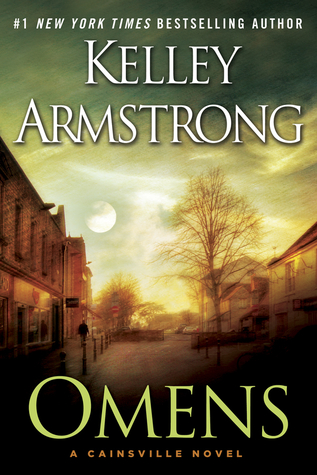
ARC Review: Omens by Kelley Armstrong


Title: Omens (Cainsville, #1) 

Author: Kelley Armstrong

Rating: 4 Stars

Release Date: August 20th, 2013

I doubt there is anything like discovering a book that, after a slow and disappointing start, finally hits its stride - and marvelously so. Armstrong's latest novel may not have the most gripping of beginnings, and I suspect a solid fifty pages could easily be cut off, but after roughly a fifth of the story, it truly takes off. Ever since I read Armstrong's DARKEST POWERS trilogy when it first released, I've been a die-hard fan of the author. I tried my hand at her other adult series, but was sadly unimpressed by BITTEN. In OMENS, though, it seems I've finally found another promising series from her.

Unlike most of Armstrong's novels, OMENS reads more like a murder mystery than a paranormal story. Olivia Taylor-Jones lives a rich and privileged life, until, that is, she discovers she's adopted and her real parents are Todd and Pamela Larson, notorious serial killers. Thus, fleeing her past and desperate for answers, Olivia turns to Cainsville and begins seeking the truth about the ritualistic murders her parents committed. With the help of Gabriel Walsh, a cunning lawyer, Olivia begins to investigate whether her parents continued claim of innocence is really true. If only superstitions and mysterious omens would stop following her wherever she went...

It is clear that Armstrong wanted to try her hand at a new type of paranormal/occult brand, one that didn't involve shapeshifters. While there are plenty of superstitions and ominous portents in this novel, I appreciate that they are toned down. Of preceding importance is the case against Olivia's parents and her own investigations to see whether or not they murdered all eight of the people they were charged with. One of the strengths of this mystery is that it is impossible to know whether or not these people are truly murderers. Of course Olivia hopes they're not, but the evidence against them is so overwhelming that we're kept guessing till the very end. And even then, there are so many unanswered questions - ones I am clamoring to find answers to in the sequel. Furthermore, though the novel is told primarily from Olivia's first-person perspective, the reader is given glimpses of multiple third-person perspectives that crop up and only add to the chilling element of the storyline. At first, I was increasingly confused by these but I grew to anticipate the insight they'd provide as the novel wore on.

Yet, OMENS shines because of its narrator, Olivia herself. As the daughter of two notorious serial killers, Olivia cannot help but wonder what truly wins out - nature or nurture? In OMENS, Olivia investigates more than just her parents murders - she investigates herself. From the beginning itself, Olivia is plucky, independent, and strong. Although she's engage, she doesn't hesitate to make it clear that her future plans are just as important as his. And later, when that engagement breaks off - along with many other relationships - Olivia doesn't hesitate to find her own two feet, move, get a job, and make a new life. Moreover, she slowly comes to accept that along with being prim and proper Olivia Taylor-Jones, she's also superstitious Eden Larson as well. I found that Olivia's growth was well-paced and gradual, something I loved because there is still so much room for her to change in a realistic manner.

Nevertheless, my favorite character in this story has to be Gabriel. A ruthless lawyer and closed-off individual, at first glance Gabriel seems to be nothing more than a ticket for Olivia to use. After all, she's not attracted to large and muscular men like him, and especially not ones who are used to getting their way...right? OMENS brilliantly sets up a relationship between these two, though, and as they become business associates and then business partners and possibly even unlikely friends, the sexual tension between them only starts to simmer. I am a total sucker for a slow-burn romance and this one has all the necessary - and delicious blue-eyed - components. Gabriel is complex enough to stand as a formidable character on his own, though. We've only peeled back a few layers of him in this installment, but it's enough to keep our interest piqued. More than anything else, I suspect I'm looking forward to reading more about this hunky lawyer in the books to come than anything else.

OMENS was, ultimately, a pleasant surprise. Armstrong has crafted a brilliant mystery plot line and an even more remarkable overarching storyline with plenty of clues to keep readers thirsty for more. With strong characters added to the mix and an intriguing small town, full of their own quirks and superstitions, it's safe to say that I will be lining up to have the next book in my hands - and soon! Welcome to Cainsville...indeed!

Friday, May 31, 2013

Review: Bronze Gods by A. A. Aguirre


Title: Bronze Gods

Author: A.A. Aguirre

Rating: 4.5 Stars

I honestly cannot re-call a time when I have sat down at my computer, poised to type out a review, and felt the urge to regurgitate word vomit. Until, that is, now. When it comes to Bronze Gods, my love can only be expressed in mere words; phrases strung together to make coherent sense will fail dramatically, I fear. (And yet, in the threat of being seen as an absolutely insane blogger, I will attempt to regurgitate type out something that makes sense. Remotely.)

At first glance, Bronze Gods seems to promise a thrilling murder mystery, all against the backdrop of a steampunk/fantasy realm, heavy in faerie mythology and shrouded in authentic criminology. In reality, though, this novel offers so much more. A.A. Aguirre’s first work is an extremely well-written and authentic murder mystery, full of perfectly-timed clues, thorough investigations, and a surprise reveal that managed to shock even this Sherlock-Holmes-and-Nancy-Drew-fanatic reader. Now, add to that a world that feels strikingly real – despite the steampunk machinations, fey qualities, and magic prevalent in the air – and Aguirre succeeds in transporting us to another realm entirely; one we don’t exactly want to leave. And yet, the icing on top of this cake isn’t the rich world-building or the intense murder mystery on hand. No, the delectable icing atop this cake is the very characters themselves, all with a rich cherry of sexual tension to enhance the sweetness.

Mikani and Ritsuko are the type of kick-ass, fearless, and yet utterly flawed characters that you only dream of discovering within the pages of a book. From the beginning itself, I loved both of them; Mikani with his roguish charm, fey capabilities, and wit; Ritsuko with her unexpected humor, diligence, and practicality. Aguirre’s world is complicated, but as a realm that started out with a marriage compromise between the fey and humans, there are very few – if any – pure-blooded fey left. Instead, humans that possess a few fey capabilities are common, Mikani among them. Ritsuko is also an anomaly, but less because of her talents and more so for her gender. As the sole woman investigator in her firm, she is constantly justifying her position and refuses to back down from what she has earned with hard work and effort. And yet, while both of them are charming in their own right, full of flaws and unlucky with their relationships, it is when put together that these two truly shine. Mikani and Ritsuko are a formidable team. Not only do they share wordless conversations, but their respect for one another seems to slowly morph into something more…romantic. For the first time, both of these sharp-minded individuals are single and the sparks between them simply fly. One of my favorite aspects of Bronze Gods, though, was that even the simplest actions and emotions between these two felt so utterly romantic. In my eyes, this is the beauty of a relationship – the unexpected feelings found in even the most mundane of actions.

As a team, this is where A. A. Aguirre truly succeeds – in writing the distinct voices of Mikani, Ritsuko, and other central characters as well. Bronze Gods is a solidly mystery-oriented novel with the romance arriving in snippets, delightful wisps of what-could-be that leave us anxious and sexually frustrated. (I don’t even want to count the number of times I yelled, “JUST KISS ALREADY!” at the book.) And yet, while the highlight of this novel was the characters, everything about it, from its steadily built mystery to its world enraptured me. It did, admittedly, take me awhile to become entirely adjusted to the writing style, but before long, I was well and truly invested. If anything is certain, it is that A. A. Aguirre has just gained a new – and enthusiastic – fan. One who will likely forgo chocolate for a year if it means more Mikani and Ritsuko. (Okay, a year is excessive. Hmm…maybe a week? A month is bearable…I guess…) If you’re still reading this, then you clearly aren’t at a bookstore, in a line, holding this book in your hands. And, evidently, that’s what you should be doing because if reading this book isn’t on your must-do-now list, then you’re the one missing out. While I get more Mikani. (Mwahaha! *cue more realistic evil laugh*)

Sunday, December 23, 2012

Review: Blood, She Read by Sara Hubbard


Title: Blood, She Read 

Author: Sara Hubbard 

Rating: 3 Stars

It isn't unusual to come across a book, every so often, that you read and simply know that you'd have loved it, if only your expectations had been a little different. In fact, one of the best things about reading those types of books is the knowledge that you'll go back to it in the future, maybe a couple of months or years down the line, and truly just love it. It happened to me very recently, with Son of the Shadows by Juliet Marillier, and seems to have happened again with Hubbard's debut, Blood, She Read.For me, the main factor preventing me from enjoying Blood, She Read more than I did was the mere fact that I was constantly anticipating for the plot to focus more on the alluded murder mystery in the synopsis. Now, don't worry - it's certainly there and very present - but unlike other novels, it isn't the sole focus. Instead, Blood, She Read is a paranormal mystery that is more character-driven than anything else and this unique change made it an extremely interesting read, to say the least. 

Hubbard's debut opens up by introducing us to Petra Marras, our protagonist who has descended from a long line of witches and has the power to read people or objects with a mere touch. When the trail of the murder of a teenage girl goes cold, the police come knocking on Petra's door for help. Petra, whose father is estranged from her family, has been forced by her father to use her powers for a variety of evil deeds. As such, she feels responsible to use her powers for good and help in any way she can, but, as most good deeds, this winds up backfiring. Not only do the police nab the wrong guy, the murdered girl's secret boyfriend, but Petra begins to be threatened by his older brother in school, not to mention the police officer keeps blackmailing her for more information and accidentally gets fed a love spell by her mother. Just to make matters worse, though, strange Petra who is usually given a wide berth in school makes a new friend, only to have him be the best friend of the murdered girl and a rival of the girl, Josie's, boyfriend, Finn, who happens to like Petra. In a world so confusing where Petra doesn't know who to trust, the killer could be lurking right around the corner and maybe, this time he's coming after her...


Although the driving force behind all the events in Blood, She Read is the murder of Josie, a local teenage girl, it isn't the main plot thread at all. Instead, as I mentioned before, this paranormal mystery is more character-driven than anything else. Petra's life has been far from normal with a father who has exploited her powers and a mother who shies away from affection. Thus, finally away from her father, all Petra wants is normal. Yet, since her mother inherited the house of Petra's aunt, who made it publicly known that they were a family of witches, Petra continues to be the odd one out. One of the first things that struck me about this tale was how complex the relationship between Petra and her mother is. It isn't your usual mother-daughter relationship and although they could behave like best friends at times, there was an undercurrent of tension throughout the novel for here are two women who don't know how to relate to one another. More than anything else, their interactions and their journey was a driving and compelling force behind this tale that, in my opinion, truly captured the heart of the teenage girl. 


In addition to Petra's relationship with her mom, her friendship with Dylan, the best friend of Josie, was a vital aspect of this novel. In Dylan, Petra finds someone she can trust and rely on and for her, this is a huge deal. I love that Petra was very strong outwardly, exhibiting a cool exterior that showed others that their dislike of her didn't bother her in the least, while inside, she was every bit as vulnerable as expected. It was Petra's constant growth throughout the novel that was so realistically portrayed and really made me a fan of her. Even Petra's romance with Finn, although going through its ups-and-downs and not being the main focus of the plot, was very sweet and nicely done. It allowed us to see both Petra and Finn as individuals before seeing how their interactions together made them better people. Furthermore, Hubbard addressed issues such as Finn being a suspected murder target, not to mention someone who might simply be using Petra or taking advantage of her because they too were now un-cool, very well. 


Nevertheless, despite my adoration of the characterization in this novel, I did have some minor qualms that, when added up, took away from this story. For one, there is no real plot to Blood, She Read. Now, that doesn't mean it's a haphazard novel, but it isn't focused on finding the murderer and nor is it focused on romance or friendship. It's a little bit of everything, which is fine, and it never lags or bores the reader, but it does leave a slightly more solidified plot thread to be desired. In addition, for a novel that is marketed as a murder mystery, there is a shocking amount of world-building that is lacking. We never even realize that we need this until the last fifth of the novel, but after finishing the book, I am increasingly curious about Petra's world. Furthermore, I found that Blood, She Read was excruciatingly predictable. On one hand, it was never irritating to wait while Petra figured out the murderer that the reader had already known, for it was a difficult choice for Petra to really acknowledge and accept, but at the same time, I can't help but wish that it hadn't been so obvious. In my mind, there were way too many clues strewn about and constantly repeated, which simply detracted from the novel. Even the plot twists surrounding Finn were deceptively easy to figure out, all making for a read that lacked a shock-factor. 


Ultimately, however, with some altered expectations about the murder mystery, Blood, She Read is a debut that won't disappoint. In Petra, we find a heroine that is strong, yet realistically vulnerable and a mother-daughter relationship that puts most others to shame. It is these character dynamics, explored so vividly and with such attention to detail, that make this novel the gem it is. If you're a fan of paranormal romance with a dash of mystery and a heavy dose of characterization, Blood, She Read is the definite book for you. 


A huge thank you to Sara Hubbard for providing me with a copy of this book in exchange for an honest review.