Showing posts with label Movie Review. Show all posts

Wednesday, August 6, 2014

On Old Hollywood, YA, and Love Triangles...

I spent my weekend with Cary Grant. After watching The Philadelphia Story, His Girl Friday, and Notorious in back-to-back succession I sent Lauren @ Love is Not a Triangle the following tweet:
And after that, I just couldn't stop thinking about these films. Why was it that these love triangles on screen translated so poignantly? I despise even the slightest hint of a love triangle in literature--and I usually despise love triangles in films too--but Old Hollywood just nailed it! ...how? 
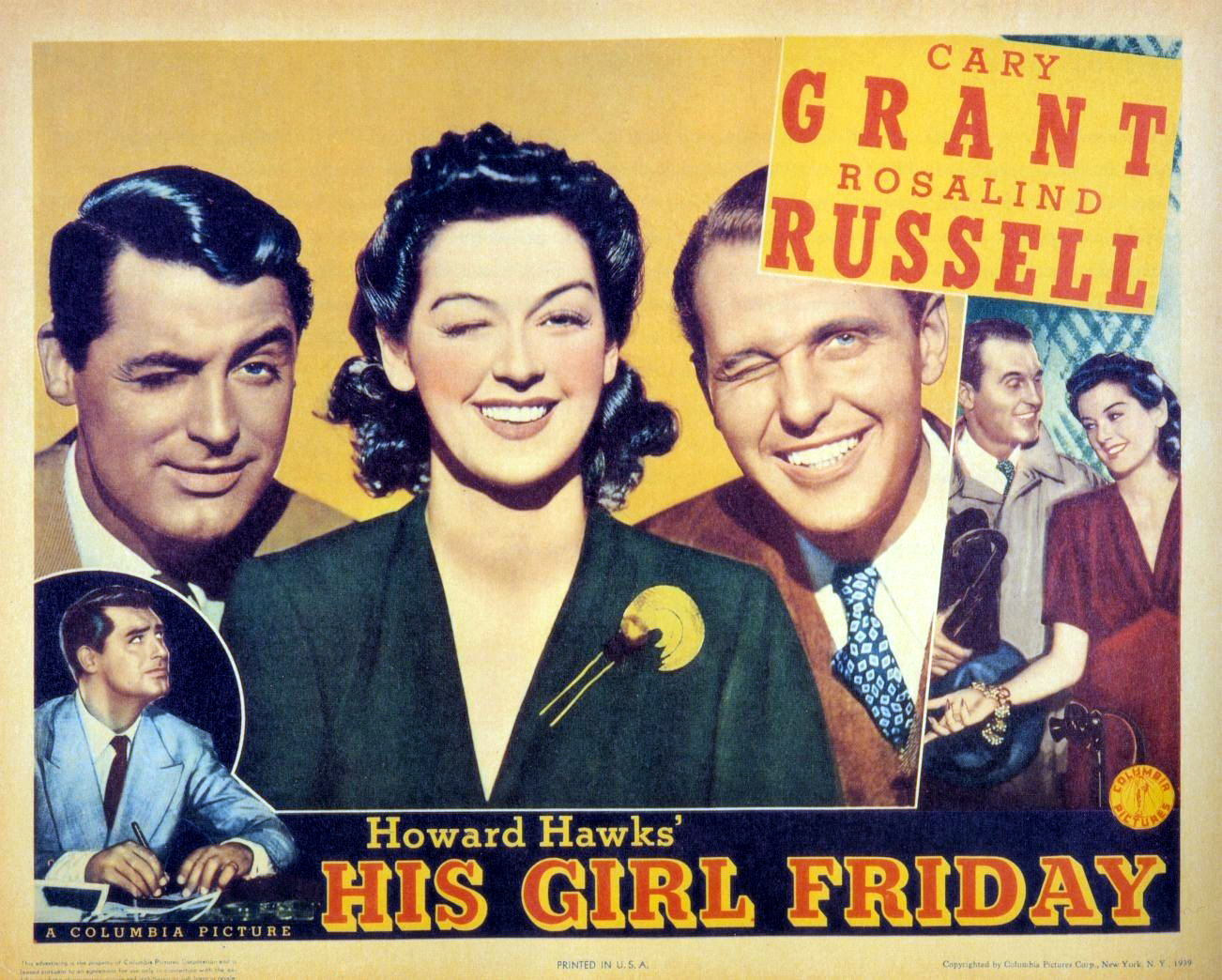
I've found that all three of these films do, in some form or the other, contain a love triangle. During Grant's era of Hollywood, "screwball" comedies were all the rage; usually involving intriguing insight into the gap between the social classes, hilarious scenes, and romances in which a divorced (or about-to-be-divorced) husband and wife couple fell back in love together. Needless to say, this romantic set-up practically calls for a love triangle and His Girl Friday represents a quintessential scenario: Grant is still very much in love with his recently divorced wife who is engaged to another man and in order to break apart their engagement, he resorts to a series of hilarious events all while showing her just how integral both he and the journalism business are to her lifestyle. It is primarily a social commentary on journalism, with comedic tid-bits and an underplayed romance, which is I why I hesitate to label it as a love triangle. You don't feel the tension between the contenders for the heroine's heart--and in this case, that's perfectly fine. His Girl Friday isn't meant to be nearly quite that dark and as a "screwball" comedy, it's certainly worth the watch. 

The Philadelphia Story, on the other hand, yet another "screwball" comedy, is a film I fell in love with. Katharine Hepburn plays the role of a rich society heiress about to marry a self-made man whose rise to wealth and politics is admirable. Grant, her ex-husband, returns after two years in South America to attend Hepburn's wedding--bringing with him two newspaper reporters to cover the event. Now, the intricate details behind this set-up are ones I'll leave for the movie reviewers to explain but the film, featuring James Stewart as one of the newspaper reporters, engages in a truly captivating love triangle. In an early scene in the film Hepburn is told by Grant that she is a goddess; cool, aloof, and in a station above all others. Next, she is told by her current fiance that he worships her--even when she tells him that she wants to be loved, not worshiped. Lastly, her own father tells her that she is made of bronze--once again re-iterating the theme that both her ex-husband and future-husband have mentioned.


Critics will tell you that The Philadelphia Story was a breakthrough film for Hepburn and, seeing her performance, it isn't hard to see why. She nails the self-righteous, independent Tracy in such a manner that we come to perfectly understand the goddess-like image she holds for Grant while also viewing the flesh-and-blood human she is underneath. Stewart, a newspaper reporter whose station in life is far below that of Hepburn's in the film, becomes fascinated by the rich woman when Hepburn reads and appreciates his novel. At first, the two strike an easy friendship--Stewart never sees the sharp edges of Hepburn's character that the men who know her most intimately do see--but their affection blossoms quickly into a romance. It's that moment--when I found myself on the edge of my seat, utterly distraught over the fact that Hepburn might wind up with Stewart and not Grant--that I even realized there was a love triangle at play here. 

Yet, the reason The Philadelphia Story works is because the film's focus is firmly on Hepburn's character. Each of the men in her life, just days before her wedding, begin to show her what she truly wants, not only from a life partner but from her own existence as well. Whether it be her fiance, who is riveted by Tracy's status more than he is by her, or James Stewart, who feeds her pride without understanding her world view, or even Cary Grant, who sees her for the woman she is and finds it in himself to forgive her--but still love her despite it all--the love triangle in The Philadelphia Story makes the tale all-the-more rewarding. What's more, Stewart is Grant's best man by the end of the film when Hepburn and Grant re-marry, neatly avoiding the angst and drama that seems to accompany any literary love triangle. Moreover, the subtle threads binding them all to one another are never spelled out, the way they seem to be in modern-day romantic comedies with the hero confessing "I love you. I forgive you. I can't live without you...marry me!" in a melodramatic manner. Instead, the leap from seemingly distant to true passion lies in the undercurrents of conversation and is up to the movie-goer to watch, interpret, and process. 

Hitchcock's Notorious is a far cry from "screwball" comedy and, instead, serves to place Grant in a much darker role. Grant, taking on the role of American agent Devlin, hires Alicia, played by Ingrid Bergman, as an American spy. Although Alicia's father has recently been arrested for treason, having worked as a German spy during WWII, Alicia herself is loyally American. Yet, following her father's sentence, Alicia drinks, parties, and conducts improper behavior with men. Devlin, upon first meeting her, is both enchanted by her beauty and repulsed by her actions. After hiring her, however, the two fall in love in Rio. In Rio, Devlin learns that Alicia's assignment is to seduce Sebastian, a German, and infiltrate his network. Alicia's duty throws a wedge in their romance and as Alicia eventually marries Sebastian, neither she nor Devlin profess their true love for another. 

It's a tragic love story, acutely felt as Devlin and Alicia are their own hurdles. Devlin, spurning Alicia for taking on the job, and then Alicia, taunting Devlin as she is "with" another man. It isn't an easy film to watch, precisely because of the acerbic quality of their interactions at times, but the talent with which the movie is shot and the quality of the acting is unparalleled. Sebastian, who serves as the third wheel in this love triangle, is ironically the better of Alicia's two options. Not only is he madly in love with her, but he defies his mother by marrying her, fighting her at every instance in order to give Alicia reign over his household and shower her with every luxury. Moreover, he never once doubts that she may be marrying him for his money or his contacts; he simply believes in her. In contrast, Devlin hears of Alicia's task and assumes that her promiscuous past leads her to take the job. Bergman's famous line--"You don't think a woman can change?"--essentially drives forward the entire broken romance. Devlin cannot trust himself--or Alicia--after such a brutal war and Alicia, who needs to be seen for who she is, opposed to her past, similarly won't settle for a man who sees her as the sum of her sins the way Devlin does. 

What I love most about this film, and its love triangle, is that Sebastian's presence drives forward the entire plot. Notorious is, at its heart, a love story and the spy plot threads serve as a mere backdrop. It certainly amps up the tension and allows for brilliant cinematic shots, but the true tale to be told is the one between Devlin and Alicia. As Alicia grows from a "lush" to a courageous woman; as Devlin learns to shed his veneer of cynicism and finally allow himself to love Alicia, especially when that means leaving the shadows he knows--the love triangle, once again, focuses on the characters. 

I find that in YA or NA, a "bad boy" persona such as Devlin's would be explained away by a tragic past--perhaps his parents perished in war, his brother was deported to a foreign land, etc.--but Hitchcock allows us to become so embroiled in the love story he tells that such extraneous information is never necessary. I found myself inching closer and closer to the television screen as the film noir played on and, by the end, I wanted to hit rewind and live in the bubble of suspense, thrill, and romantic tension that Hitchcock had built. 
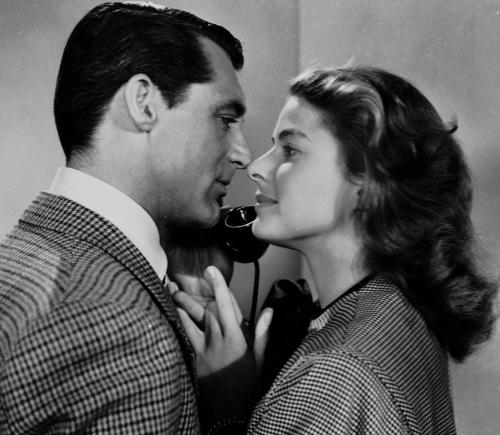
From seeing and analyzing these two classics, it is evident that where Young Adult falters is in its molds. Whether it be the mold of a trilogy--which forces authors to add tension where otherwise unnecessary--or the mold of genre, these qualities spell disaster for love triangles, authors, and readers alike. We most often see love triangles emerge in dystopian or fantasy settings and, quite simply put, the romantic entanglements take away from the world-building and plot tension at hand. We, as readers, find ourselves anticipating sequels not to see where the plot is going but rather to see who the heroine winds up with. Moreover, these literary love triangles destroy the female protagonist, putting her in such a position that she acts out in silly, un-admirable ways. 

Yet, Bergman and Hepburn's characters in these Old Hollywood films are classic, touching, and poignant. We feel for them, we understand their situation, and we root for them, by the end, Grant's handsome face be damned. (I take that back, I love you Cary Grant!) 

Lauren sent me the tweet on the right, responding to my tweet above and remarking that love triangles in films just weren't as difficult to deal with. Admittedly, she is right. Not only are love triangles in movies limited by time, but they also don't feature cliffhangers or sequels. Instead, the tension is maintained for a bearable amount. It doesn't drag for hundreds of pages, it doesn't linger in our minds for a year, it doesn't re-emerge for another hundred pages, only to ferment in our minds for another year, before we finally gain closure. It just doesn't happen with a movie and the two mediums, vastly different, are that way for a reason. 

Certainly Notorious, if it were ever to be immortalized by the written word, would lose much of its sinister appeal and impeccable atmosphere (not to mention Cary Grant's gorgeous face!). Nevertheless, I firmly believe that the decisive choice to include a love triangle in a certain work, whether it be cinematic or literary, is one that must be made after considerable thought--and Old Hollywood somehow has me wanting to see more love triangles, not less. It never occurred to me that a love triangle could work in such an effective manner, perhaps, and seeing these directorial takes on a plot point I despise simply have me looking at the love triangle in a different format altogether. 

Well, that's all I have to say on the matter, but I'd love to hear from you! Do you enjoy love triangles more on screen than on the page? Do you believe that literary love triangles are all doomed? Or can YA and NA somehow manage to imitate these black-and-white classics? 

I'd also love any novel or film recommendations on what books and movies you think I must read/watch before heading off to college in less than three weeks! You can leave a comment below or--better yet--just respond to my frantic tweet if you have any recommendations. :) 

Tuesday, May 28, 2013

Self-Discovery in Films: Mini-Reviews of Looking for Alibrandi & Center Stage

I typically don't post movie reviews since this is, after all, a book blog. Over the long weekend, though, I found myself watching the movie "Looking for Alibrandi," based off the book by Melina Marchetta and was blown away. I also saw a dance movie, "Center Stage," and couldn't help but think what a perfect New Adult novel it would make. While these aren't strictly reviews, and are more a collection of thoughts, I really wanted to share them, so I hope you enjoy. :)

Title: Looking for Alibrandi

Director: Kate Woods

Original Book By: Melina Marchetta 

Rating: 5 Stars

I am typically not the type of person who enjoys book-to-movie adaptations. Peter Jackson is, obviously, an exception but I can very easily find fault with even the "Harry Potter" movie franchise. With the "Jellicoe Road" movie coming up, though, I was curious to check this one out. Looking for Alibrandi is not my favorite Marchetta book, but that's like saying Hershey's is not my favorite chocolate. It's still chocolate, after all. Similarly, Looking for Alibrandi was still an incredible read, full of the poignancy and depth I've come to expect from Marchetta. And thankfully, that translated onto the screen perfectly. 

Now, in all honesty, I don't remember every detail of Looking for Alibrandi. I can't completely confirm that the movie stuck to every scene and included every line that had a punch. What I can tell you, though, is that "Looking for Alibrandi" managed to capture the essence of its book perfectly. It had all the important scenes and although I didn't know any of the actors, they all did a really good job. And yet, my favorite aspect of the film was the Italian culture, so tangible in Marchetta's novel, was now so very real in a film, full with a cast that speaks Italian. All the friendships, disputes, ups-and-downs that Marchetta conveyed with words were now conveyed with images. What I'm really trying to say is that the heart of Marchetta's novel was perfectly reflected in the movie. And I love that. Each of her characters, teenager and adult, experience a form of self-discovery and change in this book that is mirrored in the movie. I love that this film stayed true to the novel, but also managed to retain its own unique character apart from the book. I love that the voice of the narrator remains recognizable, that the actors - no matter how good or bad looking - managed to take on their respective personas, and I love that I finished this movie with a grin on my face, the same way I finished the book. 


Title: Center Stage

Director: Nicholas Hytner 

Rating: 5 Stars

I'll be honest: "Center Stage" does not have the best acting ever, but the dancing in it is pretty darn awesome. As a lover of movies that have to do with skating, music, or dance, this fit right up my alley and I settled down to watch it one afternoon. Surprisingly, though, I found that "Center Stage" is a perfect example of what I want the New Adult to resemble. "Center Stage" is about ballet and, in specific, it follows the stories of three girls who get admission into the prestigious American Ballet Academy. Out of the three, Jody is the least-promising, with weak technique, and yet dancing ballet is her dream. Eva is a cynic, skeptical of what the school can offer her but in love with ballet. And then there's Maureen, the best dancer in the academy whose mother pushes her to be even better than she is. For Maureen, though, dancing isn't a passion the way it is for Eva and Jody - it's a chore. ABA is intense, a complete no nonsense regime for serious students. Instead of college, there is dance. And with three such different girls who may - or may not - even know what they want from life, the room for self-discovery is limitless.

And that, plain and simple, is why I loved this movie so much. Sure, there are romantic entanglements and tight friendships and fantastic dance scenes, but mostly, there is that aspect of self-discovery. In the beginning of this movie, all three of these girls think they want something from life and through circumstance and growth, they begin to realize that plans change, passions change, and people change. I love this. While Maureen's story reminded me of Allyson from Just One Day since both have mothers who are fulfilling their dreams through their daughters, Jody and Eva went through very different transformations. In fact, Jody almost seemed as if her goals didn't change in the movie, but by the end, we see a profound difference in her self-confidence. At a ballet academy, these girls are told their bodies aren't perfect, they aren't perfect, that they have to become slimmer and slimmer and slimmer, better and better and better. And dealing with that kind of pressure isn't easy. Not everyone in this movie winds up a star performer. It's far more realistic than that. Even better than the slow and creeping understanding the characters experience in finding their place in the world, doing what they're passionate about, they grow to love themselves for who they are, attitude and body included.

And this, ladies and gentleman, is what I want New Adult to be like. In the movie, Jody has two guys vying for her attention, but the best part is that neither of them play a role in her growth. No, she comes to terms with who she is all on her own. And while Maureen has some help from others down her path, she too comes to realize what she wants without others having to tell her or lead her hand. I find that New Adult, though, is typically the opposite. You have an all-consuming and intense romance that somehow heals the concerned parties from a dark past and that, somehow, helps them face their future. And while this is the reality for some, I'm sure, the truth is that college and growing up is more about growing and discovering than it is completely about healing. It's about all the paths, all the opportunities, laid out at your feet and that nerve-wracking emotion of "What do I do? What do I choose? I can't mess up!" And it's scary. I want New Adult to explore this, not the feelings of healing from grief or dealing with abusive parents. I'm sorry, but there are other genres for that. Anyway, the bottom line? What "Center Stage" and pray for better New Adult books. I'm glad that a market exists for this genre, simply because I hope it means that more - and better - New Adult is coming our way, but I'm hoping the market changes soon too. Hmm...just my two cents on the matter. 

Favorite New Adult/Self-Discovery Novels: 
pic name pic name pic name
Not all of these books are strictly New Adult and not all of them belong in simply one genre. BUT, what they do all have in common are themes of self-discovery, are protagonists who come into their own over the course of the story, and they're all some of my all-time favorites. If you know any other titles similar to these, don't hesitate to recommend them to me in the comments below. I'm always on the hunt for more self-discovery books! :)

Friday, February 22, 2013

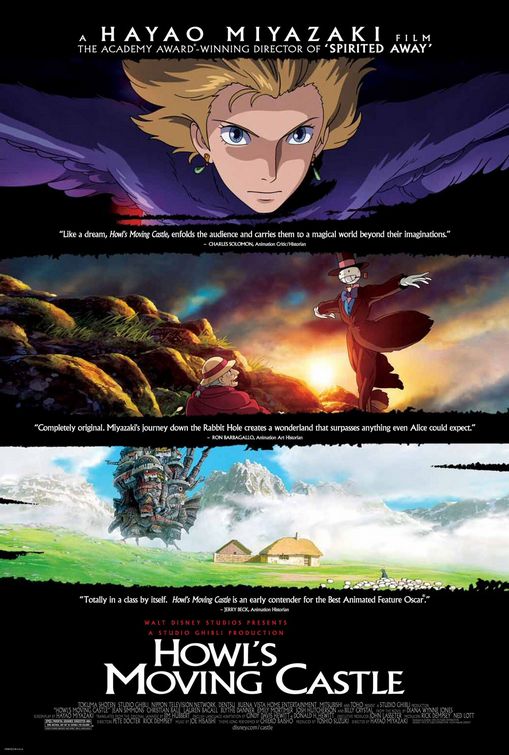
Audio Book and Movie Review: Howl's Moving Castle by Diana Wynne Jones


Title: Howl's Moving Castle 

Author: Diana Wynne Jones

Rating: 4 Stars

At least no one can accuse me of not having read this book now. Howl's Moving Castle is probably the single most popular piece of children's fantasy, right after Harry Potter of course. I've heard endless praise for this series ever since it was first released but, for some reason or the other, I was never drawn to it. It seemed charming, but not much else. Well, as I expected, Jones's story is a charming, cute, and fun adventure novel with just the right amount of depth to be considered prevalent, but also subtle. All in all, it both was and wasn't what I was expecting, but although I enjoyed it, I know for a fact that I won't be calling myself a fan of Diana Wynne Jones - or this series - any time soon.

One of the best things about Howl's Moving Castle is, hands-down, its protagonist. Sophie is the eldest of three sisters, left to work in her father's hat store after he passes away. Unlike the usual step-mothers we are used to, hers is kind, treating her three daughter equally, despite the fact that only one is hers by blood. While Sophie slaves away in a hat store, her two younger sisters depart on their own, one to be the apprentice of a witch and another to make an advantageous marriage. Quite unexpectedly, though, the Witch of the Waste, a wicked witch that the people of Sophie's town fear, even more than the mysterious Wizard Howl who eats the souls of young girls, arrives in Sophie's shop and turns her into an old woman. Now, desperate to turn herself back into the young girl she is, Sophie leaves her hat shop, only to stumble upon the moving castle of Wizard Howl himself and strike up a bargain with his fire demon, one that will change her life forever.

Needless to say, Howl's Moving Castle is a richly imagined fantasy story. Jones has created a world that is a-plenty both in politics and magic, making for a riveting read. Furthermore, the majority of the novel takes place in the moving castle of Wizard Howl himself. Howl is, quite possibly, my favorite character of the tale. As with all realistic characters, he is deeply flawed, proving to be vain, immature, and often irritating. Yet, beneath all that, he is clever, witty, and has a kind heart. Sophie, as a strong-willed heroine, knows exactly what buttons to push to get Howl riled and vice versa. Although their dynamic is unique due to the fact that Sophie is an old woman, their interactions are no less amusing or intelligent for it.

In addition to Howl and Sophie, though, the cast of secondary characters in this story plays an important role as well. Jones weaves together multiple plot lines, alluding to them in the beginning and slowly bringing them all together. At times, the plot can be hard to follow with so much going on, but it keeps you flipping the pages constantly. As an audio book, Howl's Moving Castle is one of the better ones. Although I will fault the narrator for making Howl's voice a bit too much like her own at times, she brilliantly read through this book, making me laugh out loud on more than one occasion. I did switch to an actual copy of the novel during the middle, simply because the middle does tend to drag a little and with the book, I could both read faster and skim when necessary, but either than that, the audio book was a perfect way to read this.

For all its positive points, though, I must admit to not understanding why Howl's Moving Castle receives the hype it does. Granted, it's a very well-written novel that is a great deal of fun, but it hardly warrants the numerous gushing reviews it receives. Jones does a splendid job of exploring the theme of illusion and personality; of seeing whether Sophie's appearance deters from her vivacious personality, but many other books do this as well. (Just take Frances Hardinge's A Face Like Glass for example, which is additionally MG but seems to tackle this theme with more creativity, talent, and depth). Howl's Moving Castle is a fantasy adventure I would not hesitate to recommend to any lover of good fiction, just don't go into it expected to be as blown away as the hype suggests you should be. Perhaps the movie is what gives this series the large fan following it has. I'll watch it and let you know.

Title: Howl's Moving Castle 

Director: Hayao Miyazaki 

Rating: 5 Stars

Now that's more like it! As a film, Howl's Moving Castle is everything its hype said it would be...and more! One of the main reasons I always find book-to-movie adaptations to be lacking, or inferior to their book halves, is because directors make it a point to follow the book word-for-word, plot-for-plot and then they skip an incident and the entire movie is ruined. Howl's Moving Castle the film couldn't be more different from the book if it tried, though.

Although both plot lines have the same idea of a girl, Sophie, who gets turned into an old woman, Miyazaki's rendition of the tale is infinitely darker. Jones has written a story that can only be described as charming. It's funny, witty, and great to spend a few leisure hours of time with. Yet, it can also be boring, its villain rather two-dimensional, and it never veers off the border of light/fluffy fun. Miyazaki's film version, however, casts its villain in a more three-dimensional light, putting more emphasis on both the romance element and the darker aspects of this story, which, in my eyes, only improved an already excellent idea and plot line.

In Miyazaki's Howl's Moving Castle, the country that Sophie lives in is in the midst of a war. As such, instead of a frantic scrambling to undo wicked charms that have been set upon a variety of characters, there is a more serious matter of preventing war. Howl, too, is less of the bumbling, vain fool we've come to love in the books but rather an enigmatic mystery with a curse and dark secret of his own. Although Miyazaki's film rendition lost the original - and subtle - love story that Jones created, opting for a more typical "Beauty and the Beast" type of tale, I thoroughly enjoyed it.
All in all, even if you don't plan to read Jones's acclaimed novel, DO invest in the two hours that this film takes. It is beautifully drawn, marvelously scripted, and has made me realize the true hype surrounding this tale. Granted, I did miss a few elements from the novel in the movie - and both are VERY different, with only a handful of similarities - but I think it's safe to say that I'm in love with the movie far more than I am with the book. Do take note of this - it's probably the first and only time I'll find a movie to be superior to the novel. Needless to say, I need to check out Miyazaki's other films at once!

Wednesday, December 26, 2012

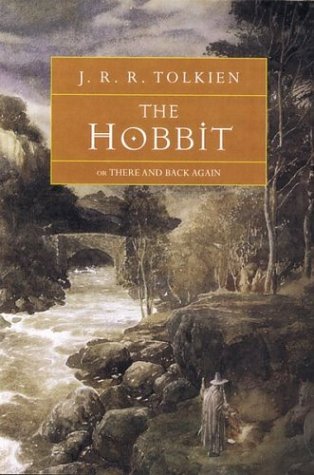
Book & Movie Review: The Hobbit by J.R.R. Tolkien


Title: The Hobbit 

Author: J.R.R. Tolkien

Rating: 3 Stars

I can never forget the first time I picked up a Tolkien novel - never. I was only thirteen, but I read through the entire Lord of the Rings Trilogy, appendixes included, in just eight days. Yes,eight days. As you can imagine, I did nothing but read those books, for they kept me utterly riveted to the page. The Hobbit, on the other hand, took me over eight weeks to read. In fact, it felt like a solid eight months. Sure, I have more work now that I did when I was thirteen and less free time to read, but for a novel as short as The Hobbit is, eight weeks (or more!) is a looong time. Needless to say, I never thought I could be disappointed by a Tolkien novel, but I was wrong. 

You should, straight up, that I worship the very ground Tolkien walks on. I've read nearly all his books, from The Lord of the Rings, to The Silmarillion, to The Children of Hurin. Thus, for me to say that The Hobbit was disappointingly boring, believe me, it was boring. In fact, if you plan to read a Tolkien novel, do not start with The Hobbit. Instead, start with Lord of the Rings. I say this for a few reasons, most notable because The Hobbit was written for children - and this, I suspect, is the root cause of my disappointment with it. 


The Lord of the Rings is a trilogy filled with darkness, with desperation, with fierce hope, and courage, and strength. It is masterful, it is genius, and it is a legendary timepiece of literature at its finest. The Hobbit, on the other hand, is a rather comical, bumbling tale of Bilbo Baggins who finds himself accompanying a group of dwarves on their quest to retrieve their treasure that is currently being hoarded by the dragon Smaug. On their journey, they meet a variety of creatures and obstacles and, as usual, Tolkien excels in his imagination. It never ceases to amaze me the depth of creativity that he uses in his stories and his writing quite literally transports you to Middle Earth - the only reason I am giving this novel three stars. 


Nevertheless, in terms of character-building, this novel suffers. Although it has fewer characters than the entire Lord of the RingsTrilogy, I felt this one lacked more of everything. First we have the dwarves, the majority of whom we can forget for their names only appear again in passing and as individuals, they possess no character. Gandalf, while remaining to be the enigmatic wizard we knew and loved from The Lord of the Rings, seems to only exist to save everyone from doom. Bilbo, as a hobbit, only dreams of food and warm fires, until, of course, Gandalf leaves and he suddenly becomes the savior of all the dwarves. Needless to say, there is a severe lack of growth which I found disappointing - the book is, after all, called The Hobbit! We barely get a glimpse into the actual hobbit's growth or impact of this journey on him. 


In many ways, The Hobbit serves as a means to better The Lord of the Rings. Certain scenes, such as Bilbo's meeting with Gollum and his ultimate possession of The Ring was very interesting while others, such as his meeting with the dragon Smaug, felt all too hyped-up and anti-climactic. Thus, while The Hobbit is a must-read for all fans of Tolkien, or just all nit-picky readers who refuse to watch the movie before reading the book, I wouldn't recommend it as the starting point for any fantasy lover. It was a relatively slow, boring, and forgettable tale that I know I won't be returning to in the future. I fear that this will be one of the few moments in life where I will find myself admitting that the movie is far, FAR better than the book. I can't see how it can't be, especially since more time is spent developing the characters themselves. While The Hobbit was a disappointing read for sure, I still reveled in being back in Middle Earth and if there's any reason to read this, then it's that. Truly, there is no place that feels quite as home as Middle Earth does - for me, at least.


Title: The Hobbit: An Unexpected Journey 

Director: Peter Jackson 

Rating: 5 Stars

I'll admit it: the movie is better. I never thought I'd say that about any novel until I read The Hobbit, but Peter Jackson makes a droll novel like The Hobbit, one that is barely three hundred pages long, seem like an epic saga - because in his eyes, through his vision, it is. With "The Hobbit: An Unexpected Journey," Peter Jackson breathes life into the flat, underdeveloped characters of Tolkien's children's novel. Not only that, but he gives them character, purpose, and a startling realistic quality that renders them remarkable heroes on their own right. While The Hobbit focused merely on Bilbo Baggins as he agreed to join a group of dwarves on their journey to reclaim their lost treasure, Peter Jackson turns this into a journey of reclaiming a lost homeland, a place to belong, and a fight for one's own land. 

What makes "The Hobbit: An Unexpected Journey" such a remarkable film is, first and foremost, the way it has been shot. I saw this film in 3D and the vision was remarkable. It truly felt as if I was in Middle Earth myself, not sitting in a theater seat with a giant bag of popcorn in front of my face. Yet, what I liked best about Jackson's movie is that he added his own flair into it. As I mentioned before, we only witness what happens to Bilbo in The Hobbit. We sense no desperation from the dwarves to reach The Lonely Mountain except for a greed of gold and Thorin, the leader of the dwarves, has no personality whatsoever. In the movie, however, Jackson begins by telling us the tale of the dwarf kingdom that Smaug razes to the ground and overtakes; he tells us of Thorin, son of Thrain, and his childhood of watching his grandfather and father perish before his eyes and lose the kingdom that he is the rightful heir to; he tells us of the orc that kills Thrain and renders Thorin an orphan; he tells us of how Thorin builds a new life for the dwarves he is responsible for and how he bides his time, waiting to reclaim his lost home. Thus, in a matter of minutes, Thorin becomes, to us, as significant, heroic, and great a leader as Aragorn is. 

Furthermore, the troop of dwarves that follow Thorin become much like the beloved Fellowship, helping one another, adding Bilbo to their circle of friends, and joining together for a greater cause, all under the wise leadership of Thorin. Perhaps, best of all, however, is how Thorin underestimates Bilbo and how, in reality, "The Hobbit: An Unexpected Journey" is a tale of friendship where the novel was not. It is the story of how Bilbo comes to find in himself a greater courage and power than he thought possible and the general theme of home, of a place to belong, is so aptly felt. Jackson adds on a storyline that wasn't prevalent in the novel, but one that works perfectly with the plot, never changing the actual adventures that Bilbo faces. Instead, he only alters them ever-so-slightly to give them more depth and shows us what occurs to Thorin and Gandalf whenever they are separated from Bilbo. 

In this manner, "The Hobbit: An Unexpected Journey" is a long film, but one that doesn't feel that way. In fact, I would have sat in that theater for nine hours if it meant watching the entire film and now I am itching to at least see the trailer for the next movie, which I am certain will be just as bold, brave, and remarkable as the first. "The Hobbit: An Unexpected Journey" is a must-see for all fans of the "Lord of the Rings" movies or books and even if you're not a fan, I'd encourage you to give it a shot. In my eyes, it's the best movie of the year - even better than "The Dark Knight Rises", which is saying a lot since I am crazy about Christian Bale and Christopher Nolan and just Batman in general. Believe me, this is one movie you'll want to go see in the theater again and again and again - it is like nothing you've ever experienced before.